



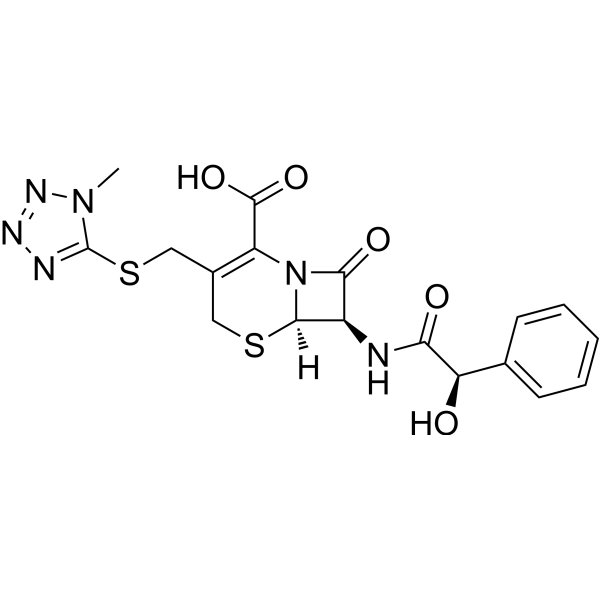
Cefamandole
Cefamandole (Cephamandole sodium) is a β-lactam antibiotic with broad-spectrum antibacterial activity. Cefamandole resists hydrolysis by β-lactamase of some Gram-negative bacteria. Cefamandole binds with high affinity to major penicillin-binding proteins (PBP) and with low affinity to PBP 2a, induces the production of low-affinity PBP associated with Methicillin (HY-121544) resistance, and blocks peptidoglycan biosynthesis through the SecA subunit of PBP. Cefamandole can be used in research related to bacterial infections.
At equivalent molar concentrations, both the salt and free forms of a compound exhibit comparable biological activity. Nevertheless, the salt form (Cefamandole sodium) usually boasts enhanced water solubility and stability.
For research use only. We do not sell to patients.
- CAS No.: 34444-01-4
- Formula: C18H18N6O5S2
- Molecular Weight:462.50
-
Storage:
Please store the product under the recommended conditions in the Certificate of Analysis.

To place orders, for customer services and technical support, please contact: MedChemExpress USA
Tel: 609-228-6898 E-mail: [email protected] [email protected]


-
 Biological Activity
-
Chemical Information
- Protocols
- Purity & Documentation
- References
-
 Help & FAQs




Biological Activity
Description
|
β-lactam |
PBP |
Cellular Effect
|
Cell Line

|
Type | Value | Description | References |
|---|---|---|---|---|
| S2 | IC50 |
450 μM
Compound: Cefamandole
|
TP_TRANSPORTER: inhibition of PAH uptake in OAT1-expressing S2 cells
TP_TRANSPORTER: inhibition of PAH uptake in OAT1-expressing S2 cells
|
[PMID: 12005172] |
| S2 | IC50 |
90 μM
Compound: Cefamandole
|
TP_TRANSPORTER: inhibition of Estrone sulfate uptake in OAT3-expressing S2 cells
TP_TRANSPORTER: inhibition of Estrone sulfate uptake in OAT3-expressing S2 cells
|
[PMID: 12005172] |
In Vitro
Cefamandole (0.12-64 μg/mL; 18 h) inhibits 90%-100% of Methicillin (HY-121544)-sensitive Staphylococcus aureus, group A and group B streptococci, Streptococcus pneumoniae, Neisseria gonorrhoeae, Haemophilus influenzae, and Salmonella typhi[3].
MedChemExpress (MCE) has not independently confirmed the accuracy of these methods. They are for reference only.
-
Cell Line:Methicillin-susceptible S. aureus, group A and B streptococci, S. pneumoniae, N. gonorrhoeae, H. influenzae, and S. typhosa
-
Concentration:Cefamandole:
0.12, 0.25, 0.5, 1, 2, 4, 8, 16, 32, 16 μg/mL -
Incubation Time:18 h
-
Result:Inhibited 90-100% of methicillin-susceptible S. aureus, group A and B streptococci, S. pneumoniae, N. gonorrhoeae, H. influenzae, and S. typhosa at concentrations of 2 μg/mL or less, with variable activity against gram-negative rods including 70% of E. coli inhibited at 4 μg/mL and 80% of B. fragilis subsp. fragilis inhibited at 32 μg/mL.
In Vivo
MedChemExpress (MCE) has not independently confirmed the accuracy of these methods. They are for reference only.
-
Animal Model:New Zealand White (2 kg)[6]
-
Dosage:100 mg/kg
-
Administration:i.v.; every 4 h; six doses total (first dose 30 min before inoculation)
-
Result:Resulted in infection in 9/29 (31%) rabbits infected with strain 220, 10/16 (63%) rabbits infected with strain 313, and 0/11 (0%) rabbits infected with strain W-05386.
In early-infection groups, rabbits had 70 CFU (n = 4) on the aortic valve for strain 313 and 54 CFU (n = 4) for strain W-05386 at 1.5 h after inoculation.


Chemical Information
-
CAS No. 34444-01-4
-
Molecular Weight 462.50
-
Formula C18H18N6O5S2
-
SMILES
O=C(C(N12)=C(CSC3=NN=NN3C)CS[C@]2([H])[C@H](NC([C@H](O)C4=CC=CC=C4)=O)C1=O)O
-
Synonyms
Cephamandole
-
Shipping
Room temperature in continental US; may vary elsewhere.
-
Storage
Please store the product under the recommended conditions in the Certificate of Analysis.


Purity & Documentation
References
[1]. Neu HC, et al. Cefamandole, a cephalosporin antibiotic with an unusually wide spectrum of activity. Antimicrob Agents Chemother. 1974;6(2):177-182. [Content Brief]
[2]. Eykyn S, et al. Antibacterial activity of cefamandole, a new cephalosporin antibiotic, compared with that of cephaloridine, cephalothin, and cephalexin. Antimicrob Agents Chemother. 1973;3(6):657-661. [Content Brief]
[3]. Griffith RS, et al. Cefamandole: in vitro and clinical pharmacokinetics. Antimicrob Agents Chemother. 1976;10(5):814-823. [Content Brief]
[4]. Lee FH, et al. Comparative tissue distribution of ceforanide, cefazolin, and cefamandole in rats. Antimicrob Agents Chemother. 1981;19(4):625-627. [Content Brief]
[5]. Yeh PH, et al. Determination of unbound cefamandole in rat blood by microdialysis and microbore liquid chromatography. Biomed Chromatogr. 2001;15(1):14-17. [Content Brief]
[6]. Chambers HF. Coagulase-negative staphylococci resistant to beta-lactam antibiotics in vivo produce penicillin-binding protein 2a. Antimicrob Agents Chemother. 1987 Dec;31(12):1919-24. [Content Brief]
[7]. Yotsuji A, et al. Mechanism of action of cephalosporins and resistance caused by decreased affinity for penicillin-binding proteins in Bacteroides fragilis. Antimicrob Agents Chemother. 1988 Dec;32(12):1848-53. [Content Brief]
[9]. Pothineni VR, et al. In vitro and in vivo evaluation of cephalosporins for the treatment of Lyme disease. Drug Des Devel Ther. 2018 Sep 11;12:2915-2921. [Content Brief]

Calculators
Concentration (start) × Volume (start) = Concentration (final) × Volume (final)


Cefamandole Related Classifications
HY-B1128 Related Classifications
 Powered by Bioz
Keywords
- Cefamandole
- 34444-01-4
- Cephamandole
- Antibiotic
- Bacterial
- Penicillin-binding protein (PBP)
- Beta-lactamase
- β-lactamase
- Lyme disease
- antibacterial activity
- bacterial infection
- beta-lactam antibiotic
- endocarditis
- gram-negative bacteria
- gram-positive bacteria
- methicillin resistance
- penicillin-binding proteins
- peptidoglycan biosynthesis
- Inhibitor
- inhibitor
- inhibit