



HL23

Based on 1 Customer Validation
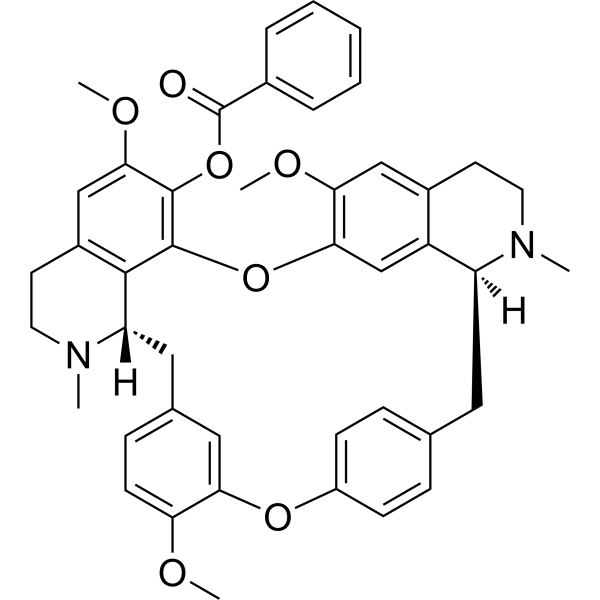
HL23 is a histone deacetylase (HDAC) inhibitor with activity against hepatocellular carcinoma (HCC). HL23 enhances acetylation of the TXNIP promoter and upregulates TXNIP expression, thereby mediating potassium channel activity and triggering TXNIP-dependent potassium deprivation. HL23 inhibits HCC progression and metastasis and has a synergistic effect with Sorafenib (HY-10201) and is more potent than Sorafenib+Vorinostat (HY-10221).
For research use only. We do not sell to patients.
- Purity : 99.64%
- CAS No.: 1448355-15-4
- Formula: C44H44N2O7
- Molecular Weight:712.83
-
Storage:Powder -20°C, 3 years , 4°C, 2 years ; In solvent -80°C, 6 months , -20°C, 1 month

To place orders, for customer services and technical support, please contact: MedChemExpress USA
Tel: 609-228-6898 E-mail: [email protected] [email protected]


-
 Biological Activity
-
Chemical Information
- Protocols
- Purity & Documentation
- References
-
 Help & FAQs




Biological Activity
Description
Cellular Effect
|
Cell Line

|
Type | Value | Description | References |
|---|---|---|---|---|
| HepG2 | IC50 |
3.69 μM
Compound: 6e
|
Antiproliferative activity against human HepG2 cells after 48 hrs by MTT assay
Antiproliferative activity against human HepG2 cells after 48 hrs by MTT assay
|
[PMID: 28057423] |
| MCF7 | IC50 |
6.34 μM
Compound: 6e
|
Antiproliferative activity against human MCF7 cells after 48 hrs by MTT assay
Antiproliferative activity against human MCF7 cells after 48 hrs by MTT assay
|
[PMID: 28057423] |


Chemical Information
-
CAS No. 1448355-15-4
-
Appearance Solid
-
Molecular Weight 712.83
-
Formula C44H44N2O7
-
Color White to off-white
-
SMILES
CN([C@@]1([H])CC2=CC=C(OC)C(OC3=CC=C(C[C@]4([H])N(C)CC5)C=C3)=C2)CCC6=C1C(OC7=C(OC)C=C5C4=C7)=C(OC(C8=CC=CC=C8)=O)C(OC)=C6
-
Shipping
Room temperature in continental US; may vary elsewhere.
-
Storage
Powder -20°C 3 years 4°C 2 years In solvent -80°C 6 months -20°C 1 month


Purity & Documentation
-
Data Sheet (275 KB)
-
SDS (251 KB)
- English - EN (251 KB)
- Français - FR (251 KB)
- Deutsch - DE (251 KB)
- Norwegian - NO (251 KB)
- Español - ES (251 KB)
- Swedish - SV (251 KB)
- Italian - IT (251 KB)
- Korean - KR (251 KB)
- Portuguese - PT (251 KB)
-
Handling Instructions (2659 KB)
References

Calculators
Concentration (start) × Volume (start) = Concentration (final) × Volume (final)


HL23 Related Classifications
HY-155248 Related Classifications
 Powered by Bioz