



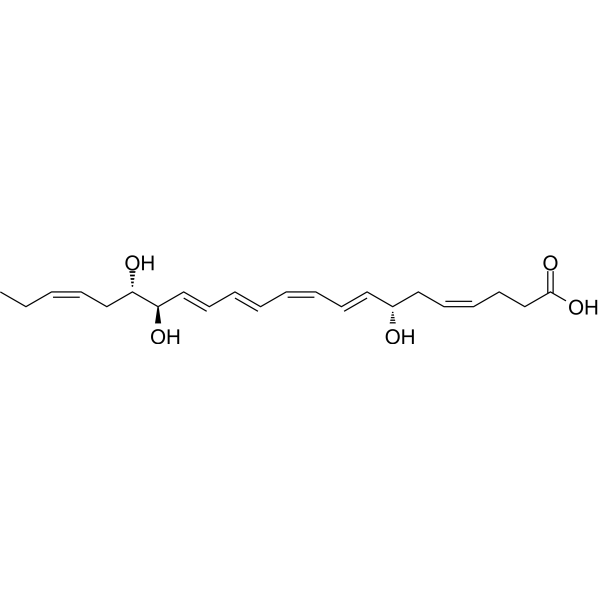
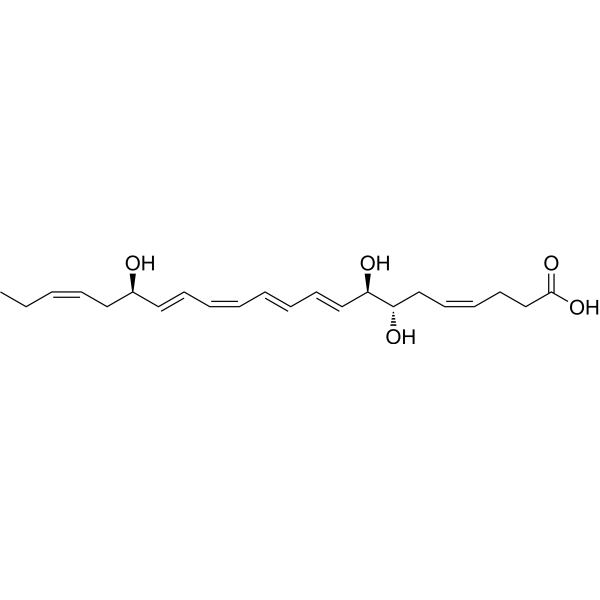
Resolvin D2
Based on 5 publication(s) in Google Scholar
Resolvin D2 is a metabolite of docosahexaenoic acid (DHA), with anti-inflammatory, anti-infective activities. Resolvin D2 is a potent regulator of leukocytes and controls microbial sepsis. Resolvin D2 is a remarkably potent inhibitor of TRPV1 (IC50 = 0.1 nM) and TRPA1 (IC50 = 2 nM) in primary sensory neurons.
For research use only. We do not sell to patients.
- Purity : 99.9%
- CAS No.: 810668-37-2
- Formula: C22H32O5
- Molecular Weight:376.49
-
Storage:
Solution, -20°C, 2 years

To place orders, for customer services and technical support, please contact: MedChemExpress USA
Tel: 609-228-6898 E-mail: [email protected] [email protected]


-
 Biological Activity
-
Chemical Information
- Protocols
- Purity & Documentation
- References
-
 Help & FAQs




Publications Citing Use of MedChemExpress (MCE) Resolvin D2
More

Biological Activity
Description
IC50 & Target
TRP Channel[3]
In Vivo
Resolvin D2 decreases leukocyte:endothelial interactions in vivo by endothelial-dependent nitric oxide production, and direct modulation of leukocyte adhesion receptor expression[2].
Peripheral administration of Resolvin D2 (10 ng; Intraplantar administration) potently inhibits inflammatory pain[3].
MedChemExpress (MCE) has not independently confirmed the accuracy of these methods. They are for reference only.
-
Animal Model:Adult CD1 mice (male, 8–10 weeks)[3]
-
Dosage:10 ng
-
Administration:Intraplantar administration
-
Result:Inhibited inflammatory pain.


Chemical Information
-
CAS No. 810668-37-2
-
Appearance Liquid
-
Molecular Weight 376.49
-
Formula C22H32O5
-
Color Colorless to light yellow
-
SMILES
CC/C=C\C[C@H](O)[C@H](O)/C=C/C=C/C=C\C=C\[C@@H](O)C/C=C\CCC(O)=O
-
Synonyms
RvD2
-
Shipping
Room temperature in continental US; may vary elsewhere.
-
Storage
Solution, -20°C, 2 years


Publications (5)
-
Journal Impact Factor
-
Most Recent
-
Drug Des Devel Ther
Activation of GPR18 by Resolvin D2 Relieves Pain and Improves Bladder Function in Cyclophosphamide-Induced Cystitis Through Inhibiting TRPV1. [Abstract]2021 Nov 15;15:4687-4699. PMID: 34815664 -
Exp Neurol
Resolvin D2 activates anti-inflammatory microglia via restoring autophagy flux and alleviate neuropathic pain following spinal cord injury in rats. [Abstract]2023 Dec:370:114573. PMID: 37858697 -
J Neurochem
2024 Nov;168(11):3715-3726. PMID: 37987505 -
Brain Sci
Resolvin D2 Reduces Chronic Neuropathic Pain and Bone Cancer Pain via Spinal Inhibition of IL-17 Secretion, CXCL1 Release and Astrocyte Activation in Mice. [Abstract]2023 Jan 15;13(1):152. PMID: 36672133 -
Int J Cardiol
Early development and SGLT2 inhibitor-mediated reversal of coronary microvascular dysfunction in an isoprenaline-induced murine HFpEF model: Insights from multimodal in vivo imaging. [Abstract]2026 Feb 27:134266. PMID: 41765145

Protocols
-
LPS-Induced Endotoxemia/Systemic Inflammation
Lipopolysaccharide (LPS)-induced endotoxemia is a widely used in vivo model of acute systemic inflammation in which LPS, a Gram-negative bacterial endotoxin, activates innate immune signaling primarily through TLR4, leading to rapid and transient induction of pro-inflammatory cytokines such as TNF-α, IL-6, and IL-1β in circulation and tissues. This cytokine surge is commonly used as a measurable readout of systemic inflammatory activation and immune dysregulation, and is typically assessed within hours after intraperitoneal LPS administration in mouse models of endotoxemia. The model captures key features of systemic inflammatory response syndrome, including cytokine release, immune cell activation, and downstream tissue responses, and has been used to evaluate anti-inflammatory interventions such as cytokine modulation, lipid mediators, and immune cell-targeting therapies.
-
Cell Cytotoxicity Assay
Cytotoxicity assays are usually based on the assessment of cell membrane damage, which can also be indirectly detected by measuring cell viability. Detection methods include MTT assay, CKK-8 assay, LDH assay and ATP assay, etc.
-
Research Protocol for Inflammation-related Diseases
The NLRP3 inflammasome is a cytosolic innate immune signaling platform that integrates priming signals and danger-signal activation to promote caspase-1 activation, maturation of IL-1β and IL-18, and gasdermin D-mediated pyroptotic cell death. The core experimental logic is to determine whether inflammatory disease phenotypes are driven by increased NLRP3 expression, ASC-containing inflammasome assembly, caspase-1 cleavage, GSDMD cleavage, and extracellular release of IL-1β/IL-18 rather than by nonspecific cell injury alone. The pathway is strongly linked to inflammation-related disease phenotypes because monosodium urate crystals activate NALP3/NLRP3 inflammasome signaling in gout-like crystal inflammation, cholesterol crystals activate NLRP3 inflammasomes in atherogenesis models, and DSS-induced intestinal inflammation has been reported to involve NLRP3 inflammasome activity. However, experimental colitis studies also show context-dependent protective effects of NLRP3 inflammasome co
-
Primary Dorsal Root Ganglion Sensory Neuron Culture
Primary dorsal root ganglion sensory neuron culture isolates DRG neuronal somata from rodent or human ganglia, dissociates tissue enzymatically and mechanically, and maintains post-mitotic sensory neurons in vitro for readouts such as neurite outgrowth, immunocytochemical marker expression, calcium imaging, electrophysiology, RNA/protein analysis, or neuropeptide release assays. The method reflects peripheral sensory neuron biology because DRG neurons are primary sensory neurons whose cell bodies reside in dorsal root ganglia and whose cultured dissociated cells can retain neuronal morphology, sensory-neuron marker expression, and stimulus-responsive properties depending on the downstream assay.


Purity & Documentation
-
Data Sheet (267 KB)
-
SDS (393 KB)
- English - EN (393 KB)
- Français - FR (393 KB)
- Deutsch - DE (393 KB)
- Norwegian - NO (393 KB)
- Español - ES (393 KB)
- Swedish - SV (393 KB)
- Italian - IT (393 KB)
- Korean - KR (393 KB)
- Portuguese - PT (393 KB)
-
Handling Instructions (2659 KB)
References
[1]. Siddiqui YD, et al. Resolvin D2 Induces Resolution of Periapical Inflammation and Promotes Healing of Periapical Lesions in Rat Periapical Periodontitis. Front Immunol. 2019 Feb 26;10:307. [Content Brief]
[2]. Spite M, et al. Resolvin D2 is a potent regulator of leukocytes and controls microbial sepsis. Nature. 2009 Oct 29;461(7268):1287-91. [Content Brief]
[3]. Park CK, et al. Resolvin D2 is a potent endogenous inhibitor for transient receptor potential subtype V1/A1, inflammatory pain, and spinal cord synaptic plasticity in mice: distinct roles of resolvin D1, D2, and E1.6. J Neurosci. 2011 Dec 14;31(50):18433-8. [Content Brief]

Calculators
Concentration (start) × Volume (start) = Concentration (final) × Volume (final)


Resolvin D2 Related Classifications
HY-121636 Related Classifications
 Powered by Bioz