



Kendomycin

Based on 1 Customer Validation
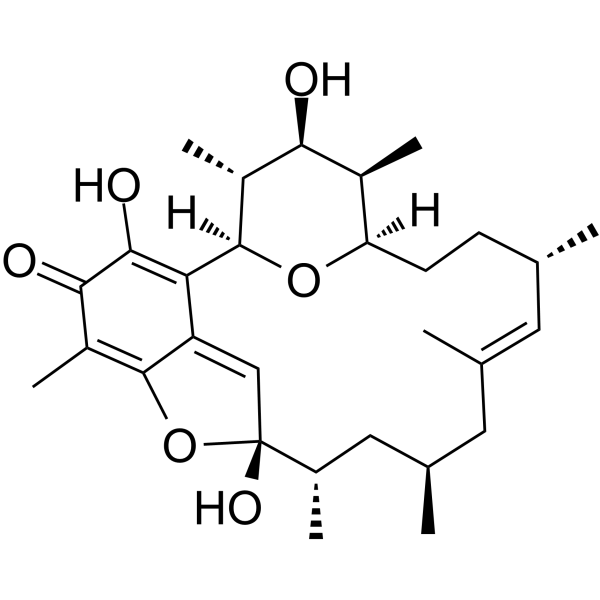
Kendomycin ((−)-TAN 2162) is a polyketide antibiotic with remarkable antibacterial and cancer cells cytotoxic activities. Kendomycin tends to be bacteriostatic rather than bactericidal and inhibits the growth of the methicillin-resistant Staphylococcus aureus (MRSA) strain COL at a low concentration (MIC of 5 μg/mL). Kendomycin is a potent antagonist of the endothelin receptor and a calcitonin receptor agonist which plays its role as an anti-osteoporotic agent.
Nur für Forschungszwecke. Wir verkaufen nicht an Patienten.
- Reinheit : 92.60%
- CAS. Nr.: 183202-73-5
- Formel: C29H42O6
- Molecular Weight:486.64
-
Speicherung:
-20°C, stored under nitrogen
* In solvent : -80°C, 6 months; -20°C, 1 month (stored under nitrogen)

To place orders, for customer services and technical support, please contact: MedChemExpress USA
Tel: 609-228-6898 E-mail: [email protected] [email protected]


-
 Biologische Aktivität
-
Chemical Information
-
Lösungsmittel & Löslichkeit
- Protokoll
- Reinheit & Dokumentation
- Verweise
-
 Help & FAQs


-
HY-10302
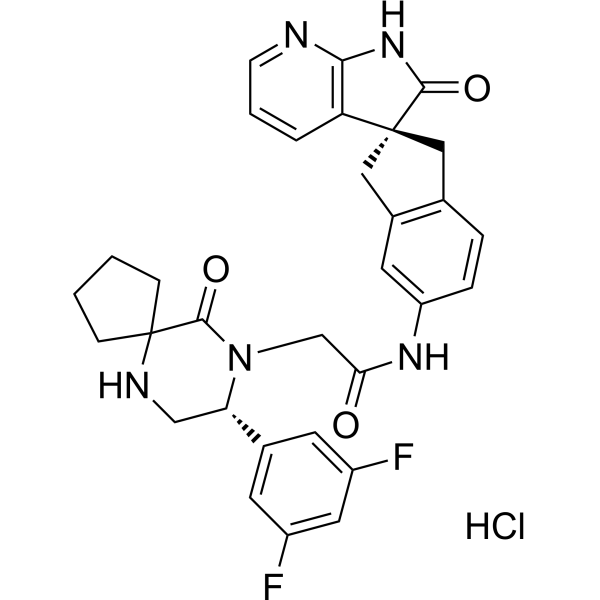
MK-3207 HydrochlorideCGRP Receptor Antagonist -

HY-10302R
MK-3207 hydrochloride (Standard)Reference Standard -
HY-12378
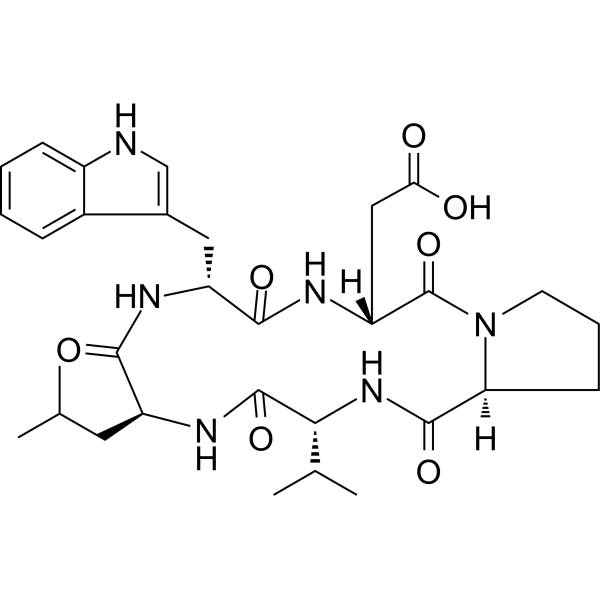
BQ-123ETA Receptor Antagonist -
HY-15895
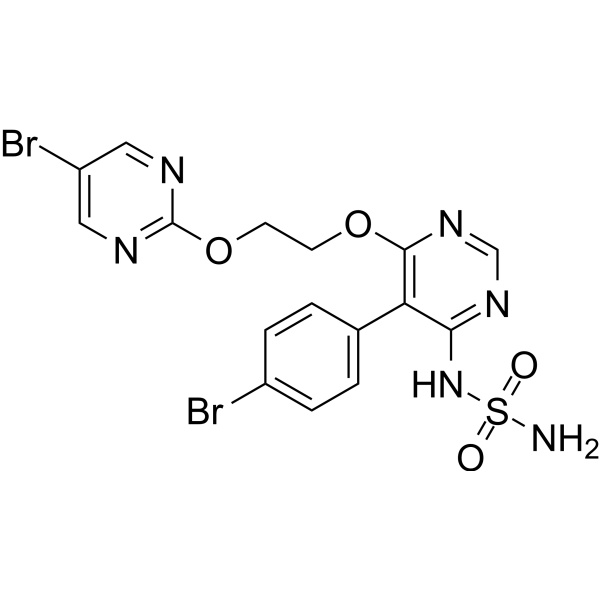
AprocitentanEndothelin Receptor Antagonist -
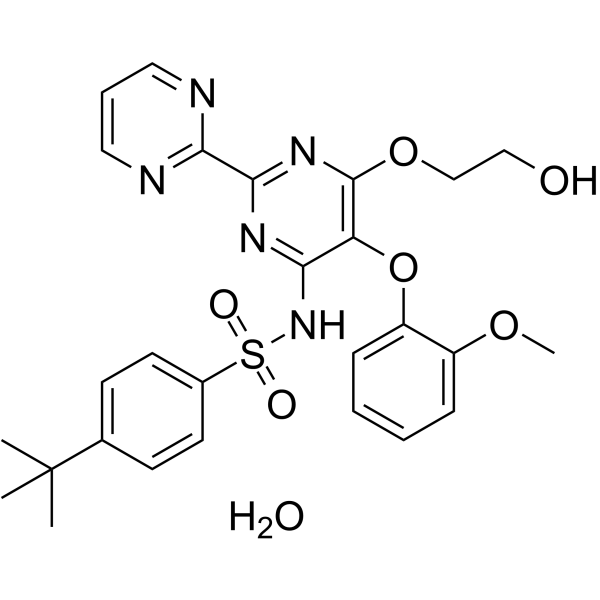
HY-A0013A
Bosentan hydrateET1 Receptor Antagonist -

HY-15895R
Aprocitentan (Standard)Endothelin Receptor Antagonist -

HY-A0013AR
Bosentan hydrate (Standard)ET1 Receptor Antagonist
Alle Antibiotic Isoform-spezifische Produkte anzeigen
More

Biologische Aktivität
Beschreibung
Cellular Effect
|
Cell Line

|
Type | Value | Description | References |
|---|---|---|---|---|
| A549 | IC50 |
16 μM
Compound: 1
|
Cytotoxicity against human A549 cells
Cytotoxicity against human A549 cells
|
[PMID: 18845435] |
| HepG2 | GI50 |
<0.1 μM
Compound: 1
|
Cytotoxicity against human HepG2 cells
Cytotoxicity against human HepG2 cells
|
[PMID: 18845435] |


Chemical Information
-
CAS. Nr. 183202-73-5
-
Appearance Solid
-
Molecular Weight 486.64
-
Formel C29H42O6
-
Color Light yellow to yellow
-
SMILES
OC(C1=O)=C([C@]([C@@H]([C@H]2O)C)([H])O[C@@](CC[C@@H]3C)([H])[C@@H]2C)C(C(O4)=C1C)=C[C@@]4([C@H](C[C@@H](C/C(C)=C/3)C)C)O
-
Synonyms
(-)-TAN2162
-
Versand
Room temperature in continental US; may vary elsewhere.
-
Speicherung
-20°C, stored under nitrogen
* In solvent : -80°C, 6 months; -20°C, 1 month (stored under nitrogen)


Lösungsmittel & Löslichkeit
In Vitro:
DMSO : 1 mg/mL (2.05 mM; Need ultrasonic and warming; Hygroscopic DMSO has a significant impact on the solubility of product, please use newly opened DMSO)
Please refer to the solubility information to select the appropriate solvent. Once prepared, please aliquot and store the solution to prevent product inactivation from repeated freeze-thaw cycles.
Storage method and period of stock solution: -80°C, 6 months; -20°C, 1 month (stored under nitrogen). When stored at -80°C, please use it within 6 months. When stored at -20°C, please use it within 1 month.
Please refer to the solubility information to select the appropriate solvent. Once prepared, please aliquot and store the solution to prevent product inactivation from repeated freeze-thaw cycles.
Storage method and period of stock solution: -80°C, 6 months; -20°C, 1 month (stored under nitrogen). When stored at -80°C, please use it within 6 months. When stored at -20°C, please use it within 1 month.
Konzentration (Stammlösung) × Volumen (Stammlösung) = Konzentration (Ziellösung) × Volumen (Ziellösung)


Reinheit & Dokumentation
-
Data Sheet (281 KB)
-
SDS (251 KB)
- English - EN (251 KB)
- Français - FR (251 KB)
- Deutsch - DE (251 KB)
- Norwegian - NO (251 KB)
- Español - ES (251 KB)
- Swedish - SV (251 KB)
- Italian - IT (251 KB)
- Korean - KR (251 KB)
- Portuguese - PT (251 KB)
-
Handling Instructions (2659 KB)
Verweise
[1]. Yasser A Elnakady, et al. Investigations to the Antibacterial Mechanism of Action of Kendomycin. PLoS One. 2016 Jan 21;11(1):e0146165. [Content Brief]
[2]. Yu Yuan, et al. Total synthesis of kendomycin: a macro-C-glycosidation approach. J Am Chem Soc. 2004 Nov 17;126(45):14720-1. [Content Brief]
[3]. Tetsuya Sengoku, et al. Total synthesis of the antibiotic kendomycin: a macrocyclization using the Tsuji-Trost etherification. Angew Chem Int Ed Engl. 2014 Apr 14;53(16):4213-6. [Content Brief]


Complete Stock Solution Preparation Table
Please refer to the solubility information to select the appropriate solvent. Once prepared, please aliquot and store the solution to prevent product inactivation from repeated freeze-thaw cycles.
Storage method and period of stock solution: -80°C, 6 months; -20°C, 1 month (stored under nitrogen). When stored at -80°C, please use it within 6 months. When stored at -20°C, please use it within 1 month.
| Optional Solvent | Concentration Solvent Mass | 1 mg | 5 mg | 10 mg | 25 mg |
|---|---|---|---|---|---|
| DMSO | 1 mM | 2.0549 mL | 10.2745 mL | 20.5491 mL | 51.3727 mL |


Kendomycin Related Classifications
HY-121300 Related Classifications
 Powered by Bioz