



XP5
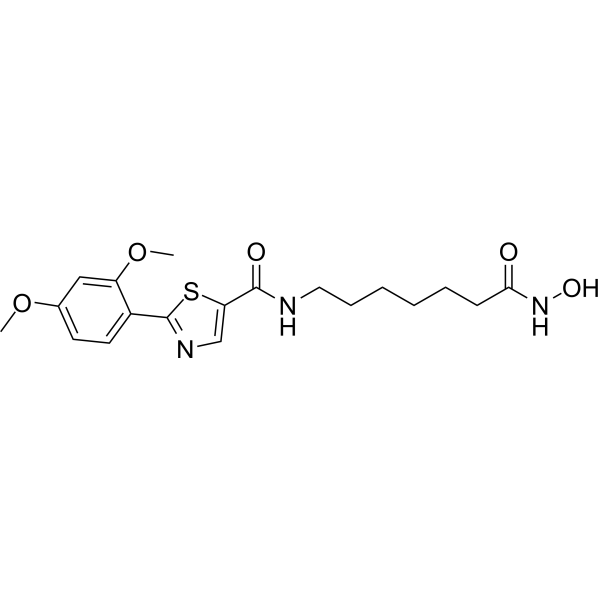
XP5 is a potent, orally active HDAC6 inhibitor with an IC50 of 31 nM. XP5 displays high antiproliferative activity against various cancer cell lines including the HDACi-resistant YCC3/7 gastric cancer cells (IC50=0.16-2.31 μM). XP5 enhances antitumor immunity when combined with a PD-L1 inhibitor in melanoma.
연구목적의 판매만을 진행합니다. 환자를 대상으로 한 판매는 하지 않습니다.
- CAS No.: 2760511-91-7
- 화학식: C19H25N3O5S
- 분자량:407.48
-
보관:
Please store the product under the recommended conditions in the Certificate of Analysis.

To place orders, for customer services and technical support, please contact: MedChemExpress USA
Tel: 609-228-6898 E-mail: [email protected] [email protected]


-
 Biological Activity
-
Chemical Information
- Protocol
- 순도&문서
- References
-
 Help & FAQs




Biological Activity
제품 설명
Cellular Effect
|
Cell Line

|
Type | Value | Description | References |
|---|---|---|---|---|
| A549 | IC50 |
1.91 μM
Compound: XP5
|
Antiproliferative activity against human A549 cells assessed as inhibition of cell proliferation measured after 48 hrs by MTT assay
Antiproliferative activity against human A549 cells assessed as inhibition of cell proliferation measured after 48 hrs by MTT assay
|
[PMID: 35043615] |
| B16-F10 | IC50 |
2.31 μM
Compound: XP5
|
Antiproliferative activity against mouse B16-F10 cells assessed as inhibition of cell proliferation measured after 48 hrs by MTT assay
Antiproliferative activity against mouse B16-F10 cells assessed as inhibition of cell proliferation measured after 48 hrs by MTT assay
|
[PMID: 35043615] |
| HCT-116 | IC50 |
0.51 μM
Compound: XP5
|
Antiproliferative activity against human HCT-116 cells assessed as inhibition of cell proliferation measured after 48 hrs by MTT assay
Antiproliferative activity against human HCT-116 cells assessed as inhibition of cell proliferation measured after 48 hrs by MTT assay
|
[PMID: 35043615] |
| Jurkat | IC50 |
0.16 μM
Compound: XP5
|
Cytotoxicity against human Jurkat cells assessed as reduction in cell viability incubated for 72 hrs by CCK-8 assay
Cytotoxicity against human Jurkat cells assessed as reduction in cell viability incubated for 72 hrs by CCK-8 assay
|
[PMID: 35043615] |
| MCF7 | IC50 |
0.91 μM
Compound: XP5
|
Antiproliferative activity against human MCF7 cells assessed as inhibition of cell proliferation measured after 48 hrs by MTT assay
Antiproliferative activity against human MCF7 cells assessed as inhibition of cell proliferation measured after 48 hrs by MTT assay
|
[PMID: 35043615] |


Chemical Information
-
CAS No. 2760511-91-7
-
분자량 407.48
-
화학식 C19H25N3O5S
-
SMILES
COC1=CC=C(C(OC)=C1)C2=NC=C(S2)C(NCCCCCCC(NO)=O)=O
-
선적
Room temperature in continental US; may vary elsewhere.
-
보관
Please store the product under the recommended conditions in the Certificate of Analysis.


순도&문서
References

Calculators
Concentration (start) × Volume (start) = Concentration (final) × Volume (final)


XP5 Related Classifications
HY-115885 Related Classifications
 Powered by Bioz