



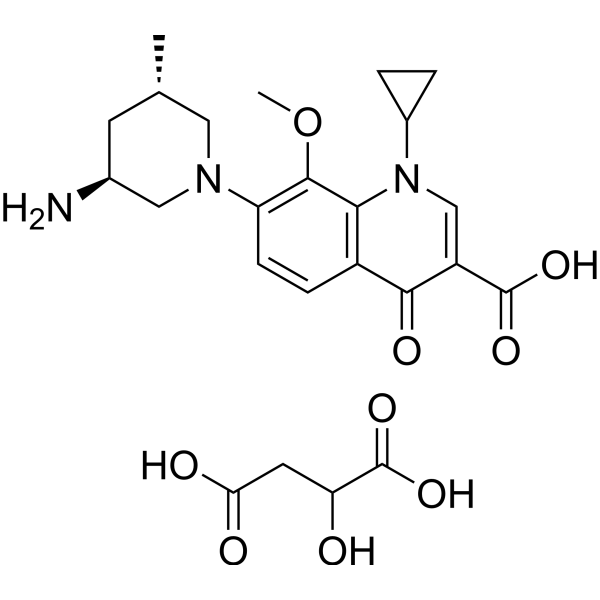
Nemonoxacin malate
Based on 1 publication(s) in Google Scholar
Nemonoxacin (TG-873870) malate is a nonfluorinated quinolone antibiotic. Nemonoxacin malate has broad-spectrum activity against Gram-positive, Gram-negative and atypical pathogens. Nemonoxacin malate can inhibit drug-resistant Streptococcus pneumoniae and Methicillin-resistant Staphylococcus aureus. Nemonoxacin malate can be used for the research of community-acquired pneumonia.
Nos produits utilisent uniquement pour la recherche. Nous ne vendons pas aux patients.
- Pureté : 99.29%
- CAS No.: 951163-60-3
- Formule: C24H31N3O9
- Masse moléculaire:505.52
-
Stockage:
Please store the product under the recommended conditions in the Certificate of Analysis.

To place orders, for customer services and technical support, please contact: MedChemExpress USA
Tel: 609-228-6898 E-mail: [email protected] [email protected]


-
 Activité biologique
-
Chemical Information
-
Solvant et solubilité
- Protocole
- Pureté et documentation
- Références
-
 Help & FAQs


Publications Citing Use of MedChemExpress (MCE) Nemonoxacin malate
MoreVoir tous les produits spécifiques à Isoform Antibiotic
More

Activité biologique
Description
IC50 & Target
|
Quinolone |
In Vitro
Nemonoxacin has antibacterial activity against Chlamydia pneumoniae with MIC90s of 0.06 μg/mL[1].
Nemonoxacin has highly active against community-acquired MRSA (CA-MRSA) (MIC90: 0.5 and 0.06 μg/ml), and exerts limited activity against (HY-B0356) Ciprofloxacin-resistant MRSA (MIC90: 1 μg/ml), and (HY-B0671) Vancomycin-intermediate MRSA (MIC90: 2 μg/ml)[2].
MedChemExpress (MCE) has not independently confirmed the accuracy of these methods. They are for reference only.
Essai clinique
| NCT Number | Sponsor | Condition | Start Date |
Phase

|
|---|---|---|---|---|
| NCT01329991 | 2011-05 | PHASE1 |


Chemical Information
-
CAS No. 951163-60-3
-
Appearance Solid
-
Masse moléculaire 505.52
-
Formule C24H31N3O9
-
Color White to off-white
-
SMILES
O=C(O)C(O)CC(O)=O.O=C(C1=CN(C2CC2)C3=C(C=CC(N4C[C@@H](N)C[C@H](C)C4)=C3OC)C1=O)O
-
Synonyms
TG-873870 malate
-
Livraison
Room temperature in continental US; may vary elsewhere.
-
Stockage
Please store the product under the recommended conditions in the Certificate of Analysis.


Publications (1)
-
Journal Impact Factor
-
Most Recent


Solvant et solubilité
In Vitro:
DMSO : 100 mg/mL (197.82 mM; Need ultrasonic; Hygroscopic DMSO has a significant impact on the solubility of product, please use newly opened DMSO)
H2O : 25 mg/mL (49.45 mM; Need ultrasonic)
* Note: If you choose water as the stock solution, please dilute it to the working solution, then filter and sterilize it with a 0.22 μm filter before use.
* Note: If you choose water as the stock solution, please dilute it to the working solution, then filter and sterilize it with a 0.22 μm filter before use.
Concentration (start) × Volume (start) = Concentration (final) × Volume (final)
In Vivo:
Select the appropriate dissolution method based on your experimental animal and administration route.
- For the following dissolution methods, please ensure to first prepare a clear stock solution using an In Vitro approach and then sequentially add co-solvents:
- To ensure reliable experimental results, the clarified stock solution can be appropriately stored based on storage conditions. As for the working solution for In Vivo experiments, it is recommended to prepare freshly and use it on the same day.
- The percentages shown for the solvents indicate their volumetric ratio in the final prepared solution. If precipitation or phase separation occurs during preparation, heat and/or sonication can be used to aid dissolution.
Add each solvent one by one: 10% DMSO 40% PEG300 5% Tween-80 45% Saline
Solubility: ≥ 2.5 mg/mL (4.95 mM); Clear solution
This protocol yields a clear solution of ≥ 2.5 mg/mL (saturation unknown).
Taking 1 mL working solution as an example, add 100 μL DMSO stock solution (25.0 mg/mL) to 400 μL PEG300, and mix evenly; then add 50 μL Tween-80 and mix evenly; then add 450 μL Saline to adjust the volume to 1 mL.
Preparation of Saline: Dissolve 0.9 g sodium chloride in ddH₂O and dilute to 100 mL to obtain a clear Saline solution.
Add each solvent one by one: 10% DMSO 90% (20% SBE-β-CD in Saline)
Solubility: ≥ 2.5 mg/mL (4.95 mM); Clear solution
This protocol yields a clear solution of ≥ 2.5 mg/mL (saturation unknown).
Taking 1 mL working solution as an example, add 100 μL DMSO stock solution (25.0 mg/mL) to 900 μL 20% SBE-β-CD in Saline, and mix evenly.
Preparation of 20% SBE-β-CD in Saline (4°C, storage for one week): 2 g SBE-β-CD powder is dissolved in 10 mL Saline, completely dissolve until clear.
In Vivo Dissolution Calculator
Please enter the basic information of animal experiments:
-
-
-
-
Recommended: Prepare an additional quantity of animals to account for potential losses during experiments.
Working solution concentration: 0.22 mg/mL
This product has good water solubility, please refer to the measured solubility data in water/PBS/Saline for details.


Pureté et documentation
-
Fiche technique (278 KB)
-
SDS (252 KB)
- English - EN (252 KB)
- Français - FR (252 KB)
- Deutsch - DE (252 KB)
- Norwegian - NO (252 KB)
- Español - ES (252 KB)
- Swedish - SV (252 KB)
- Italian - IT (252 KB)
- Korean - KR (252 KB)
- Portuguese - PT (252 KB)
-
Instruction de manipulation (2659 KB)
Références
[1]. Chotikanatis K, et al. In vitro activity of nemonoxacin, a novel nonfluorinated quinolone antibiotic, against Chlamydia trachomatis and Chlamydia pneumoniae. Antimicrob Agents Chemother. 2014;58(3):1800-1. [Content Brief]
[2]. Lai CC, et al. Nemonoxacin (TG-873870) for treatment of community-acquired pneumonia. Expert Rev Anti Infect Ther. 2014 Apr;12(4):401-17. [Content Brief]


Complete Stock Solution Preparation Table
| Optional Solvent | Concentration Solvent Mass | 1 mg | 5 mg | 10 mg | 25 mg |
|---|---|---|---|---|---|
| H2O / DMSO | 1 mM | 1.9782 mL | 9.8908 mL | 19.7816 mL | 49.4540 mL |
| 5 mM | 0.3956 mL | 1.9782 mL | 3.9563 mL | 9.8908 mL | |
| 10 mM | 0.1978 mL | 0.9891 mL | 1.9782 mL | 4.9454 mL | |
| 15 mM | 0.1319 mL | 0.6594 mL | 1.3188 mL | 3.2969 mL | |
| 20 mM | 0.0989 mL | 0.4945 mL | 0.9891 mL | 2.4727 mL | |
| 25 mM | 0.0791 mL | 0.3956 mL | 0.7913 mL | 1.9782 mL | |
| 30 mM | 0.0659 mL | 0.3297 mL | 0.6594 mL | 1.6485 mL | |
| 40 mM | 0.0495 mL | 0.2473 mL | 0.4945 mL | 1.2364 mL | |
| DMSO | 50 mM | 0.0396 mL | 0.1978 mL | 0.3956 mL | 0.9891 mL |
| 60 mM | 0.0330 mL | 0.1648 mL | 0.3297 mL | 0.8242 mL | |
| 80 mM | 0.0247 mL | 0.1236 mL | 0.2473 mL | 0.6182 mL | |
| 100 mM | 0.0198 mL | 0.0989 mL | 0.1978 mL | 0.4945 mL |
* Note: If you choose water as the stock solution, please dilute it to the working solution, then filter and sterilize it with a 0.22 μm filter before use.


Nemonoxacin malate Related Classifications
HY-111023 Related Classifications
 Powered by Bioz