



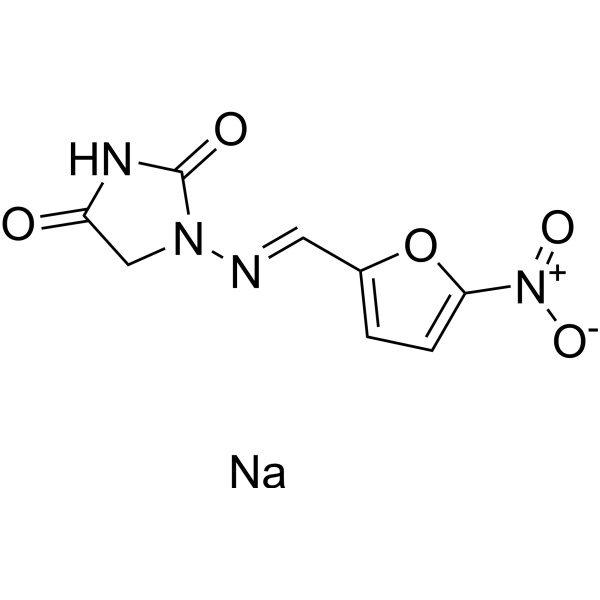
Nitrofurantoin sodium
Based on 12 publication(s) in Google Scholar
Nitrofurantoin sodium is a potent and orally active antibacterial agent. Nitrofurantoin sodium acts as an antibiotic. Nitrofurantoin sodium can be used for the study of urinary tract infections (UTIs), including cystitis and kidney infections.
For research use only. We do not sell to patients.
- Purity : 99.73%
- CAS No.: 54-87-5
- Formula: C8H6N4NaO5
- Molecular Weight:261.15
-
Storage:
4°C, sealed storage, away from moisture
* In solvent : -80°C, 6 months; -20°C, 1 month (sealed storage, away from moisture)

To place orders, for customer services and technical support, please contact: MedChemExpress USA
Tel: 609-228-6898 E-mail: [email protected] [email protected]


-
 Biological Activity
-
Chemical Information
-
Solvent & Solubility
- Protocols
- Purity & Documentation
- References
-
 Help & FAQs


Publications Citing Use of MedChemExpress (MCE) Nitrofurantoin sodium
More- Nat Commun. 2022 Mar 2;13(1):1116. [Abstract]
- Water Res. 2023 Jul 15:240:120110. [Abstract]
- J Exp Med. 2026 Mar 2;223(3):e20241287. [Abstract]
- Microbiol Spectr. 2022 Feb 23;10(1):e0099121. [Abstract]
- Biotechnol Bioeng. 2021 Dec;118(12):4687-4698. [Abstract]
- PLoS One. 2026 Jul 8;21(7):e0352997.
- Diagn Microbiol Infect Dis. 2026 Nov;116(3):117584.
- Diagn Microbiol Infect Dis. 2026 Feb;114(2):117181. [Abstract]
- bioRxiv. 2025 January 19.
- bioRxiv. 2024 May 10.
- Research Square Preprint. 2021 Aug.
- Research Square Preprint. 2020 Jun.
All Antibiotic Isoforms
More

Biological Activity
Description
In Vitro
Nitrofurantoin sodium (0-512 mg/L; 8 h) treatment inhibits the growth of E. coli isolates[3].
MedChemExpress (MCE) has not independently confirmed the accuracy of these methods. They are for reference only. Further protocols information, click here.
-
Cell Line:E. coli isolates: DA10708, DA13815, DA13824, DA13957, DA13992, DA10626, DA10627
-
Concentration:0, 32, 64, 128, 256, and 512 mg/L
-
Incubation Time:8 hours
-
Result:Observed bactericidal effect at 32 mg/L For DA10708, DA13815 and DA13824.
Inhibited the growth of DA13957 and DA13992 completely at 128 mg/L, observed bactericidal effect at 256 mg/L.
Showed a moderate killing at >128 mg/L for DA10626 and DA10627.
In Vivo
| Parameters | 10 mg/kg p.o. | 2 mg/kg i.v. |
| AUC0-720 (μg/mL•min) | 306 | |
| AUC0-120 (μg/mL•min) | 90.3 | |
| AUC0-∞ (μg/mL•min) | 344 | 91.5 |
| Cmax (μg/mL) | 1.01 | |
| CL/F or CL (ml/min/kg) | 31.0 | 22.7 |
| t1/2 (min) | 166 | 23.6 |
| Bioavailability (%) | 60.1 | |
MedChemExpress (MCE) has not independently confirmed the accuracy of these methods. They are for reference only.


Chemical Information
-
CAS No. 54-87-5
-
Appearance Solid
-
Molecular Weight 261.15
-
Formula C8H6N4NaO5
-
Color Light yellow to yellow
-
SMILES
O=C1NC(CN1/N=C/C2=CC=C([N+]([O-])=O)O2)=O.[Na]
-
Shipping
Room temperature in continental US; may vary elsewhere.
-
Storage
4°C, sealed storage, away from moisture
* In solvent : -80°C, 6 months; -20°C, 1 month (sealed storage, away from moisture)


Publications (12)
-
Journal Impact Factor
-
Most Recent
-
Nat Commun
Antimicrobial resistance and population genomics of multidrug-resistant Escherichia coli in pig farms in mainland China. [Abstract]2022 Mar 2;13(1):1116. PMID: 35236849 -
Water Res
Quantifying community-wide antibiotic usage via urban water fingerprinting: Focus on contrasting resource settings in South Africa. [Abstract]2023 Jul 15:240:120110. PMID: 37247434 -
J Exp Med
2026 Mar 2;223(3):e20241287. PMID: 41400657 -
Microbiol Spectr
The Mechanism of Action of Ginkgolic Acid (15:1) against Gram-Positive Bacteria Involves Cross Talk with Iron Homeostasis. [Abstract]2022 Feb 23;10(1):e0099121. PMID: 35019708 -
Biotechnol Bioeng
An integrated biomimetic array chip for establishment of collagen-based 3D primary human hepatocyte model for prediction of clinical drug-induced liver injury. [Abstract]2021 Dec;118(12):4687-4698. PMID: 34478150 -
-
-
Diagn Microbiol Infect Dis
2026 Feb;114(2):117181. PMID: 41205476 -
-
-
-


Solvent & Solubility
In Vitro:
DMSO : 50 mg/mL (191.46 mM; ultrasonic and warming and heat to 60°C; Hygroscopic DMSO has a significant impact on the solubility of product, please use newly opened DMSO)
Please refer to the solubility information to select the appropriate solvent. Once prepared, please aliquot and store the solution to prevent product inactivation from repeated freeze-thaw cycles.
Storage method and period of stock solution: -80°C, 6 months; -20°C, 1 month (sealed storage, away from moisture). When stored at -80°C, please use it within 6 months. When stored at -20°C, please use it within 1 month.
Please refer to the solubility information to select the appropriate solvent. Once prepared, please aliquot and store the solution to prevent product inactivation from repeated freeze-thaw cycles.
Storage method and period of stock solution: -80°C, 6 months; -20°C, 1 month (sealed storage, away from moisture). When stored at -80°C, please use it within 6 months. When stored at -20°C, please use it within 1 month.
Concentration (start) × Volume (start) = Concentration (final) × Volume (final)
In Vivo:
Select the appropriate dissolution method based on your experimental animal and administration route.
- For the following dissolution methods, please ensure to first prepare a clear stock solution using an In Vitro approach and then sequentially add co-solvents:
- To ensure reliable experimental results, the clarified stock solution can be appropriately stored based on storage conditions. As for the working solution for In Vivo experiments, it is recommended to prepare freshly and use it on the same day.
- The percentages shown for the solvents indicate their volumetric ratio in the final prepared solution. If precipitation or phase separation occurs during preparation, heat and/or sonication can be used to aid dissolution.
Add each solvent one by one: 10% DMSO 40% PEG300 5% Tween-80 45% Saline
Solubility: ≥ 5 mg/mL (19.15 mM); Clear solution
This protocol yields a clear solution of ≥ 5 mg/mL (saturation unknown).
Taking 1 mL working solution as an example, add 100 μL DMSO stock solution (50.0 mg/mL) to 400 μL PEG300, and mix evenly; then add 50 μL Tween-80 and mix evenly; then add 450 μL Saline to adjust the volume to 1 mL.
Preparation of Saline: Dissolve 0.9 g sodium chloride in ddH₂O and dilute to 100 mL to obtain a clear Saline solution.
Add each solvent one by one: 10% DMSO 90% (20% SBE-β-CD in Saline)
Solubility: ≥ 5 mg/mL (19.15 mM); Clear solution
This protocol yields a clear solution of ≥ 5 mg/mL (saturation unknown).
Taking 1 mL working solution as an example, add 100 μL DMSO stock solution (50.0 mg/mL) to 900 μL 20% SBE-β-CD in Saline, and mix evenly.
Preparation of 20% SBE-β-CD in Saline (4°C, storage for one week): 2 g SBE-β-CD powder is dissolved in 10 mL Saline, completely dissolve until clear.
In Vivo Dissolution Calculator
Please enter the basic information of animal experiments:
-
-
-
-
Recommended: Prepare an additional quantity of animals to account for potential losses during experiments.
Please enter your animal formula composition:
-
%DMSO +
Recommended: Keep the proportion of DMSO in working solution below 2% if your animal is weak.
-
%+
-
+%Tween-80 + +
-
%Saline +
The co-solvents required include: DMSO, . All of co-solvents are available by MedChemExpress (MCE). , Tween 80. All of co-solvents are available by MedChemExpress (MCE).
Working solution concentration: 0.22 mg/mL
Method for preparing stock solution: mg drug dissolved in μL DMSO. Stock solution concentration: mg/mL. * In solvent : -80°C, 6 months; -20°C, 1 month (sealed storage, away from moisture)
1. Take μL DMSO stock solution;
2. Add μL .
μL , mix evenly;
3. Then add μL Tween 80, mix evenly;
4. Then add μL
Please ensure that the stock solution in the first step is dissolved to a clear state, and add co-solvents in sequence. You can use ultrasonic heating (ultrasonic cleaner, recommended frequency 20-40 kHz), vortexing, etc. to assist dissolution.

Protocols
-
Research Protocol for Infectious Diseases
Infectious-disease experiments test how pathogens interact with host barriers, innate immune receptors, inflammatory signaling, pathogen replication, and tissue injury; pattern-recognition receptors such as TLRs, RIG-I-like receptors, NOD-like receptors, and inflammasomes detect microbial molecules and activate NF-κB, interferon, and cytokine responses. The central hypothesis is that infection severity reflects the balance between pathogen burden and host response: protective inflammation restricts pathogen growth, whereas excessive or mislocalized inflammation contributes to tissue damage and disease phenotype. Unresolved questions include which host pathways are protective versus pathogenic, why some infection models fail to translate to human disease, and which combined readouts best predict clinically relevant infection outcomes.


Purity & Documentation
-
Data Sheet (280 KB)
-
SDS (252 KB)
- English - EN (252 KB)
- Français - FR (252 KB)
- Deutsch - DE (252 KB)
- Norwegian - NO (252 KB)
- Español - ES (252 KB)
- Swedish - SV (252 KB)
- Italian - IT (252 KB)
- Korean - KR (252 KB)
- Portuguese - PT (252 KB)
-
Handling Instructions (2659 KB)
References
[1]. Huttner A, et al. Nitrofurantoin revisited: a systematic review and meta-analysis of controlled trials. J Antimicrob Chemother. 2015 Sep;70(9):2456-64. [Content Brief]
[2]. Garau J. Other antimicrobials of interest in the era of extended-spectrum beta-lactamases: fosfomycin, nitrofurantoin and tigecycline. Clin Microbiol Infect. 2008 Jan;14 Suppl 1:198-202. [Content Brief]
[3]. Linus Sandegren, et al. Nitrofurantoin resistance mechanism and fitness cost in Escherichia coli. J Antimicrob Chemother. 2008 Sep;62(3):495-503. [Content Brief]
[4]. Xiaodong Wang, et al. Effects of the flavonoid chrysin on nitrofurantoin pharmacokinetics in rats: potential involvement of ABCG2. Drug Metab Dispos. 2007 Feb;35(2):268-74. [Content Brief]


Complete Stock Solution Preparation Table
Please refer to the solubility information to select the appropriate solvent. Once prepared, please aliquot and store the solution to prevent product inactivation from repeated freeze-thaw cycles.
Storage method and period of stock solution: -80°C, 6 months; -20°C, 1 month (sealed storage, away from moisture). When stored at -80°C, please use it within 6 months. When stored at -20°C, please use it within 1 month.
| Optional Solvent | Concentration Solvent Mass | 1 mg | 5 mg | 10 mg | 25 mg |
|---|---|---|---|---|---|
| DMSO | 1 mM | 3.8292 mL | 19.1461 mL | 38.2922 mL | 95.7304 mL |
| 5 mM | 0.7658 mL | 3.8292 mL | 7.6584 mL | 19.1461 mL | |
| 10 mM | 0.3829 mL | 1.9146 mL | 3.8292 mL | 9.5730 mL | |
| 15 mM | 0.2553 mL | 1.2764 mL | 2.5528 mL | 6.3820 mL | |
| 20 mM | 0.1915 mL | 0.9573 mL | 1.9146 mL | 4.7865 mL | |
| 25 mM | 0.1532 mL | 0.7658 mL | 1.5317 mL | 3.8292 mL | |
| 30 mM | 0.1276 mL | 0.6382 mL | 1.2764 mL | 3.1910 mL | |
| 40 mM | 0.0957 mL | 0.4787 mL | 0.9573 mL | 2.3933 mL | |
| 50 mM | 0.0766 mL | 0.3829 mL | 0.7658 mL | 1.9146 mL | |
| 60 mM | 0.0638 mL | 0.3191 mL | 0.6382 mL | 1.5955 mL | |
| 80 mM | 0.0479 mL | 0.2393 mL | 0.4787 mL | 1.1966 mL | |
| 100 mM | 0.0383 mL | 0.1915 mL | 0.3829 mL | 0.9573 mL |


Nitrofurantoin sodium Related Classifications
HY-A0090A Related Classifications
 Powered by Bioz