



Hex

Based on 1 Customer Validation
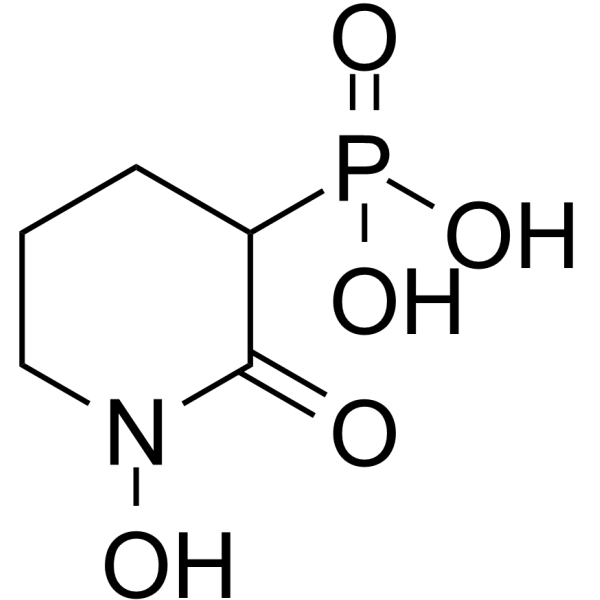
Hex is an enolase inhibitor and antimalarial agent with Ki values of 74.4 nM and 269.4 nM for ENO2 and ENO1, respectively. Hex is a NfENO and TbENO inhibitor with IC50s value of 0.14 μM and 2.1 μM, respectively. Hex has antimalarial activity against Plasmodium falciparum 3D7, Naegleria fowleri trophozoites and Plasmodium berghei ANKA strain. Hex has anti-tumor effects against intracranial tumors.
For research use only. We do not sell to patients.
- CAS No.: 2004714-32-1
- Formula: C5H10NO5P
- Molecular Weight:195.11
-
Storage:
4°C, sealed storage, away from moisture and light
* In solvent : -80°C, 6 months; -20°C, 1 month (sealed storage, away from moisture and light)

To place orders, for customer services and technical support, please contact: MedChemExpress USA
Tel: 609-228-6898 E-mail: [email protected] [email protected]


-
 Biological Activity
-
Chemical Information
-
Solvent & Solubility
- Purity & Documentation
- References
-
 Help & FAQs


All Parasite Isoforms
More

Biological Activity
Description
IC50 & Target
Ki: 74.4 nM (ENO2), 269.4 nM (ENO1); IC50: 0.14 μM (NfENO), 2.1 μM (TbENO)[1][2][3][4][5][6][7][8].
Cellular Effect
|
Cell Line

|
Type | Value | Description | References |
|---|---|---|---|---|
| D-423MG | IC50 |
7574 nM
Compound: HEX
|
Cytotoxicity against human D423 cells with ENO1 deficient assessed as reduction in cell viability incubated for 5 days by crystal violet staining based spectrophotometry
Cytotoxicity against human D423 cells with ENO1 deficient assessed as reduction in cell viability incubated for 5 days by crystal violet staining based spectrophotometry
|
[PMID: 33130289] |
| D-423MG | IC50 |
1300 nM
Compound: 5; HEX
|
Cytotoxicity against human D-423MG cells assessed as cell growth inhibition incubated for 6 days by cystal violet staining based analysis
Cytotoxicity against human D-423MG cells assessed as cell growth inhibition incubated for 6 days by cystal violet staining based analysis
|
[PMID: 36251833] |
| D-423MG | IC50 |
>300000 nM
Compound: 5; HEX
|
Cytotoxicity against human D-423MG cells expressing ENO1 assessed as cell growth inhibition incubated for 6 days by cystal violet staining based analysis
Cytotoxicity against human D-423MG cells expressing ENO1 assessed as cell growth inhibition incubated for 6 days by cystal violet staining based analysis
|
[PMID: 36251833] |
In Vitro
Hex (1 week) is toxic to D423 (ENO1-/-) cells with an IC50 of approximately 1.3 μM[1].
Hex is a potent NfENO inhibitor with an IC50 value of 0.14 μM[2].
Hex (48 h) can effectively inhibit the growth of Naegleria fowleri trophozoites, with an EC50 value of 0.21 μM[2].
Hex is a TbENO inhibitor with an IC50 value of 2.1 μM[3].
Hex has poor antimalarial activity against Plasmodium falciparum 3D7 strain, with an EC50 value of >15 μM[6].
MedChemExpress (MCE) has not independently confirmed the accuracy of these methods. They are for reference only.
In Vivo
Hex (3 mg/kg; intranasal instillation; daily; 10 days) extends the lifespan of infected animals without completely curing infection in rats infected with Naegleria fowleri[2].
Hex (100 mg/kg; i.p.; daily; 5 days) reduces the overall parasite burden, improves the clinical score, and significantly increases the survival rate in mice infected with Plasmodium berghei ANKA strain[7].
MedChemExpress (MCE) has not independently confirmed the accuracy of these methods. They are for reference only.
-
Animal Model:Female Swiss-Webster mice, infected with Plasmodium berghei ANKA strain[7]
-
Dosage:100 mg/kg
-
Administration:Intraperitoneal injection, 5 days
-
Result:Reduced the overall parasite burden.
Showed parasitemia of 3.5% on day 4.
Showed clinical score of 3.8 on day 6.
Significantly improved survival.
Kept the animals alive for 14 days.
Clinical Trial
| NCT Number | Sponsor | Condition | Start Date |
Phase
|
|---|---|---|---|---|
| NCT01329991 | Plexxikon| | 2011-05 | PHASE1 |


Chemical Information
-
CAS No. 2004714-32-1
-
Appearance Viscous Liquid
-
Molecular Weight 195.11
-
Formula C5H10NO5P
-
Color Brown to reddish brown
-
SMILES
OP(O)(C1C(N(O)CCC1)=O)=O
-
Shipping
Room temperature in continental US; may vary elsewhere.
-
Storage
4°C, sealed storage, away from moisture and light
* In solvent : -80°C, 6 months; -20°C, 1 month (sealed storage, away from moisture and light)


Solvent & Solubility
In Vitro:
DMSO : 140 mg/mL (717.54 mM; Need ultrasonic; Hygroscopic DMSO has a significant impact on the solubility of product, please use newly opened DMSO)
Please refer to the solubility information to select the appropriate solvent. Once prepared, please aliquot and store the solution to prevent product inactivation from repeated freeze-thaw cycles.
Storage method and period of stock solution: -80°C, 6 months; -20°C, 1 month (sealed storage, away from moisture and light). When stored at -80°C, please use it within 6 months. When stored at -20°C, please use it within 1 month.
Please refer to the solubility information to select the appropriate solvent. Once prepared, please aliquot and store the solution to prevent product inactivation from repeated freeze-thaw cycles.
Storage method and period of stock solution: -80°C, 6 months; -20°C, 1 month (sealed storage, away from moisture and light). When stored at -80°C, please use it within 6 months. When stored at -20°C, please use it within 1 month.
Concentration (start) × Volume (start) = Concentration (final) × Volume (final)
In Vivo:
Select the appropriate dissolution method based on your experimental animal and administration route.
- For the following dissolution methods, please ensure to first prepare a clear stock solution using an In Vitro approach and then sequentially add co-solvents:
- To ensure reliable experimental results, the clarified stock solution can be appropriately stored based on storage conditions. As for the working solution for In Vivo experiments, it is recommended to prepare freshly and use it on the same day.
- The percentages shown for the solvents indicate their volumetric ratio in the final prepared solution. If precipitation or phase separation occurs during preparation, heat and/or sonication can be used to aid dissolution.
Add each solvent one by one: 10% DMSO 40% PEG300 5% Tween-80 45% Saline
Solubility: ≥ 3.5 mg/mL (17.94 mM); Clear solution
This protocol yields a clear solution of ≥ 3.5 mg/mL (saturation unknown).
Taking 1 mL working solution as an example, add 100 μL DMSO stock solution (35.0 mg/mL) to 400 μL PEG300, and mix evenly; then add 50 μL Tween-80 and mix evenly; then add 450 μL Saline to adjust the volume to 1 mL.
Preparation of Saline: Dissolve 0.9 g sodium chloride in ddH₂O and dilute to 100 mL to obtain a clear Saline solution.
Add each solvent one by one: 10% DMSO 90% (20% SBE-β-CD in Saline)
Solubility: ≥ 3.5 mg/mL (17.94 mM); Clear solution
This protocol yields a clear solution of ≥ 3.5 mg/mL (saturation unknown).
Taking 1 mL working solution as an example, add 100 μL DMSO stock solution (35.0 mg/mL) to 900 μL 20% SBE-β-CD in Saline, and mix evenly.
Preparation of 20% SBE-β-CD in Saline (4°C, storage for one week): 2 g SBE-β-CD powder is dissolved in 10 mL Saline, completely dissolve until clear.
In Vivo Dissolution Calculator
Please enter the basic information of animal experiments:
-
-
-
-
Recommended: Prepare an additional quantity of animals to account for potential losses during experiments.
Please enter your animal formula composition:
-
%DMSO +
Recommended: Keep the proportion of DMSO in working solution below 2% if your animal is weak.
-
%+
-
+%Tween-80 + +
-
%Saline +
The co-solvents required include: DMSO, . All of co-solvents are available by MedChemExpress (MCE). , Tween 80. All of co-solvents are available by MedChemExpress (MCE).
Working solution concentration: 0.22 mg/mL
Method for preparing stock solution: mg drug dissolved in μL DMSO. Stock solution concentration: mg/mL. * In solvent : -80°C, 6 months; -20°C, 1 month (sealed storage, away from moisture and light)
1. Take μL DMSO stock solution;
2. Add μL .
μL , mix evenly;
3. Then add μL Tween 80, mix evenly;
4. Then add μL
Please ensure that the stock solution in the first step is dissolved to a clear state, and add co-solvents in sequence. You can use ultrasonic heating (ultrasonic cleaner, recommended frequency 20-40 kHz), vortexing, etc. to assist dissolution.


Purity & Documentation
-
Data Sheet (280 KB)
-
SDS (252 KB)
- English - EN (252 KB)
- Français - FR (252 KB)
- Deutsch - DE (252 KB)
- Norwegian - NO (252 KB)
- Español - ES (252 KB)
- Swedish - SV (252 KB)
- Italian - IT (252 KB)
- Korean - KR (252 KB)
- Portuguese - PT (252 KB)
-
Handling Instructions (2659 KB)
References
[1]. Lin YH, et al. An enolase inhibitor for the targeted treatment of ENO1-deleted cancers. Nat Metab. 2020 Dec;2(12):1413-1426. [Content Brief]
[2]. Milanes JE, et al. Enolase inhibitors as therapeutic leads for Naegleria fowleri infection. PLoS Pathog. 2024 Aug 1;20(8):e1012412. [Content Brief]
[3]. Roster CP, et al. Enolase Inhibitors as Early Lead Therapeutics against Trypanosoma brucei. Pathogens. 2023 Oct 28;12(11):1290. [Content Brief]
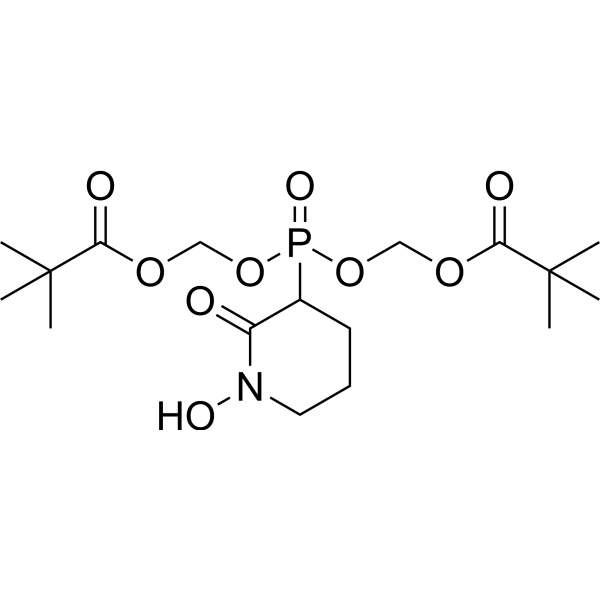
[4]. Yan VC, et al. Comparative Pharmacology of a Bis-Pivaloyloxymethyl Phosphonate Prodrug Inhibitor of Enolase after Oral and Parenteral Administration. ACS Pharmacol Transl Sci. 2023 Jan 6;6(2):245-252. [Content Brief]
[7]. Jezewski AJ, et al. Targeting Host Glycolysis as a Strategy for Antimalarial Development. Front Cell Infect Microbiol. 2021 Sep 16;11:730413. [Content Brief]
[8]. BOARD OF REGENTS, et al. Enolase inhibitors and methods of treatment there with. WO2016145113A1


Complete Stock Solution Preparation Table
Please refer to the solubility information to select the appropriate solvent. Once prepared, please aliquot and store the solution to prevent product inactivation from repeated freeze-thaw cycles.
Storage method and period of stock solution: -80°C, 6 months; -20°C, 1 month (sealed storage, away from moisture and light). When stored at -80°C, please use it within 6 months. When stored at -20°C, please use it within 1 month.
| Optional Solvent | Concentration Solvent Mass | 1 mg | 5 mg | 10 mg | 25 mg |
|---|---|---|---|---|---|
| DMSO | 1 mM | 5.1253 mL | 25.6264 mL | 51.2529 mL | 128.1322 mL |
| 5 mM | 1.0251 mL | 5.1253 mL | 10.2506 mL | 25.6264 mL | |
| 10 mM | 0.5125 mL | 2.5626 mL | 5.1253 mL | 12.8132 mL | |
| 15 mM | 0.3417 mL | 1.7084 mL | 3.4169 mL | 8.5421 mL | |
| 20 mM | 0.2563 mL | 1.2813 mL | 2.5626 mL | 6.4066 mL | |
| 25 mM | 0.2050 mL | 1.0251 mL | 2.0501 mL | 5.1253 mL | |
| 30 mM | 0.1708 mL | 0.8542 mL | 1.7084 mL | 4.2711 mL | |
| 40 mM | 0.1281 mL | 0.6407 mL | 1.2813 mL | 3.2033 mL | |
| 50 mM | 0.1025 mL | 0.5125 mL | 1.0251 mL | 2.5626 mL | |
| 60 mM | 0.0854 mL | 0.4271 mL | 0.8542 mL | 2.1355 mL | |
| 80 mM | 0.0641 mL | 0.3203 mL | 0.6407 mL | 1.6017 mL | |
| 100 mM | 0.0513 mL | 0.2563 mL | 0.5125 mL | 1.2813 mL |


Hex Related Classifications
HY-131904A Related Classifications
 Powered by Bioz