



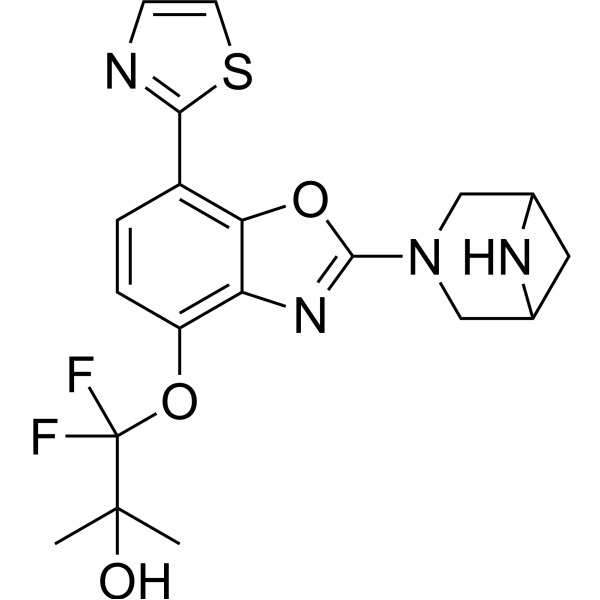
Morcamilast

Based on 1 Customer Validation
Morcamilast (ME3183) is a potent, orally active, selective phosphodiesterase 4 (PDE4) inhibitor, with IC50 values of 1.28 nM, 2.33 nM and 1.63 nM against human PDE4A1A, PDE4B1 and PDE4D2, respectively. Morcamilast inhibits the production of TNF-α, IL-12/23p40, IL-23, IL-17A, IL-4, IL-5 and IL-13 in human PBMCs and T cells, and alleviates chronic Oxazolone (HY-126360)-induced dermatitis, Substance P (HY-P0201)-induced pruritus, Imiquimod (HY-B0180)-induced psoriasis-like dermatitis and LPS (HY-D1056)-induced arthritis. Morcamilast is used for the research of psoriasis, atopic dermatitis, psoriatic arthritis and other inflammatory and immune-related diseases.
Nos produits utilisent uniquement pour la recherche. Nous ne vendons pas aux patients.
- Pureté : 98.27%
- CAS No.: 2231329-25-0
- Formule: C19H20F2N4O3S
- Masse moléculaire:422.45
-
Stockage:Powder -20°C, 3 years , 4°C, 2 years ; In solvent -80°C, 6 months , -20°C, 1 month

To place orders, for customer services and technical support, please contact: MedChemExpress USA
Tel: 609-228-6898 E-mail: [email protected] [email protected]


-
 Activité biologique
-
Chemical Information
-
Solvant et solubilité
- Protocole
- Pureté et documentation
- Références
-
 Help & FAQs




Activité biologique
Description
IC50 & Target
[4]|
PDE4A1 1.28 nM (IC50) |
PDE4B1 2.33 nM (IC50) |
PDE4D2 1.63 nM (IC50) |
PDE10A2 453 nM (IC50) |
PDE2A 1810 nM (IC50) |
PDE3A 2950 nM (IC50) |
In Vitro
Morcamilast (ME3183) potently inhibits the production of proinflammatory cytokines and chemokines induced by stimulants in whole blood cell cultures from patients with plaque psoriasis and healthy volunteers, with a potency 5 to 40 times higher than that of apremilast[2].
Morcamilast potently inhibits TNF-α production in lipopolysaccharide-stimulated peripheral blood mononuclear cells (PBMCs) from patients with psoriasis, and its inhibitory activity is 114-fold stronger than that of apremilast[3].
Morcamilast (pretreated for 1 h; stimulated with LPS at 1 ng/mL for 18 h) potently inhibits the production of psoriasis-related cytokines TNF-α, IL-12/23p40 and IL-23 in LPS-induced human PBMCs, with IC50 values of 0.648 nM, 1.96 nM and 98.4 nM, respectively[4].
Morcamilast exhibits IC50 values of 1.28 nM, 2.33 nM, and 1.63 nM against PDE4A1A, PDE4B1, and PDE4D2, respectively, and shows weak activity against most other PDE family enzymes[4].
Morcamilast (48 h) potently inhibits the production of psoriasis-associated IL-17A (IC50 28.5 nM) and Th2 cytokines IL-4 (IC50 1.15 nM), IL-5 (IC50 33.0 nM), and IL-13 (IC50 88.4 nM) in stimulated human T cells[4].
MedChemExpress (MCE) has not independently confirmed the accuracy of these methods. They are for reference only. Further protocols information, click here.
In Vivo
ME3183 (1-10 mg/kg; p.o.; single administration) dose-dependently reduces Substance P-stimulated scratching behavior in male ICR mice, exerts a significant effect at ≥3 mg/kg, with an ED50 of 3.74 mg/kg[4].
ME3183 (1-10 mg/kg; p.o.; single administration) shows a non-emetic dose of 3 mg/kg within 0-6 h post-administration in male ferrets; at this dose, only 1 out of 6 ferrets develops mild, transient vomiting during 6-24 h, while 10 mg/kg induces vomiting in 6/6 ferrets within 0-6 h and causes persistent vomiting in 4/6 ferrets during 6-24 h[4].
MedChemExpress (MCE) has not independently confirmed the accuracy of these methods. They are for reference only.
-
Animal Model:BALB/cAnNCrlCrlj (female, 7 weeks old, atopic dermatitis induced by oxazolone sensitization and challenge)[4]
-
Dosage:0.1 mg/kg; 0.3 mg/kg; 1 mg/kg; 3 mg/kg; 10 mg/kg
-
Administration:p.o.; twice daily; 10 days
-
Result:Suppressed ear swelling dose-dependently, with significant reductions observed at doses of 0.3 mg/kg or higher on day 25.
Achieved an ED50 of 1.43 mg/kg for inhibition of ear swelling.
Significantly reduced TNF-α production in lesional skin at doses of 0.3 mg/kg or higher.
Significantly reduced IL-4 production in lesional skin at doses of 0.3 mg/kg or higher.
-
Animal Model:Crl:CD1 (ICR) (male, 4 weeks old, pruritus induced by substance P intradermal injection)[4]
-
Dosage:1 mg/kg; 3 mg/kg; 10 mg/kg
-
Administration:p.o.; single dose
-
Result:Suppressed substance P-induced scratching behaviors dose-dependently, with significant suppression observed at doses of 3 mg/kg or higher.
Achieved an ED50 of 3.74 mg/kg for inhibition of scratching behaviors.
Achieved an approximately 60% inhibition ratio of scratching behaviors at 10 mg/kg.
-
Animal Model:ferrets (male, 4-5 months old)[4]
-
Dosage:1 mg/kg; 3 mg/kg; 10 mg/kg
-
Administration:p.o.; single dose
-
Result:Showed emesis in 0 of 6 ferrets over 24 hours at 1 mg/kg.
Showed emesis in 0 of 6 ferrets in the first 6 hours post-administration, with 1 of 6 showing minimal emesis (9 episodes, 1-minute cumulative duration) between 6-24 hours at 3 mg/kg.
Triggered emesis in all 6 ferrets within the first 6 hours, with 4 of 6 showing emesis between 6-24 hours at 10 mg/kg.
Essai clinique
| NCT Number | Sponsor | Condition | Start Date |
Phase

|
|---|---|---|---|---|
| NCT01329991 | Plexxikon| | 2011-05 | PHASE1 |


Chemical Information
-
CAS No. 2231329-25-0
-
Appearance Solid
-
Masse moléculaire 422.45
-
Formule C19H20F2N4O3S
-
Color White to off-white
-
SMILES
FC(F)(C(C)(C)O)OC1=C(N=C(O2)N3CC4CC(C3)N4)C2=C(C=C1)C5=NC=CS5
-
Synonyms
ME3183; PDE4-IN-14
-
Livraison
Room temperature in continental US; may vary elsewhere.
-
Stockage
Powder -20°C 3 years 4°C 2 years In solvent -80°C 6 months -20°C 1 month


Solvant et solubilité
In Vitro:
DMSO : 100 mg/mL (236.71 mM; Need ultrasonic; Hygroscopic DMSO has a significant impact on the solubility of product, please use newly opened DMSO)
Please refer to the solubility information to select the appropriate solvent. Once prepared, please aliquot and store the solution to prevent product inactivation from repeated freeze-thaw cycles.
Storage method and period of stock solution: -80°C, 6 months; -20°C, 1 month. When stored at -80°C, please use it within 6 months. When stored at -20°C, please use it within 1 month.
Please refer to the solubility information to select the appropriate solvent. Once prepared, please aliquot and store the solution to prevent product inactivation from repeated freeze-thaw cycles.
Storage method and period of stock solution: -80°C, 6 months; -20°C, 1 month. When stored at -80°C, please use it within 6 months. When stored at -20°C, please use it within 1 month.
Concentration (start) × Volume (start) = Concentration (final) × Volume (final)
In Vivo:
Select the appropriate dissolution method based on your experimental animal and administration route.
- For the following dissolution methods, please ensure to first prepare a clear stock solution using an In Vitro approach and then sequentially add co-solvents:
- To ensure reliable experimental results, the clarified stock solution can be appropriately stored based on storage conditions. As for the working solution for In Vivo experiments, it is recommended to prepare freshly and use it on the same day.
- The percentages shown for the solvents indicate their volumetric ratio in the final prepared solution. If precipitation or phase separation occurs during preparation, heat and/or sonication can be used to aid dissolution.
Add each solvent one by one: 10% DMSO 40% PEG300 5% Tween-80 45% Saline
Solubility: ≥ 5 mg/mL (11.84 mM); Clear solution
This protocol yields a clear solution of ≥ 5 mg/mL (saturation unknown).
Taking 1 mL working solution as an example, add 100 μL DMSO stock solution (50.0 mg/mL) to 400 μL PEG300, and mix evenly; then add 50 μL Tween-80 and mix evenly; then add 450 μL Saline to adjust the volume to 1 mL.
Preparation of Saline: Dissolve 0.9 g sodium chloride in ddH₂O and dilute to 100 mL to obtain a clear Saline solution.
Add each solvent one by one: 10% DMSO 90% (20% SBE-β-CD in Saline)
Solubility: ≥ 5 mg/mL (11.84 mM); Clear solution
This protocol yields a clear solution of ≥ 5 mg/mL (saturation unknown).
Taking 1 mL working solution as an example, add 100 μL DMSO stock solution (50.0 mg/mL) to 900 μL 20% SBE-β-CD in Saline, and mix evenly.
Preparation of 20% SBE-β-CD in Saline (4°C, storage for one week): 2 g SBE-β-CD powder is dissolved in 10 mL Saline, completely dissolve until clear.
In Vivo Dissolution Calculator
Please enter the basic information of animal experiments:
-
-
-
-
Recommended: Prepare an additional quantity of animals to account for potential losses during experiments.
Please enter your animal formula composition:
-
%DMSO +
Recommended: Keep the proportion of DMSO in working solution below 2% if your animal is weak.
-
%+
-
+%Tween-80 + +
-
%Saline +
The co-solvents required include: DMSO, . All of co-solvents are available by MedChemExpress (MCE). , Tween 80. All of co-solvents are available by MedChemExpress (MCE).
Working solution concentration: 0.22 mg/mL
Method for preparing stock solution: mg drug dissolved in μL DMSO. Stock solution concentration: mg/mL.
1. Take μL DMSO stock solution;
2. Add μL .
μL , mix evenly;
3. Then add μL Tween 80, mix evenly;
4. Then add μL
Please ensure that the stock solution in the first step is dissolved to a clear state, and add co-solvents in sequence. You can use ultrasonic heating (ultrasonic cleaner, recommended frequency 20-40 kHz), vortexing, etc. to assist dissolution.

Protocole
-
Collagen-Induced Arthritis
Collagen-induced arthritis (CIA) is an autoimmune murine model of rheumatoid arthritis in which immunization with type II collagen (CII) emulsified in an adjuvant induces a T cell- and autoantibody-driven inflammatory arthritis characterized by synovial hyperplasia, immune cell infiltration, and joint destruction. The model typically relies on genetically susceptible mouse strains (e. g. , DBA/1) and reproduces key features of human rheumatoid arthritis, including anti-collagen immune responses and progressive joint inflammation. Disease onset generally occurs within ~3-4 weeks after immunization, depending on antigen/adjuvant combinations and protocol variation. The immunopathology is driven by adaptive immune activation against CII, leading to systemic and local joint inflammation mediated by pro-inflammatory cytokines and effector immune cells, making CIA a standard preclinical platform for evaluating immunomodulatory and anti-arthritic interventions.
-
Imiquimod-Induced Psoriasiform Dermatitis
Imiquimod (IMQ)-induced psoriasiform dermatitis is a widely used murine model in which topical application of IMQ, a Toll-like receptor 7 (TLR7) agonist, triggers innate immune activation in the skin and induces a psoriasis-like inflammatory cascade characterized by epidermal hyperplasia, immune cell infiltration, and cytokine production dominated by the IL-23/IL-17 axis. This inflammatory response is mediated through activation of dendritic cells and downstream induction of IL-23, IL-17A, IL-22, and related pro-inflammatory mediators, recapitulating key features of human plaque psoriasis and enabling mechanistic and therapeutic studies. The model is commonly induced using Aldara (5% IMQ cream) applied topically to murine skin, resulting in rapid onset of erythema, scaling, and thickening that can be quantified as disease severity indices and validated histologically.
-
TPA/Croton Oil Ear Edema and Dermatitis
The TPA (12-O-tetradecanoylphorbol-13-acetate) and croton oil-induced mouse ear edema model is a well-established acute cutaneous inflammation system used to evaluate topical anti-inflammatory activity by measuring edema formation, neutrophil infiltration, vascular permeability, and cytokine-mediated skin responses in vivo. The inflammatory response is triggered by topical application of phorbol esters (TPA) or croton oil constituents, leading to rapid activation of protein kinase C signaling, leukocyte recruitment, and increased vascular permeability, which can be quantified by ear thickness, weight, dye extravasation, and biochemical markers such as myeloperoxidase (MPO) activity and pro-inflammatory mediators in ear tissue homogenates. This model is widely used for screening anti-inflammatory agents, where reductions in edema and inflammatory biomarkers reflect suppression of acute dermal inflammation and immune cell infiltration. Histological evaluation typically confirms epidermal


Pureté et documentation
-
Fiche technique (295 KB)
-
SDS (254 KB)
- English - EN (254 KB)
- Français - FR (254 KB)
- Deutsch - DE (254 KB)
- Norwegian - NO (254 KB)
- Español - ES (254 KB)
- Swedish - SV (254 KB)
- Italian - IT (254 KB)
- Korean - KR (254 KB)
- Portuguese - PT (254 KB)
-
Instruction de manipulation (2659 KB)
Références
[1]. Kato S, et al. Safety, Tolerability, and Pharmacokinetics of a Novel Oral Phosphodiesterase 4 Inhibitor, ME3183: First-in-Human Phase 1 Study. Clinical pharmacology in drug development. 2024 Apr;13(4):341-348. [Content Brief]
[4]. Kubota-Ishida N, et al. ME3183, a novel phosphodiesterase-4 inhibitor, exhibits potent anti-inflammatory effects and is well tolerated in a non-clinical study. European journal of pharmacology. 2024 Jan 05;962:176202. [Content Brief]


Complete Stock Solution Preparation Table
Please refer to the solubility information to select the appropriate solvent. Once prepared, please aliquot and store the solution to prevent product inactivation from repeated freeze-thaw cycles.
Storage method and period of stock solution: -80°C, 6 months; -20°C, 1 month. When stored at -80°C, please use it within 6 months. When stored at -20°C, please use it within 1 month.
| Optional Solvent | Concentration Solvent Mass | 1 mg | 5 mg | 10 mg | 25 mg |
|---|---|---|---|---|---|
| DMSO | 1 mM | 2.3671 mL | 11.8357 mL | 23.6714 mL | 59.1786 mL |
| 5 mM | 0.4734 mL | 2.3671 mL | 4.7343 mL | 11.8357 mL | |
| 10 mM | 0.2367 mL | 1.1836 mL | 2.3671 mL | 5.9179 mL | |
| 15 mM | 0.1578 mL | 0.7890 mL | 1.5781 mL | 3.9452 mL | |
| 20 mM | 0.1184 mL | 0.5918 mL | 1.1836 mL | 2.9589 mL | |
| 25 mM | 0.0947 mL | 0.4734 mL | 0.9469 mL | 2.3671 mL | |
| 30 mM | 0.0789 mL | 0.3945 mL | 0.7890 mL | 1.9726 mL | |
| 40 mM | 0.0592 mL | 0.2959 mL | 0.5918 mL | 1.4795 mL | |
| 50 mM | 0.0473 mL | 0.2367 mL | 0.4734 mL | 1.1836 mL | |
| 60 mM | 0.0395 mL | 0.1973 mL | 0.3945 mL | 0.9863 mL | |
| 80 mM | 0.0296 mL | 0.1479 mL | 0.2959 mL | 0.7397 mL | |
| 100 mM | 0.0237 mL | 0.1184 mL | 0.2367 mL | 0.5918 mL |


Morcamilast Related Classifications
HY-155830 Related Classifications
 Powered by Bioz