



Trehalose-6,6'-dibehenate

Based on 1 Customer Validation
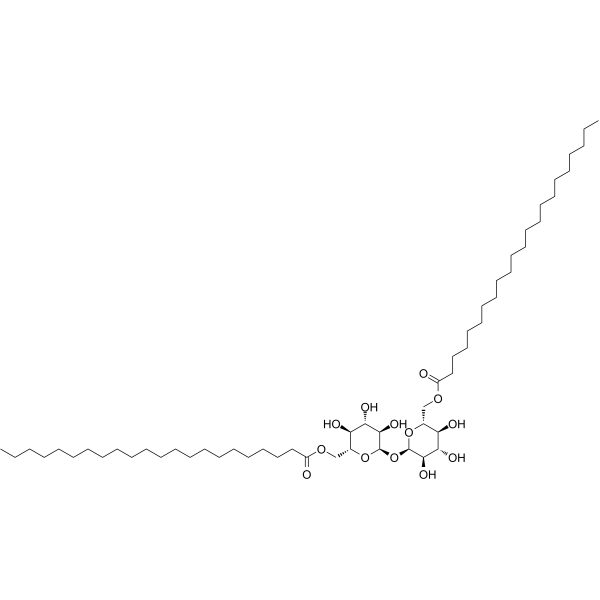
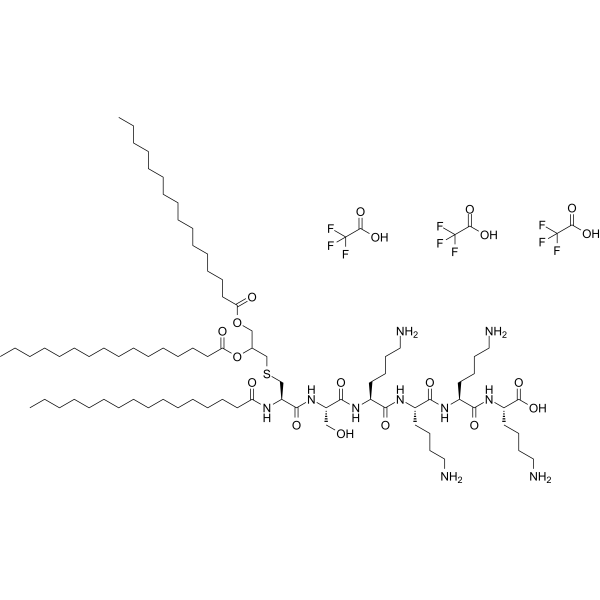
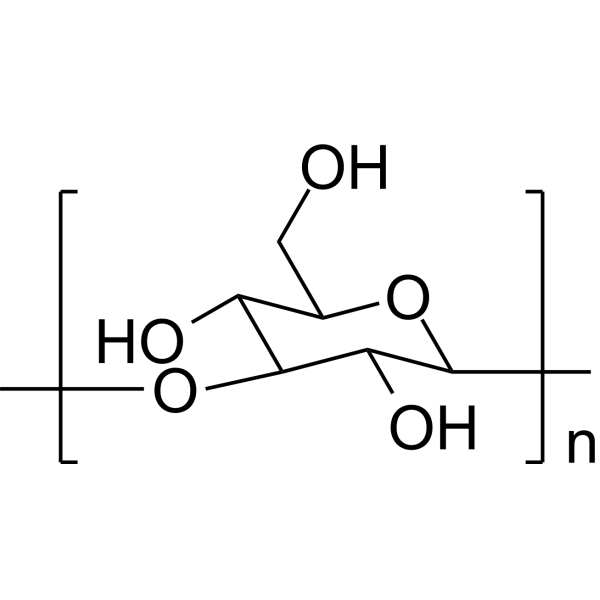
Trehalose-6,6'-dibehenate is an orally active glycolipid. Trehalose-6,6'-dibehenate activates Mincle and inflammasome, inducing IL-1β secretion in a caspase activity-dependent manner. Trehalose-6,6'-dibehenate exerts a Myd88-dependent adjuvant activity. Trehalose-6,6'-dibehenate induces Th-1/Th-17 immune responses.
For research use only. We do not sell to patients.
- Purity : 98.0%
- CAS No.: 66758-35-8
- Formula: C56H106O13
- Molecular Weight:987.43
-
Storage:Powder -20°C, 3 years , 4°C, 2 years ; In solvent -80°C, 6 months , -20°C, 1 month

To place orders, for customer services and technical support, please contact: MedChemExpress USA
Tel: 609-228-6898 E-mail: [email protected] [email protected]


-
 Biological Activity
-
Chemical Information
-
Solvent & Solubility
- Protocols
- Purity & Documentation
- References
-
 Help & FAQs


All Caspase Isoforms
More

Biological Activity
Description
IC50 & Target
|
Mincle |
In Vitro
In Vivo
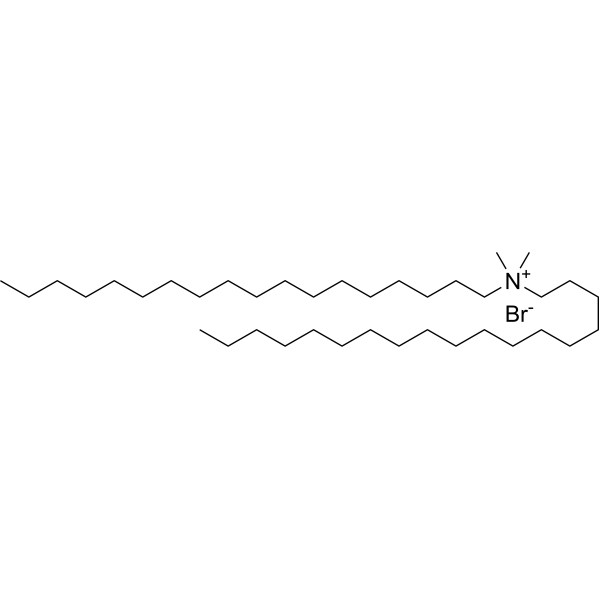
Trehalose-6,6'-dibehenate (250 μg DDA liposomes + 50 μg TDB per dose; subcutaneous injection; 2-3 times; two weeks apart) induced a strong Th-1/Th-17 response in mice immunized with the fusion protein Ag85B-ESAT6, and its adjuvant activity was strictly dependent on Myd88[3].
Trehalose-6,6'-dibehenate (present in DDA liposomes at different molar ratios (6.4-20 mol%); subcutaneous injection; 3 times; two weeks apart) was able to induce a strong and specific Th1-type immune response in female mice immunized with Ag85B-ESAT6, as evidenced by the production of a large amount of interferon-γ cytokine and high levels of IgG2b isotype antibodies[4].
Trehalose-6,6'-dibehenate (10 mg/kg. p.o., once a day, 7 days) activates Mincle in mice[5].
MedChemExpress (MCE) has not independently confirmed the accuracy of these methods. They are for reference only.
-
Animal Model:Female C57BL/6j mice (8-12 weeks old), immunization model with Ag85B-ESAT6 (0.01 mg/ml)[4]
-
Dosage:DDA liposomes with different amounts of Trehalose-6,6'-dibehenate (TDB) (e.g., 250 μg DDA liposomes plus 25, 50 or 100 μg TDB per dose)
-
Administration:Subcutaneous injection at the base of the tails three times, with a 2 - week interval between each immunization
-
Result:Induced a strong, specific Th1-type immune response.
Produced high levels of IFN-γ and low levels of IL-5.
Elevated IgG2b antibody.
Showed an IgG2b/IgG1 ratio characteristic of a Th1 immune response.


Chemical Information
-
CAS No. 66758-35-8
-
Appearance Solid
-
Molecular Weight 987.43
-
Formula C56H106O13
-
Color White to off-white
-
SMILES
CCCCCCCCCCCCCCCCCCCCCC(OC[C@H]([C@H]([C@@H]([C@H]1O)O)O)O[C@@H]1O[C@H]2O[C@@H]([C@H]([C@@H]([C@H]2O)O)O)COC(CCCCCCCCCCCCCCCCCCCCC)=O)=O
-
Shipping
Room temperature in continental US; may vary elsewhere.
-
Storage
Powder -20°C 3 years 4°C 2 years In solvent -80°C 6 months -20°C 1 month


Solvent & Solubility
In Vitro:
DMF : 0.5 mg/mL (0.51 mM; ultrasonic and warming and heat to 60°C)
DMSO : < 1 mg/mL (insoluble or slightly soluble)
In Vivo:
For the following dissolution methods, please prepare the working solution directly:
It is recommended to prepare fresh solutions and use them promptly within a short period of time.
The percentages shown for the solvents indicate their volumetric ratio in the final prepared solution. If precipitation or phase separation occurs during preparation, heat and/or sonication can be used to aid dissolution.
Add each solvent one by one: 15% Cremophor EL 85% Saline
Solubility: 2.5 mg/mL (2.53 mM); Suspended solution; Need ultrasonic

Protocols
-
Apoptosis Solutions
Apoptosis is a regulated, generally non-lytic cell-death pathway that removes unwanted, damaged, infected, or abnormal cells through coordinated morphological changes, caspase activation, DNA fragmentation, and membrane remodeling. The intrinsic apoptosis pathway is controlled mainly by mitochondrial outer membrane permeabilization, BCL-2 family proteins, cytochrome c release, apoptosome formation, caspase-9 activation, and downstream executioner caspase-3/7 activation. The extrinsic apoptosis pathway is initiated by death receptors such as Fas, TNFR, and TRAIL receptors, which recruit adaptor proteins and activate caspase-8 before engaging executioner caspases or mitochondrial amplification through BID cleavage. Apoptosis is linked to many phenotypes, including cancer cell killing, tissue homeostasis, immune regulation, neurodegeneration, infection response, and treatment-induced cytotoxicity; unresolved questions include how apoptosis interacts with necroptosis, pyroptosis, ferroptos
-
Pyroptosis Solutions
Pyroptosis is a lytic inflammatory cell-death pathway executed by gasdermin pores, most classically through inflammasome-mediated activation of caspase-1, cleavage of gasdermin D, membrane pore formation, LDH release, and secretion of IL-1β and IL-18. The canonical pathway is commonly modeled by priming cells with an inflammatory signal such as LPS to induce pro-IL-1β and inflammasome components, followed by an activation signal such as ATP or nigericin to activate NLRP3, ASC speck formation, caspase-1 cleavage, GSDMD cleavage, cytokine release, and pyroptotic membrane rupture. The non-canonical pathway is triggered when cytosolic LPS activates mouse caspase-11 or human caspase-4/5, leading to GSDMD cleavage and pyroptosis, and this can secondarily activate NLRP3-dependent IL-1β release. Pyroptosis is linked to inflammatory injury, infection, cancer, liver disease, ocular disease, placental inflammation, and other disease phenotypes, but unresolved questions include which gasdermin fam


Purity & Documentation
-
Data Sheet (271 KB)
-
SDS (393 KB)
- English - EN (393 KB)
- Français - FR (393 KB)
- Deutsch - DE (393 KB)
- Norwegian - NO (393 KB)
- Español - ES (393 KB)
- Swedish - SV (393 KB)
- Italian - IT (393 KB)
- Korean - KR (393 KB)
- Portuguese - PT (393 KB)
-
Handling Instructions (2659 KB)
References
[1]. Yu H, et, al. Chlamydia muridarum T-cell antigens formulated with the adjuvant DDA/TDB induce immunity against infection that correlates with a high frequency of gamma interferon (IFN-gamma)/tumor necrosis factor alpha and IFN-gamma/interleukin-17 double-positive CD4+ T cells. Infect Immun. 2010 May;78(5):2272-82. [Content Brief]
[2]. Schweneker K, et al. The mycobacterial cord factor adjuvant analogue trehalose-6,6'-dibehenate (TDB) activates the Nlrp3 inflammasome. Immunobiology. 2013 Apr;218(4):664-73. [Content Brief]
[4]. Davidsen J, et al. Characterization of cationic liposomes based on dimethyldioctadecylammonium and synthetic cord factor from M. tuberculosis (trehalose 6,6'-dibehenate)-a novel adjuvant inducing both strong CMI and antibody responses. Biochim Biophys Acta. 2005 Dec 10;1718(1-2):22-31. [Content Brief]

Calculators
Concentration (start) × Volume (start) = Concentration (final) × Volume (final)


Trehalose-6,6'-dibehenate Related Classifications
HY-112137 Related Classifications
 Powered by Bioz