



Dabogratinib

Based on 1 Customer Validation
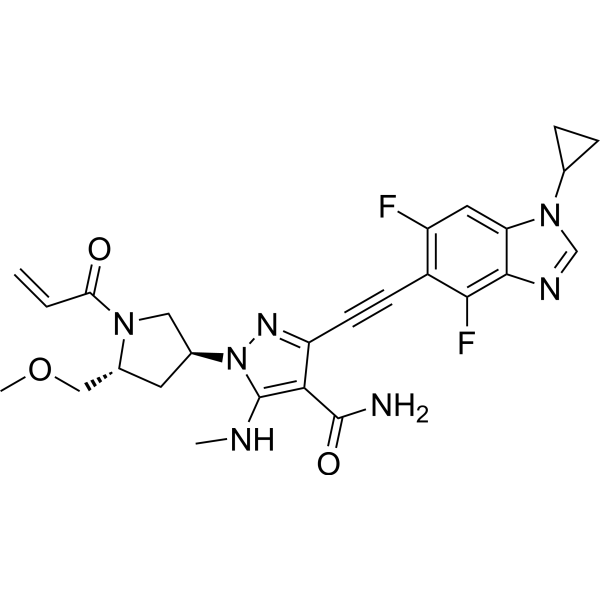
Dabogratinib (TYRA-300) is an orally active, selective FGFR3 inhibitor with an IC50 of 11 nM. Dabogratinib exhibits antitumor activity against urothelial carcinoma and solid tumors. Dabogratinib downregulates the FGFR3 and ERK1/2 signaling pathways, and induces tumor growth inhibition and regression in FGFR3-altered xenograft models. Dabogratinib promotes chondrocyte proliferation and differentiation, drives endochondral bone formation and overall body growth, partially restores long bone proportions, and improves craniofacial and spinal morphology. Dabogratinib can be used for the research of metastatic urothelial carcinoma, achondroplasia and hypochondroplasia.
商品は「研究用試薬」です。人や動物の医療用・臨床診断用・食品用の製品ではありません。
研究用途以外に使用した場合、当社は一切の責任を負いかねます。
- 純度 : 99.90%
- CAS 番号: 2800223-30-5
- 分子式: C25H24Cl2N6O3S
- 分子量:559.47
-
保管条件:Powder -20°C, 3 years , 4°C, 2 years ; In solvent -80°C, 6 months , -20°C, 1 month


To place orders, for customer services and technical support, please contact: MedChemExpress USA
Tel: 609-228-6898 E-mail: [email protected] [email protected]


-
 生物活性
生物活性
-
化学情報
-
溶剤 & 溶解度
- プロトコル
- 純度とドキュメンテーション
- 参考文献
-
 Help & FAQs




生物活性
製品説明
IC50 & Target
[3]|
FGFR3 11 nM (IC50) |
FGFR2 157 nM (IC50) |
FGFR1 278 nM (IC50) |
FGFR4 4045 nM (IC50) |
Cellular Effect
|
Cell Line

|
Type | Value | Description | References |
|---|---|---|---|---|
| DMS-114 | IC50 |
205 nM
Compound: 22
|
Inhibition of cell viability in human DMS-114 cells harboring FGFR1-amplification incubated for 72 to 120 hrs by Cell Titer Glo assay
Inhibition of cell viability in human DMS-114 cells harboring FGFR1-amplification incubated for 72 to 120 hrs by Cell Titer Glo assay
|
[PMID: 39258897] |
| KG-1 | IC50 |
109 nM
Compound: 22
|
Inhibition of cell viability in human KG-1 cells harboring FGFR1-fusion incubated for 72 to 120 hrs by Cell Titer Glo assay
Inhibition of cell viability in human KG-1 cells harboring FGFR1-fusion incubated for 72 to 120 hrs by Cell Titer Glo assay
|
[PMID: 39258897] |
| RT-4 | IC50 |
10 nM
Compound: 22
|
Inhibition of cell viability in human RT-4 cells harboring FGFR3/TACC3 fusion incubated for 72 to 120 hrs by Cell Titer Glo assay
Inhibition of cell viability in human RT-4 cells harboring FGFR3/TACC3 fusion incubated for 72 to 120 hrs by Cell Titer Glo assay
|
[PMID: 39258897] |
体外実験
Dabogratinib (0.046 nM-3 μM; 2 h) induces dose-dependent downregulation of the FGFR3 downstream signaling pathway (assessed by pERK1/2 levels) in RT112/84, RT112/84-V555M and UM-UC-14 bladder cancer cell lines[1].
Dabogratinib inhibits the viability of FGFR3-driven bladder cancer cell lines, with IC50 values of 9 nM for the RT112/84 cell line, 17 nM for the RT112/84-V555M cell line, and 16 nM for the UM-UC-14 cell line[1].
MedChemExpress (MCE) has not independently confirmed the accuracy of these methods. They are for reference only. Further protocols information, click here.
-
Cell Line:RT112/84, RT112/84-V555M, and UM-UC-14 bladder cancer cell lines
-
Concentration:0.046, 0.18, 0.73, 2.9, 12, 47, 188, 750, 3000 nM
-
Incubation Time:2 hours
-
Result:Induced a dose-dependent decrease in pERK1/2 levels in all three cell lines; showed similar dose-response patterns in gatekeeper-mutant RT112/84-V555M cell line as in RT112/84 and UM-UC-14 cell lines harboring only activating alterations.
体内実験
Dabogratinib (12.5 mg/kg; p.o.; twice daily) induces tumor regression in FGFR3::TACC3 fusion urothelial carcinoma xenograft models and FGFR3V555M urothelial carcinoma xenograft models[1].
Dabogratinib (8-14 mg/kg; p.o.; once daily; 4 weeks) dose-dependently increases the growth rate of wild-type mice and promotes their long bone growth in vivo[2].
Dabogratinib (1.2 mg/kg; s.c.; once daily; 15 days) promotes bone growth, improves skeletal proportions, optimizes growth plate structure, and increases the foramen magnum size in the Fgfr3Y367C/+ mouse model of achondroplasia (ACH)[2].
Dabogratinib (1.8 mg/kg; s.c.; once daily; 21 days) increases bone length, enlarges foramen magnum size and improves intervertebral disc morphology in the Fgfr3N534K/+ mouse model of HCH[2].
MedChemExpress (MCE) has not independently confirmed the accuracy of these methods. They are for reference only.
-
Animal Model:athymic nude (nu/nu) (female, 6 to 8 weeks old)[1]
-
Dosage:3, 6 and 9 mg/kg (twice daily); 6, 12 and18 mg/kg (once daily)
-
Administration:p.o.; twice daily; 21 days; p.o.; once daily; 21 days
-
Result:Observed no tumor growth inhibition (TGI) at 3 mg/kg twice daily; Achieved 53% TGI at 6 mg/kg twice daily, 90% TGI at 9 mg/kg twice daily, 46% TGI at 6 mg/kg once daily, 80% TGI at 12 mg/kg once daily, and 96% TGI at 18 mg/kg once daily.
Detected significant tumor volume reduction with 12, 18 mg/kg once daily and 9 mg/kg twice daily compared with vehicle.
Observed more tumor regression with 18 mg/kg once daily than erdafitinib 12.5 mg/kg twice daily.
Recorded no body weight loss in any treatment group.
-
Animal Model:C57BL/6J (female, 4-8 weeks of age)[2]
-
Dosage:8, 10, 12, 14 mg/kg
-
Administration:p.o.; once daily; 4 weeks
-
Result:Increased nasoanal length by 7.3% with 14 mg/kg compared with vehicle; increased tibia length by 3.9% and femur length by 5.0% with 12 mg/kg compared with vehicle. Increased tibia length by 6.4% and femur length by 8.2% with 14 mg/kg compared with vehicle.
Induced significant increases in nasoanal length, tibia length, and femur length with 8 mg/kg and 10 mg/kg compared with vehicle.
-
Animal Model:Tg-CMV^Cre/+ / Fgfr3^Y367C/+ (mixed male and female, 1 day of age, Achondroplasia modeling)[2]
-
Dosage:1.2 mg/kg
-
Administration:s.c.; once daily; 15 days
-
Result:Increased nasoanal length by 17.88%, tail length by 25.10%, and body weight by 52.9% compared with vehicle-treated mutant mice; increased tibia length by 33.01%, femur length by 22.55%, ulna length by 23.51%, and humerus length by 15.52% compared with vehicle. Increased skull length by 10.08%, skull width by 3.74%, skull anteroposterior length by 8.92%, and skull nasio-occipital length by 7.87% compared with vehicle; increased foramen magnum transverse diameter by 13.05%, sagittal diameter by 9.28%, and area by 25.17% compared with vehicle. Improved the grade of skull base synchondroses, increased the size of hypertrophic zone chondrocytes (HZCs), increased proliferation of proliferating zone chondrocytes (PZCs), increased bone mineral density (BMD) by 21.4%, and increased bone volume-to-tissue volume ratio (BV/TV) by 73.3% compared with vehicle; increased L4-L6 lumbar vertebrae segment length by 23.49% compared with vehicle.
-
Animal Model:Tg-CMV^Cre/+ / Fgfr3^N534K/+ (mixed male and female, 3 days of age, Hypochondroplasia modeling)[2]
-
Dosage:1.8 mg/kg
-
Administration:s.c.; once daily; 21 days
-
Result:Increased femur length by 3.70%, tibia length by 3.75%, ulna length by 5.03%, and humerus length by 3.22% compared with vehicle-treated mutant mice.
Increased foramen magnum area by 7.51% and sagittal diameter by 6.35% compared with vehicle; reduced the grade of skull base synchondroses from grade V (completely fused) to grade IV (completely fused with cartilage margin remnants) in most mice and improved intervertebral disc shape compared with vehicle.


化学情報
-
CAS 番号 2800223-30-5
-
性状 Solid
-
分子量 559.47
-
分子式 C25H24Cl2N6O3S
-
Color White to off-white
-
SMILES
O=S(N(C1)CC1(C2)CN2C(N=C3)=CC=C3C4=NNC5=CC=C(O[C@H](C)C6=C(Cl)C=NC=C6Cl)C=C54)(C)=O
-
別名
TYRA-300
-
輸送条件
Room temperature in continental US; may vary elsewhere.
-
保管条件
Powder -20°C 3 years 4°C 2 years In solvent -80°C 6 months -20°C 1 month


溶剤 & 溶解度
体外:
DMSO : 100 mg/mL (178.74 mM; ultrasonic and warming and heat to 60°C; Hygroscopic DMSO has a significant impact on the solubility of product, please use newly opened DMSO)
Please refer to the solubility information to select the appropriate solvent. Once prepared, please aliquot and store the solution to prevent product inactivation from repeated freeze-thaw cycles.
Storage method and period of stock solution: -80°C, 6 months; -20°C, 1 month. When stored at -80°C, please use it within 6 months. When stored at -20°C, please use it within 1 month.
Please refer to the solubility information to select the appropriate solvent. Once prepared, please aliquot and store the solution to prevent product inactivation from repeated freeze-thaw cycles.
Storage method and period of stock solution: -80°C, 6 months; -20°C, 1 month. When stored at -80°C, please use it within 6 months. When stored at -20°C, please use it within 1 month.
濃度 (開始) × 体積 (開始) = 濃度 (終了) × 体積 (終了)
体内:
Select the appropriate dissolution method based on your experimental animal and administration route.
- For the following dissolution methods, please ensure to first prepare a clear stock solution using an In Vitro approach and then sequentially add co-solvents:
- To ensure reliable experimental results, the clarified stock solution can be appropriately stored based on storage conditions. As for the working solution for In Vivo experiments, it is recommended to prepare freshly and use it on the same day.
- The percentages shown for the solvents indicate their volumetric ratio in the final prepared solution. If precipitation or phase separation occurs during preparation, heat and/or sonication can be used to aid dissolution.
Add each solvent one by one: 10% DMSO 40% PEG300 5% Tween-80 45% Saline
Solubility: ≥ 5 mg/mL (8.94 mM); Clear solution
This protocol yields a clear solution of ≥ 5 mg/mL (saturation unknown).
Taking 1 mL working solution as an example, add 100 μL DMSO stock solution (50.0 mg/mL) to 400 μL PEG300, and mix evenly; then add 50 μL Tween-80 and mix evenly; then add 450 μL Saline to adjust the volume to 1 mL.
Preparation of Saline: Dissolve 0.9 g sodium chloride in ddH₂O and dilute to 100 mL to obtain a clear Saline solution.
In Vivo Dissolution Calculator
Please enter the basic information of animal experiments:
-
-
-
-
Recommended: Prepare an additional quantity of animals to account for potential losses during experiments.
Please enter your animal formula composition:
-
%DMSO +
Recommended: Keep the proportion of DMSO in working solution below 2% if your animal is weak.
-
%+
-
+%Tween-80 + +
-
%Saline +
The co-solvents required include: DMSO, . All of co-solvents are available by MedChemExpress (MCE). , Tween 80. All of co-solvents are available by MedChemExpress (MCE).
Working solution concentration: 0.22 mg/mL
Method for preparing stock solution: mg drug dissolved in μL DMSO. Stock solution concentration: mg/mL.
1. Take μL DMSO stock solution;
2. Add μL .
μL , mix evenly;
3. Then add μL Tween 80, mix evenly;
4. Then add μL
Please ensure that the stock solution in the first step is dissolved to a clear state, and add co-solvents in sequence. You can use ultrasonic heating (ultrasonic cleaner, recommended frequency 20-40 kHz), vortexing, etc. to assist dissolution.

プロトコル
-
Patient-Derived Xenograft (PDX)
Patient-derived xenograft (PDX) models are generated by engrafting primary human tumor tissue directly into immunodeficient mice, allowing in vivo propagation of patient tumor biology without initial in vitro adaptation. These models are used to preserve key histopathological and molecular characteristics of the original tumor and enable assessment of tumor growth dynamics and therapeutic response in a living organism. The biological readout is tumor engraftment and subsequent growth in the murine host, which reflects the ability of human tumor cells to survive, vascularize, and expand in an immunocompromised microenvironment.
-
Patient-Derived Orthotopic Xenograft (PDOX)
Patient-derived orthotopic xenograft (PDOX) modeling implants fresh patient tumor tissue or patient-derived tumor cells into the anatomically corresponding organ or tissue site of immunodeficient mice, usually by surgical orthotopic implantation, to preserve patient tumor histology, local microenvironmental context, invasion, metastatic behavior, and treatment-response features better than subcutaneous implantation. PDOX readouts include tumor engraftment, orthotopic tumor growth, local invasion, metastasis, recurrence after resection, histologic similarity to the donor tumor, biomarker retention, molecular concordance, survival, and response or resistance to therapy. PDOX models are used for preclinical drug testing and individualized therapy evaluation, but engraftment success varies by tumor type and specimen quality.
-
Splenic/Portal-Vein Liver Metastasis Xenograft
Splenic and portal-vein liver metastasis xenograft models deliver tumor cells into the portal circulation so that cells reach the liver first and form hepatic metastatic lesions; splenic injection uses the spleen as an access route to the portal system, while direct portal-vein injection introduces cells into the portal vein without requiring splenectomy. The assay detects liver colonization, intrahepatic tumor growth, tumor distribution, treatment response, survival, and liver-metastasis microenvironment changes; readouts include bioluminescence or fluorescence imaging, gross liver nodule counts, liver weight or tumor burden, histology, and survival.
-
Subcutaneous Cell-Line-Derived Xenograft
Subcutaneous cell-line-derived xenograft (CDX) models are established by implanting cultured human cancer cell lines into immunodeficient mice, where the injected cells form localized tumors that can be monitored in vivo as a measure of tumorigenic potential, growth kinetics, and treatment response. These models are widely used in oncology research because they allow reproducible tumor formation and enable comparative assessment of tumor growth between different cell lines or genetic manipulations in a controlled in vivo microenvironment. Subcutaneous implantation of cancer cells in immunodeficient mice is a standard approach for evaluating tumor growth behavior and therapeutic response across multiple cancer types, including prostate, esophageal, pancreatic, and colon cancer models.
-
Orthotopic Cell-Line Xenograft
Orthotopic cell-line xenograft models involve implantation of human cancer cell lines into the anatomically corresponding organ of immunodeficient mice to reproduce tumor growth within a native microenvironment, enabling more clinically relevant tumor behavior compared with subcutaneous models. These models are widely used because orthotopic placement better recapitulates tumor progression, including invasion and metastatic spread, which are often underrepresented in heterotopic implantation systems. Compared with conventional xenografts, orthotopic implantation is described as more technically complex but provides improved simulation of tumor-microenvironment interactions and metastatic behavior, making it particularly valuable for translational oncology research. Surgical orthotopic implantation approaches have been emphasized as enabling faithful reproduction of clinical cancer features, including metastasis and disease progression patterns that align with the tumor’s organ of origi
-
Intraperitoneal/Peritoneal Dissemination Xenograft
Intraperitoneal (IP) or peritoneal dissemination xenograft models are based on the introduction of human cancer cells into the peritoneal cavity of immunodeficient mice, where they attach to peritoneal surfaces, form multicellular aggregates or spheroids, and progressively generate disseminated tumor nodules that mimic advanced peritoneal metastatic disease. These models are widely used to study ovarian cancer progression, tumor-microenvironment interactions, and intraperitoneal therapeutic responses, often incorporating bioluminescence or fluorescence imaging to longitudinally monitor tumor burden in vivo. The biological principle relies on the capacity of tumor cells such as SKOV3 or related ovarian carcinoma lines to survive in suspension, aggregate within ascites-like fluid, adhere to mesothelial surfaces, and invade peritoneal organs, thereby recapitulating human peritoneal carcinomatosis patterns observed in advanced disease.
-
Cell Viability Determination by MTT Colorimetric Assay
The following protocol uses the MTT colorimetric assay as a classic literature-established method for assessing cell viability/metabolic activity in cultured mammalian cells. MTT[3-(4,5-dimethylthiazol-2-yl)-2,5-diphenyltetrazolium bromide] is reduced by metabolically active cells to a colored formazan product; the amount of formazan is quantified spectrophotometrically and provides an indirect measure of metabolically active viable cells. Importantly, MTT reduction reflects cellular oxidoreductase/metabolic activity rather than an absolute direct count of living cells, so changes in cellular metabolism can alter the signal independently of cell number.


純度とドキュメンテーション
-
データシート (284 KB)
-
SDS (254 KB)
- English - EN (254 KB)
- Français - FR (254 KB)
- Deutsch - DE (254 KB)
- Norwegian - NO (254 KB)
- Español - ES (254 KB)
- Swedish - SV (254 KB)
- Italian - IT (254 KB)
- Korean - KR (254 KB)
- Portuguese - PT (254 KB)
-
取扱説明書 (2659 KB)
参考文献
[1]. Starrett JH, et al. Dabogratinib (TYRA-300), an FGFR3 isoform-selective inhibitor: preclinical and initial clinical evidence of anti-tumor activity. Mol Cancer Ther. Published online October 14, 2025. [Content Brief]
[2]. Starrett JH, et al. TYRA-300, an FGFR3-selective inhibitor, promotes bone growth in two FGFR3-driven models of chondrodysplasia. JCI Insight. 2025;10(9):e189307. Published 2025 Apr 3. [Content Brief]


Complete Stock Solution Preparation Table
Please refer to the solubility information to select the appropriate solvent. Once prepared, please aliquot and store the solution to prevent product inactivation from repeated freeze-thaw cycles.
Storage method and period of stock solution: -80°C, 6 months; -20°C, 1 month. When stored at -80°C, please use it within 6 months. When stored at -20°C, please use it within 1 month.
| Optional Solvent | Concentration Solvent Mass | 1 mg | 5 mg | 10 mg | 25 mg |
|---|---|---|---|---|---|
| DMSO | 1 mM | 1.7874 mL | 8.9370 mL | 17.8741 mL | 44.6852 mL |
| 5 mM | 0.3575 mL | 1.7874 mL | 3.5748 mL | 8.9370 mL | |
| 10 mM | 0.1787 mL | 0.8937 mL | 1.7874 mL | 4.4685 mL | |
| 15 mM | 0.1192 mL | 0.5958 mL | 1.1916 mL | 2.9790 mL | |
| 20 mM | 0.0894 mL | 0.4469 mL | 0.8937 mL | 2.2343 mL | |
| 25 mM | 0.0715 mL | 0.3575 mL | 0.7150 mL | 1.7874 mL | |
| 30 mM | 0.0596 mL | 0.2979 mL | 0.5958 mL | 1.4895 mL | |
| 40 mM | 0.0447 mL | 0.2234 mL | 0.4469 mL | 1.1171 mL | |
| 50 mM | 0.0357 mL | 0.1787 mL | 0.3575 mL | 0.8937 mL | |
| 60 mM | 0.0298 mL | 0.1490 mL | 0.2979 mL | 0.7448 mL | |
| 80 mM | 0.0223 mL | 0.1117 mL | 0.2234 mL | 0.5586 mL | |
| 100 mM | 0.0179 mL | 0.0894 mL | 0.1787 mL | 0.4469 mL |


Dabogratinib 関連分類
HY-159642 関連分類
 Powered by Bioz