



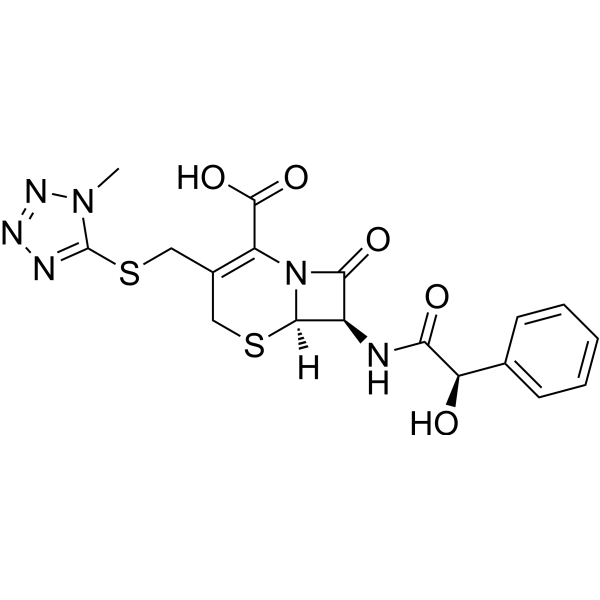
Cefamandole
Cefamandole (Cephamandole sodium) is a β-lactam antibiotic with broad-spectrum antibacterial activity. Cefamandole resists hydrolysis by β-lactamase of some Gram-negative bacteria. Cefamandole binds with high affinity to major penicillin-binding proteins (PBP) and with low affinity to PBP 2a, induces the production of low-affinity PBP associated with Methicillin (HY-121544) resistance, and blocks peptidoglycan biosynthesis through the SecA subunit of PBP. Cefamandole can be used in research related to bacterial infections.
For research use only. We do not sell to patients.
- CAS No.: 34444-01-4
- Formula: C18H18N6O5S2
- Molecular Weight:462.50
-
Storage:
Please store the product under the recommended conditions in the Certificate of Analysis.

To place orders, for customer services and technical support, please contact: MedChemExpress USA
Tel: 609-228-6898 E-mail: [email protected] [email protected]


-
 Biological Activity
-
Chemical Information
- Protocols
- Purity & Documentation
- References
-
 Help & FAQs




Biological Activity
Description
|
β-lactam |
PBP |
Cellular Effect
|
Cell Line

|
Type | Value | Description | References |
|---|---|---|---|---|
| S2 | IC50 |
450 μM
Compound: Cefamandole
|
TP_TRANSPORTER: inhibition of PAH uptake in OAT1-expressing S2 cells
TP_TRANSPORTER: inhibition of PAH uptake in OAT1-expressing S2 cells
|
[PMID: 12005172] |
| S2 | IC50 |
90 μM
Compound: Cefamandole
|
TP_TRANSPORTER: inhibition of Estrone sulfate uptake in OAT3-expressing S2 cells
TP_TRANSPORTER: inhibition of Estrone sulfate uptake in OAT3-expressing S2 cells
|
[PMID: 12005172] |
In Vitro
Cefamandole (0.12-64 μg/mL; 18 h) inhibits 90%-100% of Methicillin (HY-121544)-sensitive Staphylococcus aureus, group A and group B streptococci, Streptococcus pneumoniae, Neisseria gonorrhoeae, Haemophilus influenzae, and Salmonella typhi[3].
MedChemExpress (MCE) has not independently confirmed the accuracy of these methods. They are for reference only.
-
Cell Line:Methicillin-susceptible S. aureus, group A and B streptococci, S. pneumoniae, N. gonorrhoeae, H. influenzae, and S. typhosa
-
Concentration:Cefamandole:
0.12, 0.25, 0.5, 1, 2, 4, 8, 16, 32, 16 μg/mL -
Incubation Time:18 h
-
Result:Inhibited 90-100% of methicillin-susceptible S. aureus, group A and B streptococci, S. pneumoniae, N. gonorrhoeae, H. influenzae, and S. typhosa at concentrations of 2 μg/mL or less, with variable activity against gram-negative rods including 70% of E. coli inhibited at 4 μg/mL and 80% of B. fragilis subsp. fragilis inhibited at 32 μg/mL.
In Vivo
MedChemExpress (MCE) has not independently confirmed the accuracy of these methods. They are for reference only.
-
Animal Model:New Zealand White (2 kg)[6]
-
Dosage:100 mg/kg
-
Administration:i.v.; every 4 h; six doses total (first dose 30 min before inoculation)
-
Result:Resulted in infection in 9/29 (31%) rabbits infected with strain 220, 10/16 (63%) rabbits infected with strain 313, and 0/11 (0%) rabbits infected with strain W-05386.
In early-infection groups, rabbits had 70 CFU (n = 4) on the aortic valve for strain 313 and 54 CFU (n = 4) for strain W-05386 at 1.5 h after inoculation.


Chemical Information
-
CAS No. 34444-01-4
-
Molecular Weight 462.50
-
Formula C18H18N6O5S2
-
SMILES
O=C(C(N12)=C(CSC3=NN=NN3C)CS[C@]2([H])[C@H](NC([C@H](O)C4=CC=CC=C4)=O)C1=O)O
-
Synonyms
Cephamandole
-
Shipping
Room temperature in continental US; may vary elsewhere.
-
Storage
Please store the product under the recommended conditions in the Certificate of Analysis.


Purity & Documentation
References
[1]. Neu HC, et al. Cefamandole, a cephalosporin antibiotic with an unusually wide spectrum of activity. Antimicrob Agents Chemother. 1974;6(2):177-182. [Content Brief]
[2]. Eykyn S, et al. Antibacterial activity of cefamandole, a new cephalosporin antibiotic, compared with that of cephaloridine, cephalothin, and cephalexin. Antimicrob Agents Chemother. 1973;3(6):657-661. [Content Brief]
[3]. Griffith RS, et al. Cefamandole: in vitro and clinical pharmacokinetics. Antimicrob Agents Chemother. 1976;10(5):814-823. [Content Brief]
[4]. Lee FH, et al. Comparative tissue distribution of ceforanide, cefazolin, and cefamandole in rats. Antimicrob Agents Chemother. 1981;19(4):625-627. [Content Brief]
[5]. Yeh PH, et al. Determination of unbound cefamandole in rat blood by microdialysis and microbore liquid chromatography. Biomed Chromatogr. 2001;15(1):14-17. [Content Brief]
[6]. Chambers HF. Coagulase-negative staphylococci resistant to beta-lactam antibiotics in vivo produce penicillin-binding protein 2a. Antimicrob Agents Chemother. 1987 Dec;31(12):1919-24. [Content Brief]
[7]. Yotsuji A, et al. Mechanism of action of cephalosporins and resistance caused by decreased affinity for penicillin-binding proteins in Bacteroides fragilis. Antimicrob Agents Chemother. 1988 Dec;32(12):1848-53. [Content Brief]
[9]. Pothineni VR, et al. In vitro and in vivo evaluation of cephalosporins for the treatment of Lyme disease. Drug Des Devel Ther. 2018 Sep 11;12:2915-2921. [Content Brief]

Calculators
Concentration (start) × Volume (start) = Concentration (final) × Volume (final)


Cefamandole Related Classifications
HY-B1128 Related Classifications
 Powered by Bioz
Keywords
- Cefamandole
- 34444-01-4
- Cephamandole
- Antibiotic
- Bacterial
- Penicillin-binding protein (PBP)
- Beta-lactamase
- Lyme disease
- antibacterial activity
- bacterial infection
- beta-lactam antibiotic
- endocarditis
- gram-negative bacteria
- gram-positive bacteria
- methicillin resistance
- penicillin-binding proteins
- peptidoglycan biosynthesis
- Inhibitor
- inhibitor
- inhibit