Infection
-
Infection Related Products (18904)
Related Products (18904)

-
Antibodies (22)
-
Miromavimab
 0 ImagesCat. No.: HY-P99739CAS No.: 2247163-73-9Synonyms: M777-16-3
Miromavimab (M777-16-3) is a anti-rabies virus strain ERAGP ectodomainepitope G-II mAb.
-
(Rac)-Lateritin
 0 ImagesCat. No.: HY-121407ACAS No.: 2180287-51-6
(Rac)-Lateritin is an acyl-CoA:cholesterol acyltransferase (ACAT/SOAT) inhibitor, with IC50 values of 5.7 μM and 5.6 μM in rat liver, respectively. (Rac)-Lateritin exerts time-dependent irreversible enzyme inhibition that persists even after microsomal washing. (Rac)-Lateritin inhibits cholesterol ester formation in macrophages without altering triglyceride synthesis or other steps in oxidized low-density lipoprotein metabolism. (Rac)-Lateritin inhibits the growth of cancer cells, Gram-positive bacteria, and Candida albicans. (Rac)-Lateritin can be used in studies related to atherosclerosis, human solid tumors, mouse lymphocytic leukemia, as well as fungal and bacterial infections.
-
Anti-virus agent 2
 0 ImagesCat. No.: HY-183592
Anti-virus agent 2 is an orally active and selective anti-orthopoxvirus (poxvirus) agent, with EC50 values of 6.1 μM and 47.1 μM against VTT-Fluc and MPXV clade IIb, respectively. Anti-virus agent 2 covalently binds to viral A17L protein and mRNA methyltransferase, blocks viral membrane fusion and intracellular biosynthesis, and acts on multiple stages of the viral replication cycle. Anti-virus agent 2 achieves viral inhibition in nude mouse models. Anti-virus agent 2 can be used for the research of orthopoxvirus infections such as monkeypox and smallpox.
-
7-Hydroxytropolone
 0 ImagesCat. No.: HY-W983893CAS No.: 34777-04-3Synonyms: 3-Hydroxytropolone
7-Hydroxytropolone (3-Hydroxytropolone) is an antibiotic with anti-Gram-positive bacteria, negative bacteria, yeast and fungi activity, and has the effect of inhibiting 2''-O-Adenylyltransferase.
-
1,3,4-Thiadiazol-2-amine
 0 ImagesCat. No.: HY-W018798CAS No.: 4005-51-0
1,3,4-Thiadiazol-2-amine is a 1,3,4-thiadiazole antitumor agent with the potential to penetrate the blood-brain barrier. 1,3,4-Thiadiazol-2-amine can induce hyperuricemia, and this effect is blocked by Nicotinamide (HY-B0150). 1,3,4-Thiadiazol-2-amine supports the simultaneous administration of Allopurinol (HY-B0219), and their combined use prevents hyperuricemia without reducing antitumor activity.\n1,3,4-Thiadiazol-2-amine is a condensation precursor for the synthesis of antibacterial Schiff bases and their Co/Cu/Ni/Zn (II) complexes. 1,3,4-Thiadiazol-2-amine is used in research related to tumors and bacterial infections.
-
Quabodepistat-d7
 0 ImagesCat. No.: HY-134940SSynonyms: OPC-167832-d7
Quabodepistat-d7 (OPC-167832-d7) is deuterium labeled Quabodepistat. Quabodepistat (OPC-167832) is a potent and orally active dprE1 inhibitor with?an IC50 of 0.258 μM. Quabodepistat has antituberculosis activity and can be used for the research of tuberculosis?caused by?Mycobacterium tuberculosis.
-
MFB-1041
 0 ImagesCat. No.: HY-125694CAS No.: 151856-47-2
MFB-1041 is an orally active antifungal agent, but exhibits poor oral absorption. MFB-1041 induces the binding of drug to serum albumin.
-
Aminoacyl tRNA synthetase-IN-3
 0 ImagesCat. No.: HY-161800
Aminoacyl tRNA synthetase-IN-3 (compound 36K3) is an inhibitor of lysine tRNA synthetase (PfLysRS) from Plasmodium falciparum (IC50=59.2 nM), which inhibits the activity of PfLysRS by occupying the ATP binding site and L-lysine binding site of PfLysRS. Aminoacyl tRNA synthetase-IN-3 can be used in the development of antimalarial drugs.
-
K11002 hydrobromide
 0 ImagesCat. No.: HY-183387CAS No.: 1348565-08-1
K11002 hydrobromide is a cysteine protease inhibitor. K11002 hydrobromide forms a covalent bond with the active site cysteine residue via Michael addition. K11002 hydrobromide inhibits the growth of Trypanosoma brucei. K11002 hydrobromide can be used in the research of African human trypanosomiasis (sleeping sickness).
-
Pneumocandin A1
 0 ImagesCat. No.: HY-N14464CAS No.: 135862-90-7
Pneumocandin A1 is a lipopeptide antibiotic. Pneumocandin A1 has a strong anti-Candida effect. Pneumocandin A1 has the effect of inhibiting the synthesis of 1,3 early-glucan in vitro, with an IC50 of 0.07-0.5 μg/mL.
-
Periglaucine A
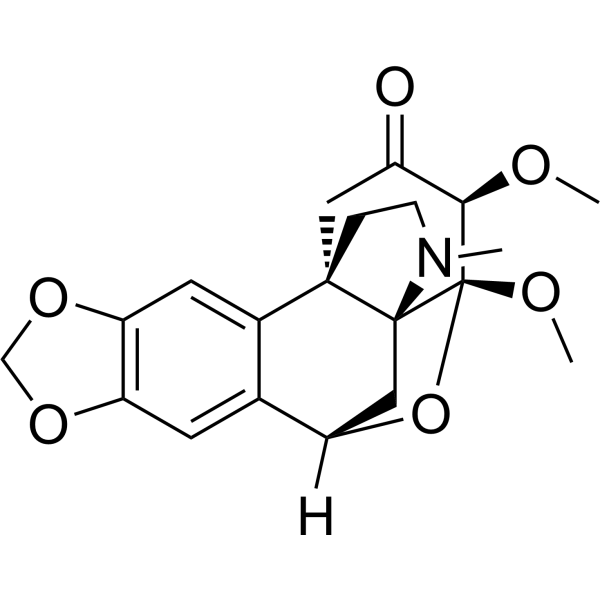 0 ImagesCat. No.: HY-N3094CAS No.: 1025023-04-4
Periglaucine A, a hasubanane-type alkaloid, can be isolated from Pericampylus glaucus. Periglaucine A can inhibits HBV surface antigen (HBsAg) secretion in Hep G2.2.15 cells. Periglaucine A also shows anti-HIV-1 activity in C8166 cells (EC50: 204 μM).
-
Antileishmanial agent-43
 0 ImagesCat. No.: HY-183621
Antileishmanial agent-43 is a 3,4,5‑trisubstituted isoxazole with selective antileishmanial activity. Antileishmanial agent-43 shows IC50 values of 12.7 μM against Leishmania amazonensis promastigotes and 0.96 μM against intracellular amastigotes. Antileishmanial agent-43 induces ROS elevation, oxidative stress and mitochondrial dysfunction, resulting in lipid peroxidation, mitochondrial depolarization and ATP imbalance. Antileishmanial agent-43 causes cell shrinkage, phosphatidylserine externalization, plasma membrane permeabilization, and promotes autophagy. Antileishmanial agent-43 can be used for the research of leishmaniasis.
-
Oryzalin (Standard)
 0 Images
Oryzalin (Standard) is the analytical standard of Oryzalin (HY-147092). This product is intended for research and analytical applications. Oryzalin is a dinitroaniline herbicide with antimitotic and antileishmanial activities. Oryzalin can bind to plant tubulin, inhibit the polymerization of microtubules in plant cells, and affect chromosome migration. Oryzalin can also be used to induce chromosome doubling.
-
Liriodenine methiodide
 0 ImagesCat. No.: HY-N7784CAS No.: 55974-07-7
Liriodenine methiodide is an antibiotic that is active against C. albicans and S. cereuisiae with antimicrobial activities.
-
rel-Avibactam
 0 ImagesCat. No.: HY-187660CAS No.: 396731-14-9Synonyms: rel-NXL-104 free acid; rel-AVE1330A free acid
rel-Avibactam (rel-NXL-104 free acid) is an isomer of Avibactam (HY-14879). Avibactam is a β-lactamase inhibitor with an IC50 of 8 nM against TEM-1 β-lactamase and an IC50 of 80 nM against P99 β-lactamase. Avibactam exhibits no significant intrinsic antibacterial activity when used alone. Avibactam restores the activity of Ceftazidime (HY-B0593) against β-lactamase-producing Enterobacteriaceae and Pseudomonas aeruginosa. Avibactam does not enhance the activity of Ceftazidime against Acinetobacter spp., Burkholderia spp., or most anaerobic Gram-negative bacilli. Avibactam is used in research related to Gram-negative bacterial infections.
-
Neothramycin A
 0 ImagesCat. No.: HY-129331CAS No.: 59593-16-7
Neothramycin A is an antibiotic, which can be isolated from Streptomyces. Neothramycin A exhibits board spectrum antimicrobial activity, inhibits Staphylococcus aureus, Klebsiella pneumoniae, Escherichia coli W677, and Saccharomyces cerevisia with MIC of 25-50 μg/mL. Neothramycin A exhibits antitumor efficacy against leukemia in mouse models.
-
A 33903
 0 ImagesCat. No.: HY-108002CAS No.: 70890-53-8
A 33903 is a respiratory syncytial virus (RSV) replication inhibitor. A 33903 can be used for the research of RSV-infection.
-
VCC234718
 0 ImagesCat. No.: HY-118061CAS No.: 1278553-16-4
VCC234718 is a molecule with mycobacterial growth inhibitory activity, specifically targeting Mycobacterium tuberculosis (Mtb). The primary molecular target of VCC234718 is inosine monophosphate dehydrogenase (GuaB2), and it inhibits the growth of Mtb by affecting the function of this enzyme. VCC234718 inhibits GuaB2 with a K value of 100 nM and exhibits non-competitive inhibition with IMP and NAD+. VCC234718 exerts its inhibitory effect by directly interacting with IMP and binding at the NAD+ site.
-
Triticonazole
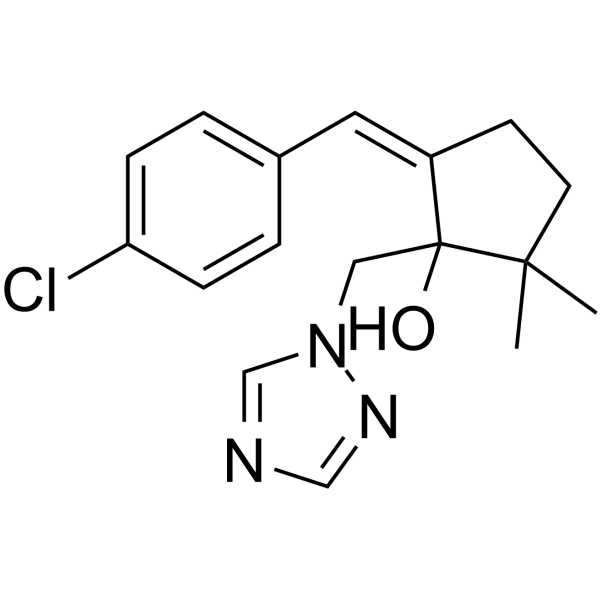 0 ImagesCat. No.: HY-B2058CAS No.: 131983-72-7
Triticonazole is an orally active triazole fungicide and androgen receptor antagonist. Triticonazole inhibits testosterone-induced androgen receptor activation and reduces basal testosterone secretion. Prenatal exposure to Triticonazole causes shortened anogenital distance in male rat fetuses and induces organ-specific histopathological changes in pigs. Triticonazole can be used for detoxification of seeds contaminated with fungal pathogens, but there is a risk of animal poisoning if the treated seeds are used as animal feed.
-
Tigolaner (Standard)
 0 ImagesCat. No.: HY-109077RCAS No.: 1621436-41-6Synonyms: BAY-1272858 (Standard)