



Aryl Hydrocarbon Receptor
AhR
Aryl Hydrocarbon Receptor (AhR or AHR) is a cytoplasmic receptor and transcription factor that belongs to the family of basic helix-loop-helix transcription factors. The AhR is activated or inhibited by various types of exogenous and endogenous ligands. AhR is an important factor in immunity and tissue homeostasis, and structurally diverse compounds from the environment, diet, microbiome, and host metabolism can induce AhR activity, such as 2,3,7,8-tetrachlorodibenzo-p-dioxin (TCDD).
Endogenous ligands include indigoids, heme metabolites, eicosanoids, tryptophan derivatives, and equilenin. Exogenous ligands include polycyclic aromatic hydrocarbons, polychlorinated biphenyls, natural compounds, and small molecule compounds. The different structures and properties of AhR ligands mean that when they combine with AhR they have distinct biological effects.
Unliganded AHR is sequestered in the cytoplasm by chaperone proteins including Hsp90, AHR-interacting protein (AIP), and p23. Upon ligand binding, AHR translocates to the nucleus and heterodimerizes with ARNT. The AHR-ARNT complex regulates transcription by binding with high affinity to specific DNA sequences termed aryl hydrocarbon response elements located in the regulatory regions of target genes including CYP1A1, CYP1B1, and TIPARP.
All Product Categories
-
Aryl Hydrocarbon Receptor Inhibitors
(18)
View all products
-
Aryl Hydrocarbon Receptor Agonists
(61)
View all products
-
Aryl Hydrocarbon Receptor Antagonists
(35)
View all products
-
Aryl Hydrocarbon Receptor Activators
(40)
View all products
-
Aryl Hydrocarbon Receptor Modulators
(12)
View all products
-
Aryl Hydrocarbon Receptor Controls
(5)
View all products
-
Aryl Hydrocarbon Receptor Ligands
(11)
View all products
-
Aryl Hydrocarbon Receptor Related Products (202)
Related Products (202)

-
Antibodies (1)
-
Cyprodinil-d5
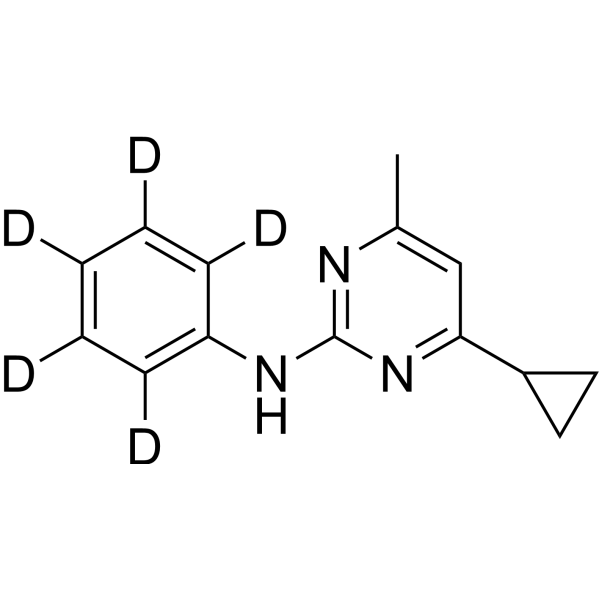 0 ImagesCat. No.: HY-116214SCAS No.: 1773496-67-5Synonyms: CGA-219417-d5Cyprodinil-d5(CGA-219417-d5) is the deuterium labeled Cyprodinil (HY-116214). Cyprodinil (CGA-219417) is a broad-spectrum anilinopyrimidine fungicide and an activator of the aryl hydrocarbon receptor. Cyprodinil also has anti-androgenic and androgenic activities. Cyprodinil can inhibit the biosynthesis of methionine in plant-pathogenic fungi and protect fruits and vegetables from a variety of pathogens.
-
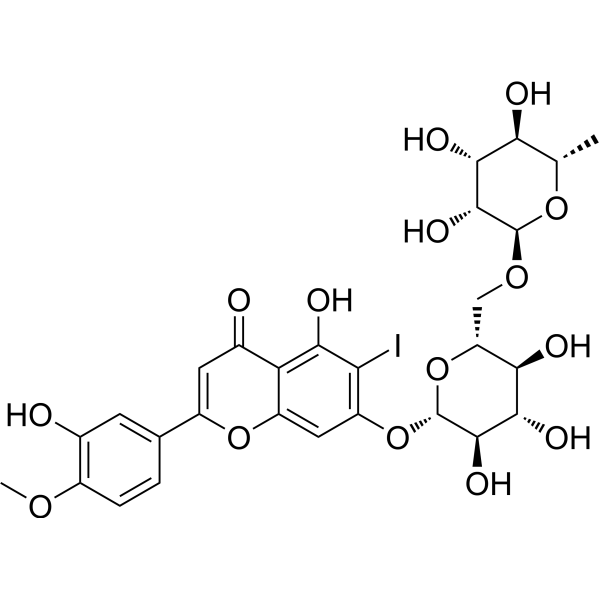
AhR agonist 7
 0 ImagesCat. No.: HY-158169CAS No.: 3033281-98-7AhR agonist 7 (Compound 8) has a good activation activity against AhR (ECsub>50 = 13nM).
-
L-Kynurenine sulfate
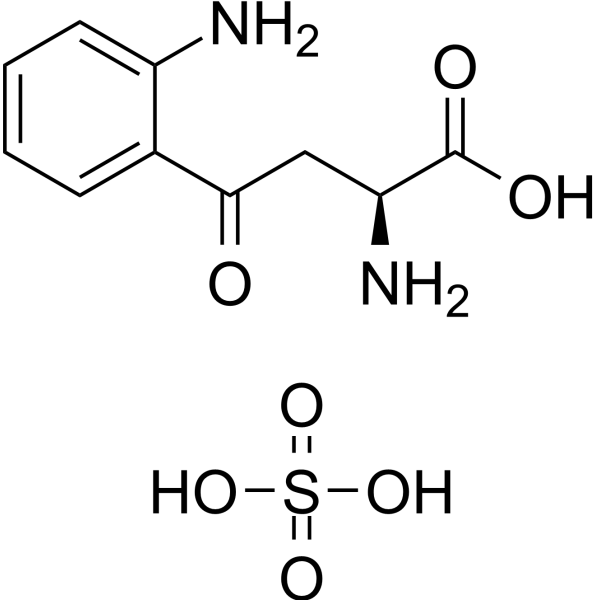 0 ImagesL-Kynurenine sulfate, an aryl hydrocarbon receptor (AHR) agonist that activates AHR-directed, naive T cell polarization to the anti-inflammatory Treg phenotype.
-
Omeprazole sulfone-13C,d3
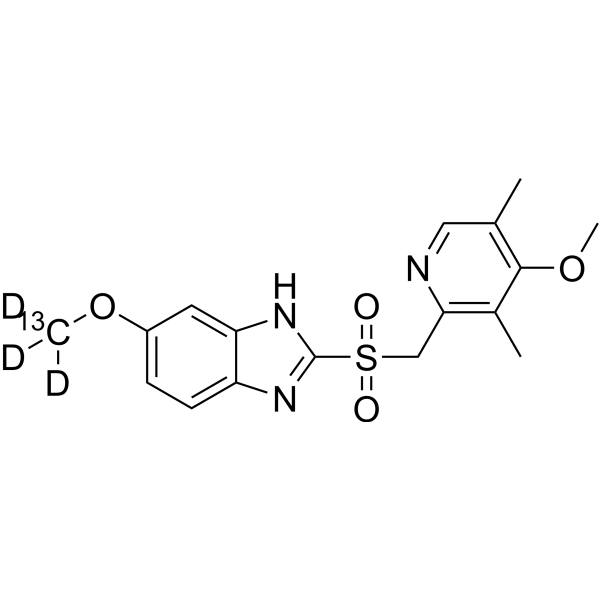 0 ImagesCat. No.: HY-G0007S1CAS No.: 1261393-28-5Synonyms: Omeprazole sulfone-13C,d3; Omeprazole sulphone-13C,d3Omeprazole sulfone-13C,d3 is the deuterium and 13C labeled Omeprazole sulfone. Omeprazole sulfone (Omeprazole sulphone) is one of the major circulating metabolites of Omeprazole (HY-B0113) in vivo, and belongs to class 4 non-mutagenic impurities. Omeprazole sulfone does not bind to the aryl hydrocarbon receptor (AhR), nor does it induce the expression of CYP1A1 or CYP1A2. However, Omeprazole sulfone promotes the migration of gastric epithelial cells under basal conditions and reverses the inhibitory effect of Indomethacin (HY-14397) on cell migration. Omeprazole sulfone does not promote cell proliferation, nor does it upregulate COX-2 expression or activate signaling pathways such as ERK, P38 MAPK and PI3K. Omeprazole sulfone maintains basal ulcer healing under non-acid-dependent conditions and can be used in studies related to gastric ulcer repair.
-
1-Hydroxypyrene (Standard)
 0 Images1-Hydroxypyrene (Standard) is the analytical standard of 1-Hydroxypyrene (HY-W014075). This product is intended for research and analytical applications. 1-Hydroxypyrene, a biomarker of exposure to polycyclic aromatic hydrocarbons (PAHs), is analyzed in urine samples. 1-Hydroxypyrene is the major biomarker of exposure to pyrenes. 1-Hydroxypyrene is the orally active agonist for aryl hydrocarbon receptor (AhR) and can lead to renal fibrosis.
-
L-Kynurenine-d4-1
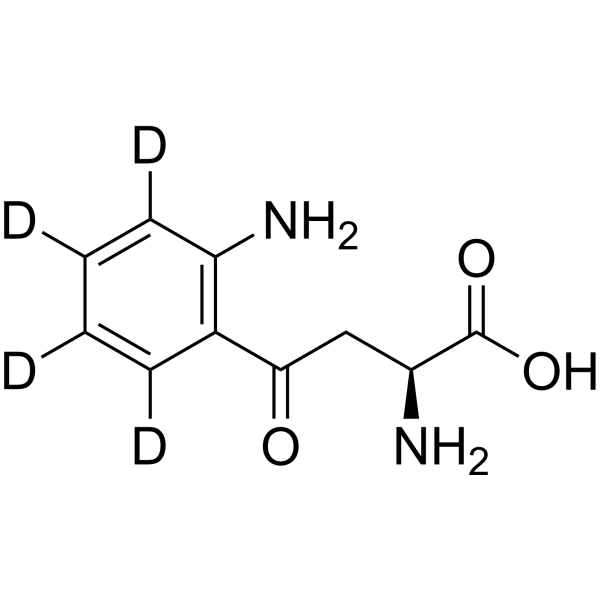 0 ImagesL-Kynurenine-d4-1 is deuterium labeled L-Kynurenine. L-Kynurenine is a metabolite of the amino acid L-tryptophan. L-Kynurenine is an aryl hydrocarbon receptor agonist.
-
AhR/PDE4 modulator-1
 0 ImagesCat. No.: HY-189218AhR/PDE4 modulator-1 is a AhR/PDE4D dual-target modulator, with an AhR agonistic EC50 of 0.11 μM and a PDE4D inhibitory IC50 of 2.12 μM. AhR/PDE4 modulator-1 activates the AhR-CYP1A1 signaling pathway, promotes AhR nuclear translocation, and upregulates downstream CYP1A1; it inhibits PDE4D activity, elevates intracellular cAMP levels, and activates the downstream cAMP-PKA-CREB signaling pathway. Topical administration of AhR/PDE4 modulator-1 exerts anti-inflammatory effects in the Imiquimod (HY-B0180)-induced psoriasis-like mouse model, alleviates epidermal hyperplasia and inflammatory infiltration, and suppresses the expression of IL-17A/F. AhR/PDE4 modulator-1 can be used in research related to psoriasis.
-
Aminoflavone
 0 ImagesCat. No.: HY-132974CAS No.: 165179-35-1Synonyms: NSC-686288Aminoflavone is an anti-tumor agent. Aminoflavone inhibits the expression of ITGA6/SOX2 by activating the AhR-miR-125b-2-3p axis, thereby targeting breast cancer stem cells. Aminoflavone induces an increase in intracellular ROS, increases the level of oxidative DNA damage marker 8-oxodG and DNA-protein cross-links. Aminoflavone causes S-phase arrest, activates caspase-3/8/9 and induces apoptosis (apoptosis). Aminoflavone inhibits HIF-1α expression in a manner independent of AhR. Aminoflavone can be used for the study of breast cancer.
-
Omeprazole sulfone (Standard)
 0 ImagesCat. No.: HY-G0007RCAS No.: 88546-55-8Synonyms: Omeprazole sulphone (Standard)Omeprazole sulfone (Standard) is the analytical standard of Omeprazole sulfone. This product is intended for research and analytical applications. Omeprazole sulfone (Omeprazole sulphone) is one of the major circulating metabolites of Omeprazole (HY-B0113) in vivo, and belongs to class 4 non-mutagenic impurities. Omeprazole sulfone does not bind to the aryl hydrocarbon receptor (AhR), nor does it induce the expression of CYP1A1 or CYP1A2. However, Omeprazole sulfone promotes the migration of gastric epithelial cells under basal conditions and reverses the inhibitory effect of Indomethacin (HY-14397) on cell migration. Omeprazole sulfone does not promote cell proliferation, nor does it upregulate COX-2 expression or activate signaling pathways such as ERK, P38 MAPK and PI3K. Omeprazole sulfone maintains basal ulcer healing under non-acid-dependent conditions and can be used in studies related to gastric ulcer repair.
-
2,3-Dichlorodibenzofuran
 0 ImagesCat. No.: HY-184857CAS No.: 64126-86-92,3-Dichlorodibenzofuran (Compound 29; R: 2,3-Cl2) is an aryl hydrocarbon receptor (Ah receptor) ligand, with a pEC50 value of 5.326.
-
2-Hydroxy nevirapine-d3
 0 ImagesCat. No.: HY-132460SCAS No.: 1329834-05-02-Hydroxy nevirapine-d3 (2-OH NVP-d3) is the deuterated-labeled 2-Hydroxy nevirapine (2-OH NVP) (HY-W739986). 2-Hydroxy nevirapine (2-OH NVP) is a phase I metabolite of Nevirapine (HY-10570) and an Aryl Hydrocarbon Receptor activator. It induces hepatic Apolipoprotein A1 levels and modulates paraoxonase-1 enzyme activity. 2-Hydroxy nevirapine is used in research on atherosclerosis and HIV-1 infection.
-
S101
 0 ImagesCat. No.: HY-165526CAS No.: 362508-67-6S101 is an inhibitor of SLP-76 and AhR. By inhibiting SLP-76 phosphorylation, S101 blocks the TCR signaling pathway and prevents AhR nuclear translocation, thereby selectively suppressing the proliferation of activated T cells, inducing their apoptosis, and reducing TNF-α levels. S101 can be used in studies of graft rejection, psoriasis, and superantigen-induced toxic shock.
-
1,2,3,4,7,8,9-Heptachlorodibenzofuran
 0 ImagesCat. No.: HY-W517092CAS No.: 55673-89-7Synonyms: 1,2,3,4,7,8,9-HpCDF1,2,3,4,7,8,9-Heptachlorodibenzofuran (1,2,3,4,7,8,9-HpCDF) is a compound that induces the expression of CYP1A1 and CYP1B1 genes in human peripheral blood lymphocytes, while also promoting the expression of the aryl hydrocarbon receptor repressor (AhRR). 1,2,3,4,7,8,9-Heptachlorodibenzofuran can increase ethoxyresorufin-O-deethylase (EROD) activity in isolated human peripheral blood lymphocytes in a concentration-dependent manner, which serves as a marker of CYP1A1 activity. Furthermore, 1,2,3,4,7,8,9-Heptachlorodibenzofuran exhibits immunosuppressive effects by reducing the number of splenic plaque-forming cells in mice and increasing aryl hydrocarbon hydroxylase (AHH) activity in liver microsomes of mice injected with sheep red blood cells. 1,2,3,4,7,8,9-Heptachlorodibenzofuran can be used in research in the fields of immunology, metabolic diseases, and environmental toxicology.
-
1,2,3,4,7,8-Hexachlorodibenzofuran
 0 ImagesCat. No.: HY-W775354CAS No.: 70648-26-9Synonyms: 1,2,3,4,7,8-HxCDF1,2,3,4,7,8-Hexachlorodibenzofuran (1,2,3,4,7,8-HxCDF) promotes the gene expressions of CYP1A1, CYP1B1, and aryl hydrocarbon receptor repressor (AhRR) in human peripheral blood lymphocytes (PBLs). 1,2,3,4,7,8-Hexachlorodibenzofuran activates the ethoxyresorufin-Odeethylase, achieves 20% of the maximum response caused by TCDD with a BMR20TCDD of 0.115-0.143 nM.
-
26-Deoxyactein (Standard)
 0 ImagesCat. No.: HY-N6264RCAS No.: 264624-38-626-Deoxyactein (Standard) is the analytical standard of 26-Deoxyactein. This product is intended for research and analytical applications. 26-Deoxyactein is a constituent isolated from Cimicifuga racemosa, prevents TCDD-induced osteoblasts damage. 26-Deoxyactein inhibits increased AhR, CYP1A1 and ERK levels.
-
Carbidopa (Standard)
 0 ImagesCat. No.: HY-B0311RCAS No.: 28860-95-9Synonyms: (S)-(-)-Carbidopa (Standard)Carbidopa (Standard) is the analytical standard of Carbidopa. This product is intended for research and analytical applications. Carbidopa ((S)-(-)-Carbidopa), a peripheral decarboxylase inhibitor, can be used for the research of Parkinson's disease. Carbidopa is a selective aryl hydrocarbon receptor (AhR) modulator. Carbidopa inhibits pancreatic cancer cell and tumor growth.
-
Mivotilate (Standard)
 0 ImagesSynonyms: YH439 (Standard)Mivotilate (Standard) is the analytical standard of Mivotilate. This product is intended for research and analytical applications. Mivotilate is a nontoxic, potent activator of the aryl hydrocarbon receptor (AhR), and acts as a hepatoprotective agent.
-
AHR antagonist 8
 0 ImagesCat. No.: HY-163665CAS No.: 3052113-26-2AHR antagonist 8 (compound SG-02) is a regulator of utrophin, a homolog of dystrophin, and an AhR antagonist (Kd: 41.68 nM). Studies have shown that 800 nM of AHR antagonist 8 can upregulate utrophin by 2.7 times. AHR antagonist 8 also stimulates increased MyHC expression, suggesting that it has the potential to enhance myogenesis. After ADME evaluation, AHR antagonist 8 also has a certain oral bioavailability.
-
Tapinarof (Standard)
 0 ImagesSynonyms: WBI-1001 (Standard); Benvitimod (Standard); GSK2894512 (Standard)Tapinarof (Standard) is the analytical standard of Tapinarof. This product is intended for research and analytical applications. Tapinarof (WBI-1001) is a natural aryl hydrocarbon receptor (AhR) agonist with an EC50 of 13 nM. Tapinarof resolves skin inflammation in mice.




