



Aryl Hydrocarbon Receptor
AhR
Aryl Hydrocarbon Receptor (AhR or AHR) is a cytoplasmic receptor and transcription factor that belongs to the family of basic helix-loop-helix transcription factors. The AhR is activated or inhibited by various types of exogenous and endogenous ligands. AhR is an important factor in immunity and tissue homeostasis, and structurally diverse compounds from the environment, diet, microbiome, and host metabolism can induce AhR activity, such as 2,3,7,8-tetrachlorodibenzo-p-dioxin (TCDD).
Endogenous ligands include indigoids, heme metabolites, eicosanoids, tryptophan derivatives, and equilenin. Exogenous ligands include polycyclic aromatic hydrocarbons, polychlorinated biphenyls, natural compounds, and small molecule compounds. The different structures and properties of AhR ligands mean that when they combine with AhR they have distinct biological effects.
Unliganded AHR is sequestered in the cytoplasm by chaperone proteins including Hsp90, AHR-interacting protein (AIP), and p23. Upon ligand binding, AHR translocates to the nucleus and heterodimerizes with ARNT. The AHR-ARNT complex regulates transcription by binding with high affinity to specific DNA sequences termed aryl hydrocarbon response elements located in the regulatory regions of target genes including CYP1A1, CYP1B1, and TIPARP.
All Product Categories
-
Aryl Hydrocarbon Receptor Inhibitors
(18)
View all products
-
Aryl Hydrocarbon Receptor Agonists
(61)
View all products
-
Aryl Hydrocarbon Receptor Antagonists
(35)
View all products
-
Aryl Hydrocarbon Receptor Activators
(40)
View all products
-
Aryl Hydrocarbon Receptor Modulators
(12)
View all products
-
Aryl Hydrocarbon Receptor Controls
(5)
View all products
-
Aryl Hydrocarbon Receptor Ligands
(11)
View all products
-
Aryl Hydrocarbon Receptor Related Products (202)
Related Products (202)

-
Antibodies (1)
-
6,2',4'-Trimethoxyflavone (Standard)
 0 ImagesCat. No.: HY-103220RCAS No.: 720675-74-16,2',4'-Trimethoxyflavone (Standard) is the analytical standard of 6,2',4'-Trimethoxyflavone (HY-103220). This product is intended for research and analytical applications. 6,2',4'-Trimethoxyflavone is a potent aryl hydrocarbon receptor (AHR) antagonist. 6,2',4'-Trimethoxyflavone represses AHR-mediated gene induction.
-
CB7993113 (Standard)
 0 ImagesCat. No.: HY-111450RCAS No.: 819827-50-4CB7993113 (Standard) is the analytical standard of CB7993113 (HY-111450). This product is intended for research and analytical applications. CB7993113 is a potent AHR antagonist, with an IC50 of 0.33 μM. CB7993113 directly binds AHR protein and blocks AHR nuclear translocation. CB7993113 inhibits polycyclic aromatic hydrocarbon (PAH)- and TCDD-induced reporter activity by 75% and 90% respectively.
-
Pifithrin-α hydrobromide (Standard)
 0 ImagesCat. No.: HY-15484RCAS No.: 63208-82-2Synonyms: Pifithrin hydrobromide (Standard); PFTα hydrobromide (Standard)Pifithrin-α (hydrobromide) (Standard) is the analytical standard of Pifithrin-α (hydrobromide). This product is intended for research and analytical applications. Pifithrin-α hydrobromide is a p53 inhibitor which blocks its transcriptional activity and prevents cells from apoptosis. Pifithrin-α hydrobromide is also an aryl hydrocarbon receptor (AhR) agonist.
-
3-Bromocarbazole-d7
 0 Images3-Bromocarbazole-d7 is the d7-labeled 3-Bromocarbazole (HY-33798). 3-Bromocarbazole is an inhibitor of the aryl hydrocarbon receptor (AHR). 3-Bromocarbazole induces the mRNA expression of CYP1A1 and CYP1B1, with EC50 values of 2500 nM and 1100 nM, respectively. 3-Bromocarbazole inhibits motor neuron axon length by downregulating the mRNA transcription levels of α1-tubulin, Gap43, Syn2a and shha in zebrafish larvae. 3-Bromocarbazole reduces central nervous system neurogenesis by downregulating the mRNA transcription levels of elavl3, nrd, mbp and gfap in zebrafish larvae. 3-Bromocarbazole induces developmental neurotoxicity and decreases body length in zebrafish larvae or embryos; at high concentrations, it also reduces hatching rate, and increases mortality and malformation rate. 3-Bromocarbazole can be used in studies related to developmental neurotoxicity and breast cancer.
-
Prochloraz (Standard)
 0 ImagesSynonyms: BTS 40542 (Standard)Prochloraz (Standard) is the analytical standard of Prochloraz. This product is intended for research and analytical applications. Prochloraz is an imidazole antifungal. Prochloraz is as an estrogen receptor (ER) and androgen receptor (AR) antagonist and an aromatase inhibitor with IC50 values of 25 μM, 4 μM and 0.3 μM, respectively. Prochloraz is able to activate the aryl hydrocarbon receptor (AhR) having an EC50 of 1 μM.
-
1,2,4,7,8-Pentachlorodibenzo-p-dioxin
 0 ImagesCat. No.: HY-184885CAS No.: 58802-08-71,2,4,7,8-Pentachlorodibenzo-p-dioxin (compound 7) is a polyhalogenated aromatic compound that binds to the cytosolic Aryl Hydrocarbon Receptor.
-
Neburon
 0 ImagesCat. No.: HY-W714200CAS No.: 555-37-3Neburon is a phenylurea herbicide whose main mechanism of action is to inhibit photosynthetic electron transport, thereby disrupting algal growth. Neburon activates the Ahr and Notch1 signaling pathways, and induces oxidative stress and apoptosis. Long-term exposure causes significant male reproductive toxicity and cardiotoxicity in zebrafish.
-
3',4'-Dimethoxyflavone (Standard)
 0 Images3',4'-Dimethoxyflavone is a lipophilic flavone, can be isolated from the leaves of Primula veris. 3',4'-Dimethoxyflavone can reduce the synthesis and accumulation of PARP and protect cortical neurones against cell death induced by Parthanatos. 3',4'-Dimethoxyflavone is also an aryl hydrocarbon receptor antagonist in human breast cancer cells. 3',4'-Dimethoxyflavone can promote the proliferation of human hematopoietic stem cells. 3',4'-Dimethoxyflavone has various biological activities, including antioxidant, anti-cancer, anti-inflammatory, anti-atherogenic, hypolipidaemic, and neuroprotective or neurotrophic effects.
-
Picoberin
 0 ImagesCat. No.: HY-148637CAS No.: 3034663-23-2Picoberin is a low picomolar inhibitor of Hedgehog-induced osteoblast differentiation. Picoberin is a potent aryl hydrocarbon receptor (AhR) agonist. Picoberin inhibits Wnt3A-induced osteoblast differentiation of C3H10T1/2 cells. Picoberin can upregulate genes encoding phase I and II metabolic enzymes.
-
1,4-Chrysenequinone (Standard)
 0 ImagesCat. No.: HY-111441RCAS No.: 100900-16-1Synonyms: Chrysene-1,4-dione (Standard)1,4-Chrysenequinone (Standard) is the analytical standard of 1,4-Chrysenequinone (HY-111441). This product is intended for research and analytical applications. 1,4-Chrysenequinone, a polycyclic aromatic quinone, acts as an activator of aryl hydrocarbon receptor (AhR).
-
Lupinalbin A
 0 ImagesCat. No.: HY-N4069CAS No.: 98094-87-2Synonyms: Boeravinone LLupinalbin A (Boeravinone L) is a dipeptidyl peptidase 4 (DPP4) and α-glucosidase inhibitor with IC50 values of 45.2 and 53.4 µM, respectively. Lupinalbin A exhibits antidiabetic activity.
-
1,2,3,7,8,9-Hexachlorodibenzofuran
 0 ImagesCat. No.: HY-170514CAS No.: 72918-21-91,2,3,7,8,9-Hexachlorodibenzofuran is a polychlorinated dibenzofuran homologue. 1,2,3,7,8,9-Hexachlorodibenzofuran can interact with AhR. 1,2,3,7,8, 9-hexachlorodibenzofuran is highly toxic, teratogenic, carcinogenic and mutagenic.
-
Sudan IV-d6
 0 ImagesCat. No.: HY-D0932SCAS No.: 1014689-18-9Synonyms: Solvent Red 24-d6; C.I. 26105-d6Sudan IV-d6 (Solvent Red 24-d6) is the deuterium labeled Sudan IV(HY-D0932). Sudan IV is an agonist of the aryl hydrocarbon receptor (AhR) that activates downstream signaling pathways and induces CYP1A1 expression. Sudan IV promotes CYP1A1 gene transcription by activating AhR-ARNT heterodimers and binding to exogenous response elements (XREs) on DNA, thereby enhancing drug metabolizing enzyme activity. Sudan IV can be used to study the toxicity mechanisms of industrial dyes and the effects of interactions with serum proteins (such as bovine serum albumin (BSA)) on their distribution in vivo. Sudan IV is a fat-soluble diazo dye that can be used to stain lipids, triglycerides, and lipoproteins on frozen sections.
-
Plumericin
 0 ImagesPlumericin is an anti-inflammatory, antioxidant, and antibacterial agent. Plumericin reduces Apoptosis, promotes Nrf-2 and inhibits NF-κB and AhR activation, blocks STAT3 signaling. Plumericin inhibits Mycobacterium tuberculosis growth. Plumericin can be used for the research of chronic kidney disease, vascular diseases, inflammatory bowel diseases, peritonitis, and tuberculosis.
-
Versicolorin A
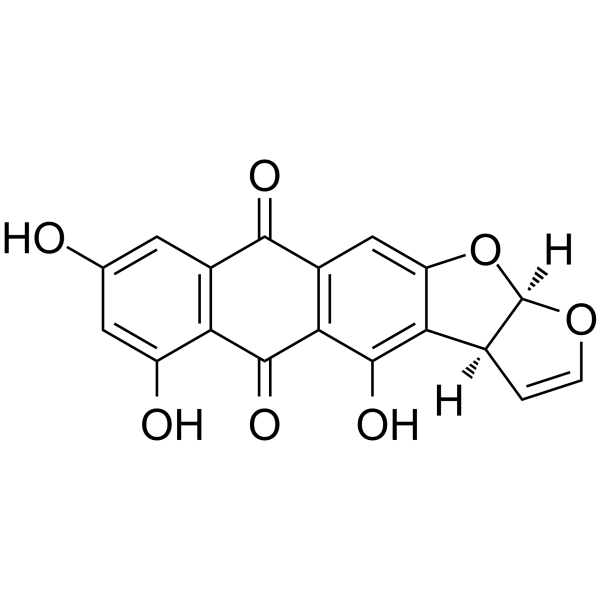 0 ImagesVersicolorin A is a biosynthetic precursor of Aflatoxin B1 (HY-N6615). Versicolorin A induces phosphorylation of p53. Versicolorin A activates the aryl hydrocarbon receptor AhR and significantly induces the expression of CYP1A1. Versicolorin A exerts genotoxic and cytotoxic effects. Versicolorin A enhances the genotoxicity of aflatoxin B1 in cells by promoting CYP450-mediated bioactivation of aflatoxin B1. Versicolorin A can be used in research related to colorectal cancer and hepatocellular carcinoma.
-
AHR antagonist 6
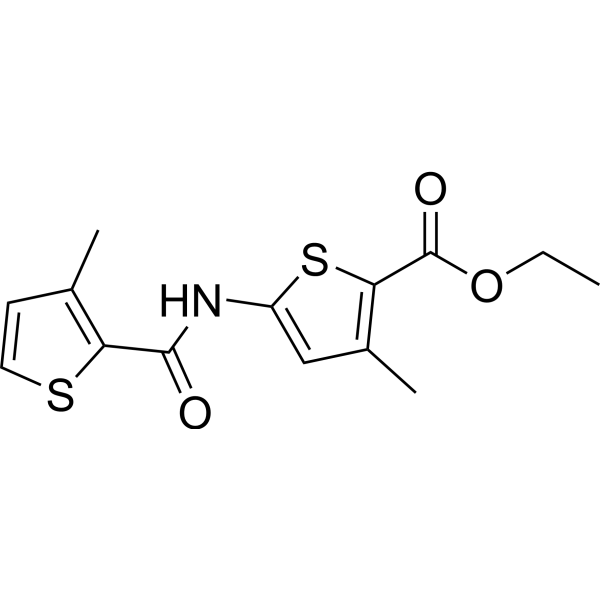 0 ImagesAHR antagonist 6 (Compound 44) is an aryl hydrocarbon receptor (AHR) antagonist used in cancer research.
-
FICZ (Standard)
 0 ImagesCat. No.: HY-12451RCAS No.: 172922-91-7FICZ (Standard) is the analytical standard of FICZ (HY-12451). This product is intended for research and analytical applications. FICZ is a potent aryl hydrocarbon receptor (AhR) agonist with a Kd of 70 pM.
-
Glucoerucin
 0 ImagesCat. No.: HY-N9924CAS No.: 21973-56-8Glucoerucin is an aryl hydrocarbon receptor antagonist and is the 4-methylthio-butyl glucosinolate found in the seeds of Eruca sativa Mill.
-
Aceanthrenequinone
 0 ImagesAceanthrenequinone is a polycyclic aromatic hydrocarbon quinone organic compound that belongs to the category of free radical photoinitiators. Aceanthrenequinone serves as an intermediate for dyes and pigments, and also acts as a substrate for organic synthesis and polymer materials. Aceanthrenequinone activates the Aryl Hydrocarbon Receptor pathway, induces the expression of CYP1A protein in the vascular system of zebrafish embryos, and causes the death of embryos at 120 hpf. Aceanthrenequinone is applicable to research related to industrial or biomedical applications.
-
CH-223191 (Standard)
 0 ImagesCat. No.: HY-12684RCAS No.: 301326-22-7CH-223191 (Standard) is the analytical standard of CH-223191 (HY-12684). This product is intended for research and analytical applications. CH-223191 is a potent and specific antagonist of aryl hydrocarbon receptor (AhR). CH-223191 inhibits TCDD-mediated nuclear translocation and DNA binding of AhR, and inhibits TCDD-induced luciferase activity with an IC50 of 0.03 μM.




