



Potassium Channel
KcsA
Potassium channels are the most widely distributed type of ion channel and are found in virtually all living organisms. They form potassium-selective pores that span cell membranes. Potassium channels are found in most cell types and control a wide variety of cell functions. Potassium channels function to conduct potassium ions down their electrochemical gradient, doing so both rapidly and selectively. Biologically, these channels act to set or reset the resting potential in many cells. In excitable cells, such asneurons, the delayed counterflow of potassium ions shapes the action potential. By contributing to the regulation of the action potential duration in cardiac muscle, malfunction of potassium channels may cause life-threatening arrhythmias. Potassium channels may also be involved in maintaining vascular tone.
All Product Categories
-
Potassium Channel Inhibitors
(693)
View all products
-
Potassium Channel Agonists
(31)
View all products
-
Potassium Channel Antagonists
(39)
View all products
-
Potassium Channel Activators
(242)
View all products
-
Potassium Channel Modulators
(44)
View all products
-
Potassium Channel Chemical
(1)
View all products
-
Potassium Channel Controls
(11)
View all products
-
Potassium Channel Related Products (1155)
Related Products (1155)

-
Antibodies (6)
-
Related Compound Screening Libraries (1)
-
Dihydroberberine (Standard)
 0 ImagesDihydroberberine (Standard) is the analytical standard of Dihydroberberine. This product is intended for research and analytical applications. Dihydroberberine is a naturally occurring isoquinoline alkaloid with anti-inflammatory, anti-atherosclerotic, hypolipidemic and anti-tumor activities. Dihydroberberine inhibits the human ether-related gene (hERG) channel and significantly reduces the expression of heat shock protein 90 (Hsp90) and its interaction with hERG. Dihydroberberine also blocks the TLR4/MyD88/NF-κB signaling pathway to reduce pro-inflammatory cytokines and immunoglobulins, and has inhibitory effects on DSS (HY-116282C)-induced experimental colitis. Dihydroberberine also increases the sensitivity of lung cancer to sunitinib (HY-10255A), with synergistic efficacy.
-
Sideromycin 7
 0 ImagesCat. No.: HY-181966Sideromycin 7 is an antibacterial agent. Sideromycin 7 forms a 7-Bi3+ coordination complex with bismuth citrate, exerting a three-pronged antibacterial mode of action: direct DNA binding to induce damage and arrest replication, suppression of KdpC synthesis to block KdpFABC-mediated potas-sium transport, and inhibition of ATP production. Sideromycin 7 exhibits potent antibacterial activity against Ciprofloxacin (HY-B0356)-resistant Pseudomonas aeruginosa strains. Sideromycin 7 exerts antibiofilm activity against Pseudomonas aeruginosa. Sideromycin 7 can be used for the research of ciprofloxacin-resistant Pseudomonas aeruginosa infection.
-
BML264
 0 ImagesSynonyms: (E)-N-(p-Amylcinnamoyl) anthranilic acidBML264 ((E)-N-(p-amylcinnamoyl) anthranilic acid) is an agonist for TREK-1. BML264 can be used to study diseases associated with TASK1 dysfunction.
-
BDS-I
 0 ImagesCat. No.: HY-P5156CAS No.: 207621-38-3BDS-I known as blood depressing substance, is a marine toxin which can be extracted from Anemonia sulcata. BDS-I is a specific inhibitor of Potassium Channel, targeting to Kv3.4. BDS-I inhibits Aβ1-42-induced enhancement of KV3.4 activity, caspase-3 activation, and abnormal nuclear morphology of NGF-differentiated PC-12 cells. BDS-I reverts the Aβ peptide-induced cell death.
-
Correolide
 0 ImagesCat. No.: HY-N21896CAS No.: 190017-00-6Correolide is a pentacyclic nortriterpene isolated from Spachea correa. Correolide blocks Kv1 family voltage-gated potassium channels (Kv1.3 Kd = 90 nM) and acts on the inner pore between the selectivity filter and the activation gate, thereby inhibiting T cell proliferation and modulating vascular tone. Correolide can be used in research on delayed-type hypersensitivity and autoimmune diseases.
-
TMEM175 modulator-4
 0 ImagesCat. No.: HY-182768CAS No.: 3119251-34-9TMEM175 modulator 4 (Compound 3) is a TMEM175 modulator. TMEM175 modulator 4 modulates the activity of the lysosomal potassium channel TMEM175. TMEM175 modulator 4 can be used for research related to Parkinson's disease.
-
VU6080824
 0 ImagesCat. No.: HY-178058VU6080824 (Compound 5s), a derivative of ML-133 (HY-100230), is an inward-rectifier potassium channel (Kir2.1) inhibitor with an IC50 of 0.35 μM. VU6080824 has superior thallium flux and manual patch clamp (MPC) functional potency.
-
AB-FUBICA
 0 ImagesCat. No.: HY-117403CAS No.: 1801338-22-6AB-FUBICA (Compound 13) is a CB1 and CB2 receptor agonist that activates G-protein coupled inwardly rectifying potassium channels (GIRK) by binding to CB1 and CB2 receptors, displaying notable cannabinoid-like activity. AB-FUBICA has EC50 values of 21 nM for CB1 and 15 nM for CB2. AB-FUBICA may be suitable for studying pain management, neurodegenerative diseases, and inflammation-related mechanisms.
-
Tetramisole
 0 ImagesTetramisole is an orally active, selective inward rectifier potassium channel agonist with an EC50 of approximately 30 μM for the Kir2.1 subunit. Tetramisole is also an anti-nematode agent that blocks neuromuscular transmission by non-competitive depolarization. Tetramisole promotes the forward transport of Kir2.1 channels, hyperpolarizes the resting potential (RP), shortens the action potential duration (APD), inhibits intracellular calcium overload and the PKA signaling pathway, and exerts anti-arrhythmic and anti-myocardial remodeling activities. Tetramisole can be used in cardiac electrophysiology research and research related to myocardial ischemia and heart failure.
-
Inakalant
 0 ImagesCat. No.: HY-14924CAS No.: 335619-18-6Inakalant is an atrial specific potassium channel blocker with antiarrhythmic activity. Inakalant works by selectively blocking potassium channels in heart cells, thereby prolongs the action potential duration (APD) of cardiomyocytes and increases the effective refractory period of the atria and ventricles, which helps to terminate and prevent the occurrence of arrhythmias such as atrial fibrillation (AF). Inakalant can be used in the study of arrhythmia and cardiac electrophysiology.
-
Meclofenamic acid sodium hydrate
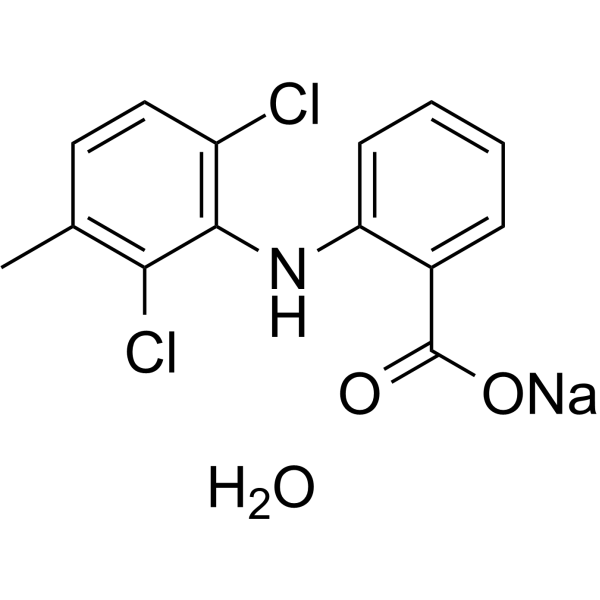 0 ImagesSynonyms: Meclofenamate sodium hydrateMeclofenamic acid (Meclofenamate) sodium hydrate is a non-steroidal anti-inflammatory agent. Meclofenamic acid sodium hydrate is a highly selective FTO (fat mass and obesity-associated) enzyme inhibitor. Meclofenamic acid sodium hydrate competes with FTO binding for the m(6)A-containing nucleic acid. Meclofenamic acid sodium hydrate is a non-selective gap-junction blocker. Meclofenamic acid sodium hydrate inhibits hKv2.1 and hKv1.1, with IC50 values of 56.0 and 155.9 μM, respectively.
-
BMS-182264
 0 ImagesCat. No.: HY-120540CAS No.: 127749-54-6BMS-182264 is a highly selective ATP-sensitive potassium channel agonist. BMS-182264 promotes potassium efflux and membrane hyperpolarization to induce smooth muscle relaxation and vasodilation. BMS-182264 is promising for research of cardiovascular diseases such as hypertension and myocardial ischemia.
-
ERG-IN-5
 0 ImagesCat. No.: HY-180919CAS No.: 3047675-62-4ERG-IN-5 (Compound M1) is a metabolite of ERG-IN-4 (HY-180918), and it is a hERG potassium channel inhibitor with an IC50 of 1.5 μM. ERG-IN-5 is cytotoxic to MTAPdel HCT116 and its CC50 is 28 nM. ERG-IN-5 can be used for the study of colon cancer.
-
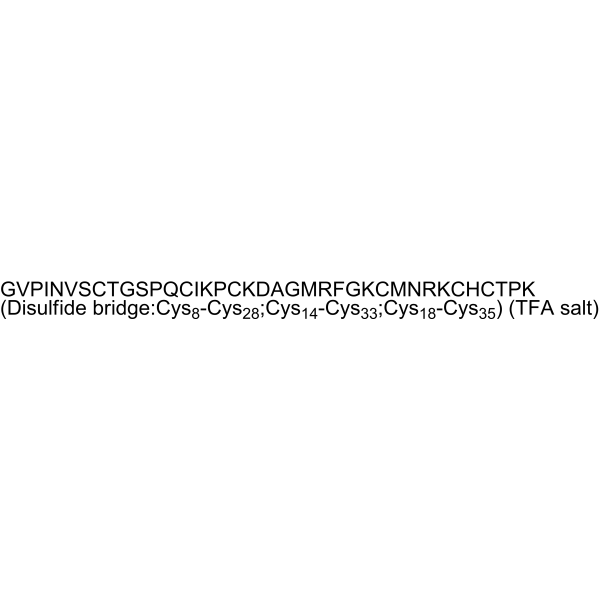
Budiodarone-d10 tartrate
 0 ImagesCat. No.: HY-14834ASSynonyms: ATI-2042-d10 tartrateBudiodarone-d10 tartrate (ATI-2042-d10 tartrate) is the deuterium labeled Budiodarone tartrate (HY-14834A). Budiodarone (ATI-2042) tartrate is a chemical analogue of Amiodarone (HY-14187) with balanced, multiple cardiac ion channel (potassium, sodium and calcium channels) inhibiting activity. Budiodarone tartrate is an antiarrhythmic agent.
-
Mepyramine-d2
 0 ImagesCat. No.: HY-118807SSynonyms: Pyrilamine-d2Mepyramine-d2 (Pyrilamine-d2) is the d2-labeled Mepyramine (HY-118807). Mepyramine (Pyrilamine) is a selective histamine H1 receptor antagonist and KCNQ channel inhibitor, with an IC50 of 12.5 μM against KCNQ2/Q3. Mepyramine shows no activity against allergic asthma in mice when used alone, but modulates the effect of JNJ 7777120 (HY-13508) on allergic asthma in mice; it inhibits the development of morphine physical dependence and increases histamine levels in mouse brains. Mepyramine can be used in studies related to seizures, convulsions, allergic asthma and morphine physical dependence.
-
Antiarrhythmic agent-4
 0 ImagesCat. No.: HY-189366Antiarrhythmic agent-4 is an orally active cardiac ion channel modulator. Antiarrhythmic agent-4 selectively inhibits pathological late sodium current of the cardiac NaV1.5 channel (IC50 = 2.5 μM) while blocking the hERG (IKr) channel (IC50 = 1.5 μM). Antiarrhythmic agent-4 reduces intracellular sodium/calcium overload, prolongs the cardiac action potential, and avoids conduction block and negative inotropic effects. Antiarrhythmic agent-4 exhibits antiarrhythmic efficacy in an isoproterenol-induced atrial fibrillation model in isolated rabbit hearts and improves survival and cardiac function in a Doxorubicin (HY-15142A)-induced heart failure mouse model. Antiarrhythmic agent-4 can be used for research on atrial fibrillation and heart failure.
-
Bimakalim
 0 ImagesCat. No.: HY-133931CAS No.: 117545-11-6Synonyms: EMD-52692; SR-44866Bimakalim (EMD-52692) is an ATP-sensitive potassium channel opener. Bimakalim reduces transmural MPO activity. Bimakalim mimics the effects of ischemic preconditioning to reduce infarct size, adenosine release, and neutrophil function in dogs.
-
Topiramate D12 (Standard)
 0 ImagesCat. No.: HY-110234RCAS No.: 1279037-95-4Synonyms: McN 4853 D12 (Standard); RWJ 17021 D12 (Standard)Topiramate D12 (Standard) is the analytical standard of Topiramate D12. This product is intended for research and analytical applications. Topiramate D12 (McN 4853 D12) is a deuterium labeled Topiramate. Topiramate is a broad-spectrum antiepileptic agent. Topiramate is a GluR5 receptor antagonist. Topiramate produces its antiepileptic effects through enhancement of GABAergic activity, inhibition of kainate/AMPA receptors, inhibition of voltage-sensitive sodium and calcium channels, increases in potassium conductance, and inhibition of carbonic anhydrase.
-
NIP 142
 0 ImagesCat. No.: HY-W705705CAS No.: 203002-58-8NIP-142 is a benzopyran derivative with multiple ion channel-blocking effects. NIP-142 selectively blocks the potassium ion channels enriched in atrial muscle, prolonging the effective refractory period (ERP) and action potential duration (APD) of the atrium, while having minimal effect on ventricular repolarization. NIP-142 also inhibits L-type/T-type calcium channels and sodium channels, further contributing to its anti-arrhythmic effect. NIP-142 shows significant efficacy in various atrial fibrillation models. NIP-142 can be used for research on arrhythmias.




