



Topoisomerase
Topoisomerases are enzymes that regulate the overwinding or underwinding of DNA. The winding problem of DNA arises due to the intertwined nature of its double-helical structure. Topoisomerases are isomerase enzymes that act on the topology of DNA. Type I topoisomerase cuts one strand of a DNA double helix, relaxation occurs, and then the cut strand is reannealed. Type I topoisomerases are subdivided into two subclasses: type IA topoisomerases, which share many structural and mechanistic features with the type II topoisomerases, and type IB topoisomerases, which utilize a controlled rotary mechanism. Type II topoisomerase cuts both strands of one DNA double helix, pass another unbroken DNA helix through it, and then reanneal the cut strands. This class is also split into two subclasses: type IIA and type IIB topoisomerases, which possess similar structure and mechanisms.
Topoisomerase Isoform Specific Products
All Product Categories
-
Topoisomerase Inhibitors
(769)
View all products
-
Topoisomerase Agonists
(2)
View all products
-
Topoisomerase Modulator
(1)
View all products
-
Topoisomerase Inducer
(1)
View all products
-
Topoisomerase Degraders
(3)
View all products
-
Topoisomerase Controls
(3)
View all products
-
Topoisomerase Ligands
(2)
View all products
-
Topoisomerase Proteins
(1)
View all products
-
DNA topoisomerase II Proteins
(1)
View all products
-
Topoisomerase Related Products (847)
Related Products (847)

-
Recombinant Proteins (1)
-
Antibodies (4)
-
Topoisomerase Isoform Comparison
-
A20832
 0 ImagesCat. No.: HY-114684CAS No.: 40526-96-3A20832 is a specific resolvase inhibitor that blocks both the recombination and topoisomerase activities of resolvase. A20832 inhibits the site-specific recombination reaction mediated by the Tn3-encoded resolvase protein at the strand cleavage step and has no effect on synapsis.
-
Merbarone (Standard)
 0 ImagesCat. No.: HY-19024RCAS No.: 97534-21-9Synonyms: NSC 336628 (Standard)Merbarone (Standard) is the analytical standard of Merbarone. This product is intended for research and analytical applications. Merbarone (NSC 336628) is an orally active inhibitor of topoisomerase II. Merbarone acts primarily by blocking topoisomerase II-mediated DNA cleavage without stabilizing topo II-DNA covalent complexes. Merbarone is an anticancer agent.
-
Chloroquinoxaline sulfonamide (Standard)
 0 ImagesChloroquinoxaline sulfonamide (Standard) is the analytical standard of Chloroquinoxaline sulfonamide. This product is intended for research and analytical applications. Chloroquinoxaline sulfonamide (Chloroquinoxaline), a structural analogue of sulfaquinoxaline, is a topoisomerase II alpha/beta poison. Chloroquinoxaline sulfonamide is used to control coccidiosis in poultry, rabbit, sheep, and cattle. Antitumor activity.
-
DNA gyrase/Topo IV-IN-3
 0 ImagesCat. No.: HY-183700DNA gyrase/Topo IV-IN-3 is an inhibitor of Escherichia coli DNA gyrase and Topoisomerase IV, with IC50 values of 1.75 μM and 3.47 μM, respectively. DNA gyrase/Topo IV-IN-3 acts as a biofilm inhibitor and exhibits antibacterial activity against both Gram-negative and Gram-positive bacteria. DNA gyrase/Topo IV-IN-3 can be used in studies related to bacterial infections.
-
Niranthin (Standard)
 0 ImagesCat. No.: HY-N6054RCAS No.: 50656-77-4Niranthin (Standard) is the analytical standard of Niranthin. This product is intended for research and analytical applications. Niranthin, a lignan with a wide spectrum of pharmacological activities. Niranthin is a potent and non-competitive inhibitor of heterodimeric type IB topoisomerase of L. donovani. Niranthin can be used for the research of drug-resistant leishmaniasis research.
-
IKE16
 0 ImagesCat. No.: HY-178330IKE16 is a fungi-selective eukaryotic topoisomerase II inhibitor, with an IC50 value of 13.68 μM. IKE16 suppresses both the DNA relaxation activity and the decatenation activity of yTOPOII selectively. IKE16 shows moderate activity against standard fungal strains (Candida albicans ATCC 10231, Saccharomyces cerevisiae ATCC 89763) with a minimum inhibitory concentration (MIC) of 2 μg/mL against S. cerevisiae ATCC 89763. IKE16 exhibits high cytotoxicity against human cells, with an EC50 of 0.07 μM in HepG2 and 0.045 μM in HEK-293. IKE16 can be used for the study of antifungal infection.
-
Topoisomerase I inhibitor 10
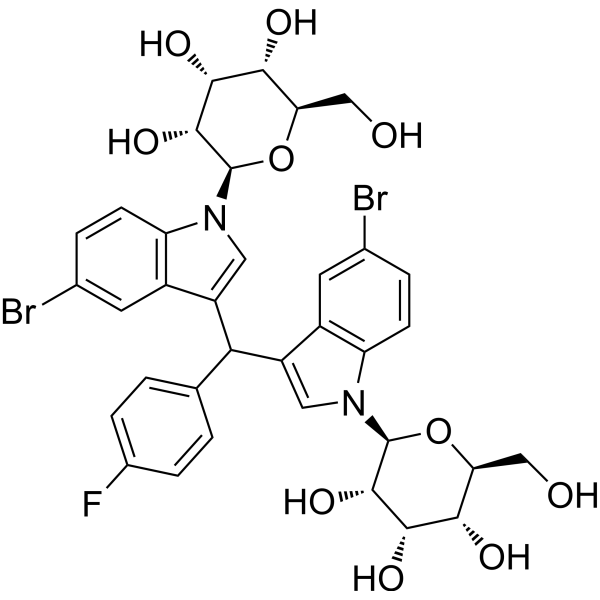 0 ImagesCat. No.: HY-156464Topoisomerase I inhibitor 10 (compound 13) is a leishmanial topoisomerase IB inhibitor. Topoisomerase I inhibitor 10 has antileishmanial activity against L. donovani promastigotes, with the IC50 of 27.91 μM.
-
Gatifloxacin mesylate
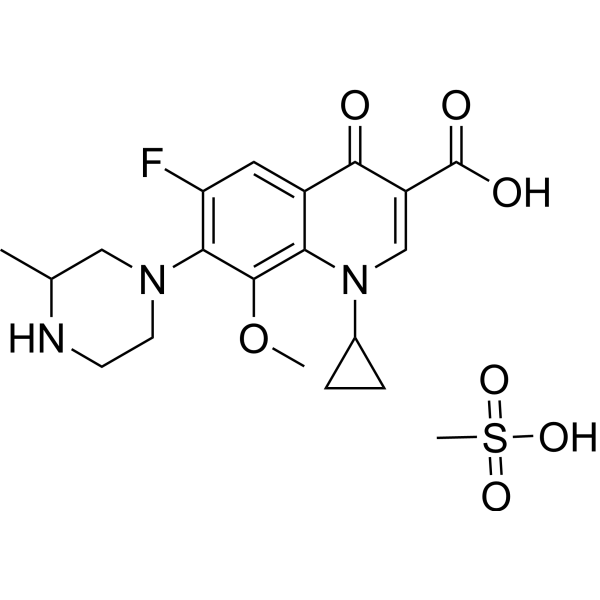 0 ImagesCat. No.: HY-10581BCAS No.: 316819-28-0Synonyms: AM-1155 mesylate; BMS-206584 mesylate; PD135432 mesylateGatifloxacin mesylate (AM-1155; BMS-206584; PD135432) is a potent fluoroquinolone antibiotic with broad-spectrum antibacterial activity. Gatifloxacin mesylate inhibits bacterial type II topoisomerases (IC50=13.8 μg/ml for S. aureus topoisomerase IV) and E. coli DNA gyrase (IC50 = 0.109 μg/ml). Gatifloxacin mesylate can be used to treat bacterial conjunctivitis in vivo.
-
Antibacterial agent 327
 0 ImagesCat. No.: HY-181819CAS No.: 1311163-39-9Antibacterial agent 327 (Compound 6f) is an Antibacterial agent. Antibacterial agent 327 potently inhibits the supercoiling activity of Staphylococcus aureus DNA gyrase with an IC50 of 0.28 μM. It also inhibits the ATPase activities of DNA gyrase and Topoisomerase IV, as well as the decatenation activity of Topoisomerase IV (IC50: 0.43 μM, 0.73 μM, and 2.31 μM, respectively). Antibacterial agent 327 potently inhibits Clostridioides difficile and methicillin-resistant Staphylococcus aureus (HY-121544), with an MIC of 0.78 μg/mL for both. Antibacterial agent 327 inhibits Escherichia coli with an MIC50 of 0.78 μg/mL.
-
Suptopin-2
 0 ImagesCat. No.: HY-W781148CAS No.: 331852-66-5Sutopin-2 is a topoisomerase II inhibitor. Suptopin-2 affects cell cycle progression and stability of microtubules. Sutopin-2 induces cell cycle arrest by regulating the nucleocytoplasmic transport of cyclin B1.
-
Desethylene Ciprofloxacin hydrochloride (Standard)
 0 ImagesCat. No.: HY-122139RCAS No.: 528851-31-2Desethylene Ciprofloxacin hydrochloride (Standard) is the analytical standard of Desethylene Ciprofloxacin hydrochloride (HY-122139). This product is intended for research and analytical applications. Desethylene Ciprofloxacin hydrochloride is a major metabolite and degradation product of Ciprofloxacin (HY-B0356). Desethylene Ciprofloxacin hydrochloride inhibits topoisomerase (Topoisomerase) IIα and IIβ-mediated DNA relaxation.
-
Aclacinomycin A (Standard)
 0 ImagesCat. No.: HY-N2306RCAS No.: 57576-44-0Synonyms: Aclarubicin (Standard)Aclacinomycin A (Standard) is the analytical standard of Aclacinomycin A. This product is intended for research and analytical applications. Aclacinomycin A (Aclarubicin) is an orally active and potent anthracycline antitumor antibiotic. Aclacinomycin A is an inhibitor of topoisomerase I and II. Aclacinomycin A inhibits synthesis of nucleic acid, especially RNA. Aclacinomycin A might inhibit the 26S protease complex as well as the ubiquitin-ATP-dependent proteolysis.
-
(S)-10-Hydroxycamptothecin-d5
 0 ImagesCat. No.: HY-N0095SCAS No.: 1330277-66-1Synonyms: 10-HCPT-d5; 10-Hydroxycamptothecin-d5(S)-10-Hydroxycamptothecin-d5 (10-HCPT-d5) is the deuterium labeled (S)-10-Hydroxycamptothecin. (S)-10-Hydroxycamptothecin (10-HCPT) is a DNA topoisomerase I inhibitor. (S)-10-Hydroxycamptothecin exhibits a remarkable apoptosis-inducing effect. (S)-10-Hydroxycamptothecin has the potential for hepatoma, gastric carcinoma, colon cancer and leukaemia research.
-
RPR132595A-d3
 0 ImagesCat. No.: HY-132545SCAS No.: 1217625-98-3Synonyms: NPC-d3RPR132595A-d3 is the deuterium labeled RPR132595A. RPR132595A is an active metabolite of Irinotecan (CPT-11), which is generated by cytochrome P-450 3A4 (CYP3A4) and finally excreted through urine.
-
(1R,2S,7R)-Sitafloxacin
 0 ImagesCat. No.: HY-B0395DCAS No.: 127254-10-8Synonyms: (1R,2S,7R)-DU-6859a; DU-6857(R)-Sitafloxacin (DU-6857), a stereoisomer of Sitafloxacin (DU-6859a), is also an inhibitor of topoisomerases, with an IC50 of 0.18 μg/mL of DNA gyrase.
-
Pyrazoloacridine (Standard)
 0 ImagesCat. No.: HY-108969RCAS No.: 99009-20-8Synonyms: NSC 366140 (Standard); PD 115934 (Standard)Pyrazoloacridine (Standard) is the analytical standard of Pyrazoloacridine. This product is intended for research and analytical applications. Pyrazoloacridine (NSC 366140), an intercalating agent with anti-cancer activity, inhibits the activity of topoisomerases 1 and 2. Pyrazoloacridine (NSC 366140) exhibits an IC50 of 1.25 μM in K562 myeloid leukemia cells for 24 h treatment.
-
Gatifloxacin-d4 hydrochloride
 0 ImagesCat. No.: HY-10581AS1CAS No.: 1189946-71-1Synonyms: AM-1155-d4 hydrochloride; BMS-206584-d4 hydrochloride; PD135432-d4 hydrochlorideGatifloxacin-d4 (AM-1155-d4; BMS-206584-d4; PD135432-d4) hydrochloride is deuterium-labeled Gatifloxacin (hydrochloride) (HY-10581A).
-
Heliquinomycin
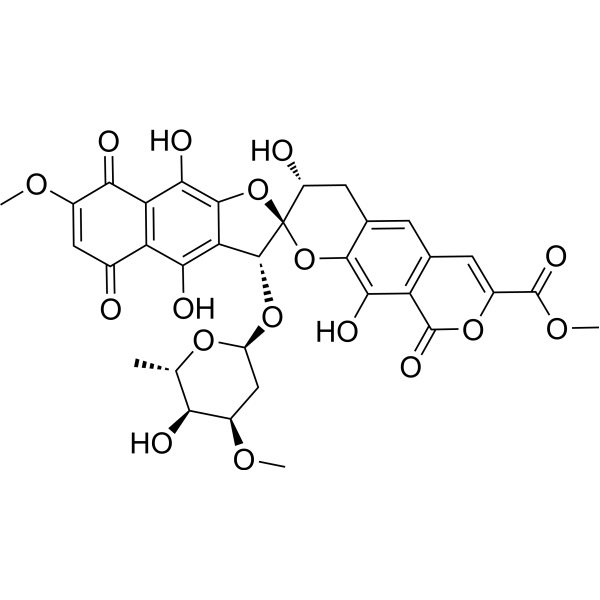 0 ImagesCat. No.: HY-105387CAS No.: 178182-49-5Heliquinomycin is an inhibitor of DNA helicase (Ki: 6.8 μM) and inhibits DNA and RNA synthesis. Heliquinomycin is effective against Gram-positive bacteria strains. Heliquinomycin inhibits cancer cell growth.
-
Zabofloxacin hydrochloride (Standard)
 0 ImagesCat. No.: HY-106410ARCAS No.: 623574-00-5Synonyms: DW-224a (Standard)Zabofloxacin hydrochloride (Standard) is the analytical standard of Zabofloxacin hydrochloride (HY-106410A). This product is intended for research and analytical applications. Zabofloxacin hydrochloride (DW-224a) is a potent and seletive inhibitor of the bacterial type II and IV topoisomerases. Zabofloxacin hydrochloride has excellent activity against gram-positive pathogens including Steptococcus aureus, Streptococcus pyogenes and S.pneumonia. Zabofloxacin hydrochloride is a novel fluoronaphthyridone quinolone that is considered as an alternative antibiotic for treatment of quinolone-susceptible (QSSP) and quinolone-resistant gonorrhea (QRSP).
-
(±)-Evodiamine (Standard)
 0 Images(±)-Evodiamine Standard is the analytical standard of (±)-Evodiamine (HY-N0114A). This product is intended for research and analytical applications. (±)-Evodiamine is an orally active indoloquinazoline alkaloid composed of equal amounts of enantiomers, with (+)-Evodiamine exerting the primary biological functions. (±)-Evodiamine is a Top1 inhibitor and a TRPV1 receptor agonist. (±)-Evodiamine induces cell cycle arrest and apoptosis by inhibiting Top1 and disrupting Tubulin polymerization, suppresses oncogenic signaling pathways such as NF-κB and Akt, and specifically agonizes TRPV1 receptors to regulate neuropeptide release and energy metabolism. (±)-Evodiamine is used in research on traumatic brain injury, obesity, cancer, neuropathy, dry eye disease, and colitis.




