



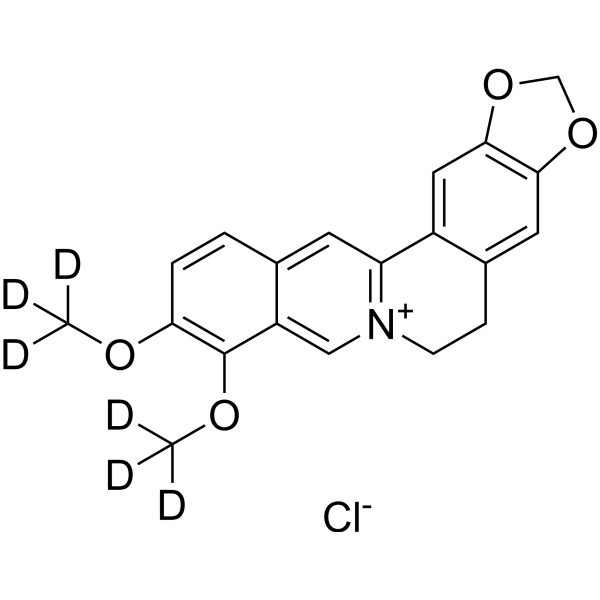
Berberine-d6 chloride

Based on 1 Customer Validation
Berberine-d6 (chloride) is the deuterium labeled Berberine chloride. Berberine chloride is an alkaloid that acts as an antibiotic. Berberine chloride induces reactive oxygen species (ROS) generation and inhibits DNA topoisomerase. Antineoplastic properties.
연구목적의 판매만을 진행합니다. 환자를 대상으로 한 판매는 하지 않습니다.
- Purity : 98.71%
- 화학식: C20H12D6ClNO4
- 분자량:377.85
-
보관:
4°C, stored under nitrogen, away from moisture
* In solvent : -80°C, 6 months; -20°C, 1 month (stored under nitrogen, away from moisture)

To place orders, for customer services and technical support, please contact: MedChemExpress USA
Tel: 609-228-6898 E-mail: [email protected] [email protected]


-
 Biological Activity
-
Chemical Information
-
용액&용해도
- Protocol
- 순도&문서
- References
-
 Help & FAQs


All Topoisomerase Isoforms
MoreAll Antibiotic Isoforms
MoreAll Endogenous Metabolite Isoforms
More

Biological Activity
제품 설명
In Vitro
Stable heavy isotopes of hydrogen, carbon, and other elements have been incorporated into drug molecules, largely as tracers for quantitation during the drug development process. Deuteration has gained attention because of its potential to affect the pharmacokinetic and metabolic profiles of drugs[1].
MedChemExpress (MCE) has not independently confirmed the accuracy of these methods. They are for reference only.
신청
1. This compound can be used as a tracer
2. This compound can be used as an internal standard for quantitative analysis by NMR, GC-MS, or LC-MS.


Chemical Information
-
Unlabeled CAS 633-65-8
-
Appearance Solid
-
분자량 377.85
-
화학식 C20H12D6ClNO4
-
Color Light yellow to yellow
-
SMILES
[2H]C([2H])([2H])OC1=C(OC([2H])([2H])[2H])C2=C[N+]3=C(C4=CC5=C(C=C4CC3)OCO5)C=C2C=C1.[Cl-]
-
Synonyms
Natural Yellow 18-d6 chloride
-
선적
Room temperature in continental US; may vary elsewhere.
-
보관
4°C, stored under nitrogen, away from moisture
* In solvent : -80°C, 6 months; -20°C, 1 month (stored under nitrogen, away from moisture)


용액&용해도
In Vitro:
DMSO : ≥ 52 mg/mL (137.62 mM; Hygroscopic DMSO has a significant impact on the solubility of product, please use newly opened DMSO)
* "≥" means soluble, but saturation unknown.
Please refer to the solubility information to select the appropriate solvent. Once prepared, please aliquot and store the solution to prevent product inactivation from repeated freeze-thaw cycles.
Storage method and period of stock solution: -80°C, 6 months; -20°C, 1 month (stored under nitrogen, away from moisture). When stored at -80°C, please use it within 6 months. When stored at -20°C, please use it within 1 month.
Please refer to the solubility information to select the appropriate solvent. Once prepared, please aliquot and store the solution to prevent product inactivation from repeated freeze-thaw cycles.
Storage method and period of stock solution: -80°C, 6 months; -20°C, 1 month (stored under nitrogen, away from moisture). When stored at -80°C, please use it within 6 months. When stored at -20°C, please use it within 1 month.
Concentration (start) × Volume (start) = Concentration (final) × Volume (final)


순도&문서
-
Data Sheet (276 KB)
-
SDS (252 KB)
- English - EN (252 KB)
- Français - FR (252 KB)
- Deutsch - DE (252 KB)
- Norwegian - NO (252 KB)
- Español - ES (252 KB)
- Swedish - SV (252 KB)
- Italian - IT (252 KB)
- Korean - KR (252 KB)
- Portuguese - PT (252 KB)
-
Handling Instructions (2659 KB)
References
[1]. Russak EM, et al. Impact of Deuterium Substitution on the Pharmacokinetics of Pharmaceuticals. Ann Pharmacother. 2019;53(2):211-216. [Content Brief]
[2]. Cai Y, et al. Berberine inhibits the growth of human colorectal adenocarcinoma in vitro and in vivo. J Nat Med. 2014 Jan;68(1):53-62. [Content Brief]


Complete Stock Solution Preparation Table
Please refer to the solubility information to select the appropriate solvent. Once prepared, please aliquot and store the solution to prevent product inactivation from repeated freeze-thaw cycles.
Storage method and period of stock solution: -80°C, 6 months; -20°C, 1 month (stored under nitrogen, away from moisture). When stored at -80°C, please use it within 6 months. When stored at -20°C, please use it within 1 month.
| Optional Solvent | Concentration Solvent Mass | 1 mg | 5 mg | 10 mg | 25 mg |
|---|---|---|---|---|---|
| DMSO | 1 mM | 2.6466 mL | 13.2328 mL | 26.4655 mL | 66.1638 mL |
| 5 mM | 0.5293 mL | 2.6466 mL | 5.2931 mL | 13.2328 mL | |
| 10 mM | 0.2647 mL | 1.3233 mL | 2.6466 mL | 6.6164 mL | |
| 15 mM | 0.1764 mL | 0.8822 mL | 1.7644 mL | 4.4109 mL | |
| 20 mM | 0.1323 mL | 0.6616 mL | 1.3233 mL | 3.3082 mL | |
| 25 mM | 0.1059 mL | 0.5293 mL | 1.0586 mL | 2.6466 mL | |
| 30 mM | 0.0882 mL | 0.4411 mL | 0.8822 mL | 2.2055 mL | |
| 40 mM | 0.0662 mL | 0.3308 mL | 0.6616 mL | 1.6541 mL | |
| 50 mM | 0.0529 mL | 0.2647 mL | 0.5293 mL | 1.3233 mL | |
| 60 mM | 0.0441 mL | 0.2205 mL | 0.4411 mL | 1.1027 mL | |
| 80 mM | 0.0331 mL | 0.1654 mL | 0.3308 mL | 0.8270 mL | |
| 100 mM | 0.0265 mL | 0.1323 mL | 0.2647 mL | 0.6616 mL |


Berberine-d6 chloride Related Classifications
HY-18258S Related Classifications
 Powered by Bioz