



Zavabresib

Based on 1 Customer Validation
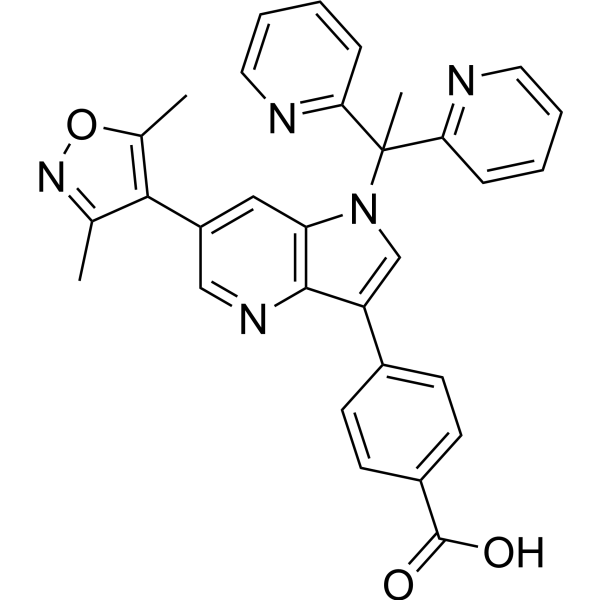
Zavabresib (OPN-2853; PLX2853; BET-IN-16) is an orally active inhibitor of the BET family of proteins. Zavabresib blocks bromodomain-mediated interactions, reduces BRD4 enrichment at the regulatory regions of transcription factors in T cells, exerts tumor growth inhibitory effects, and enhances the efficacy of immunotherapy. Zavabresib is applicable to research on chronic lymphocytic leukemia, castration-resistant prostate cancer, diffuse large B-cell lymphoma, colon adenocarcinoma, and myelofibrosis.
For research use only. We do not sell to patients.
- Purity : 99.60%
- CAS No.: 2089390-09-8
- Formula: C31H25N5O3
- Molecular Weight:515.56
-
Storage:Powder -20°C, 3 years , 4°C, 2 years ; In solvent -80°C, 6 months , -20°C, 1 month

To place orders, for customer services and technical support, please contact: MedChemExpress USA
Tel: 609-228-6898 E-mail: [email protected] [email protected]


-
 Biological Activity
-
Chemical Information
-
Solvent & Solubility
- Protocols
- Purity & Documentation
- References
-
 Help & FAQs




Biological Activity
Description
IC50 & Target
[5]|
BET |
BRD4 |
Cellular Effect
|
Cell Line

|
Type | Value | Description | References |
|---|---|---|---|---|
| LNCaP | IC50 |
43 nM
|
Cell growth inhibition against human LNCaP prostate cancer cells (mutant androgen receptor AR-T877A) assessed via luminescent signal using CellTiter-Glo Reagent after 5 days of incubation.
Cell growth inhibition against human LNCaP prostate cancer cells (mutant androgen receptor AR-T877A) assessed via luminescent signal using CellTiter-Glo Reagent after 5 days of incubation.
|
en?oq=WO2022040512 |
| 22Rv1 | IC50 |
34 nM
|
Cell growth inhibition against human 22Rv1 prostate cancer cells (expresses full-length AR and AR-V7, enzalutamide/abiraterone acetate-resistant) assessed via luminescent signal using CellTiter-Glo Reagent after 5 days of incubation.
Cell growth inhibition against human 22Rv1 prostate cancer cells (expresses full-length AR and AR-V7, enzalutamide/abiraterone acetate-resistant) assessed via luminescent signal using CellTiter-Glo Reagent after 5 days of incubation.
|
en?oq=WO2022040512 |
In Vitro
Zavabresib (OPN-2853; PLX2853; BET-IN-16) at 10 nM reduces BRD4 enrichment at the regulatory regions of RUNX3, PRDM1 and BATF in T cells from healthy donors, but exerts no such effect on the TCF7, TBX21 or EOMES loci[1].
Zavabresib (compound 1) (0.001-100 μM; 5 days) potently inhibits the growth of human prostate cancer cell line LNCaP with an IC50 of 43 nM, and exerts a synergistic inhibitory effect on LNCaP cell growth when combined with enzalutamide or Abiraterone (HY-70013)[4].
Zavabresib (0.001-100 μM; 5 days) potently inhibits the proliferation of 22Rv1 human prostate cancer cells with an IC50 of 34 nM, and its combination with enzalutamide or Abiraterone exerts a synergistic inhibitory effect on 22Rv1 cell proliferation[4].
MedChemExpress (MCE) has not independently confirmed the accuracy of these methods. They are for reference only.
-
Cell Line:LNCaP human prostate cancer cells
-
Concentration:0.001, 0.01, 0.1, 1, 10, 100 μM
-
Incubation Time:5 days
-
Result:Potently inhibited LNCaP cell growth with an IC50 of 43 nM.
-
Cell Line:22Rv1 human prostate cancer cells
-
Concentration:0.001, 0.01, 0.1, 1, 10, 100 μM
-
Incubation Time:5 days
-
Result:Potently inhibited 22Rv1 cell growth with an IC50 of 34 nM.
In Vivo
Zavabresib (administered for 21 days) achieves 78% tumor growth inhibition as a monotherapy, and 93% tumor growth inhibition when combined with anti-CTLA4, in a mouse xenograft model of colon adenocarcinoma[5].
When administered as a monotherapy, Zavabresib (6-10 mg/kg; p.o.; once daily/once every 2 days; for 21 days) achieves 78% tumor growth inhibition in the mouse MC38 syngeneic colorectal cancer model at the dosage of 6 mg/kg once daily; when dosed at 10 mg/kg once every 2 days in combination with Anti-Mouse CTLA-4 Antibody (9D9) (αCTLA-4) (HY-P99132), the efficacy is boosted to a maximum TGI of 95%, with a complete response rate of 50%.
MedChemExpress (MCE) has not independently confirmed the accuracy of these methods. They are for reference only.
-
Animal Model:C57BL/6 (6-7 weeks old; injected subcutaneously with 2 × 10⁶ MC38 murine colon adenocarcinoma cells)[6]
-
Dosage:6, 10 mg/kg
-
Administration:p.o.; once daily for 21 days (6 mg/kg monotherapy and combination); p.o.; once every 2 days for 21 days (10 mg/kg combination)
-
Result:Achieved 78% tumor growth inhibition (TGI) by day 21, with no complete responses (CR).
Contributed to 95% TGI by day 21 and a 50% CR rate (5/10 mice with no detectable tumor) when combined with αCTLA-4.
Contributed to 93% TGI by day 21 and a 10% CR rate (1/10 mice with no detectable tumor) when combined with αCTLA-4.
Showed minimal body weight loss across all groups.


Chemical Information
-
CAS No. 2089390-09-8
-
Appearance Solid
-
Molecular Weight 515.56
-
Formula C31H25N5O3
-
Color White to light yellow
-
SMILES
O=C(C1=CC=C(C2=CN(C(C3=NC=CC=C3)(C)C4=NC=CC=C4)C5=C2N=CC(C6=C(C)ON=C6C)=C5)C=C1)O
-
Synonyms
OPN-2853; PLX2853; BET-IN-16
-
Shipping
Room temperature in continental US; may vary elsewhere.
-
Storage
Powder -20°C 3 years 4°C 2 years In solvent -80°C 6 months -20°C 1 month


Solvent & Solubility
In Vitro:
DMSO : 100 mg/mL (193.96 mM; ultrasonic and warming and heat to 60°C; Hygroscopic DMSO has a significant impact on the solubility of product, please use newly opened DMSO)
Please refer to the solubility information to select the appropriate solvent. Once prepared, please aliquot and store the solution to prevent product inactivation from repeated freeze-thaw cycles.
Storage method and period of stock solution: -80°C, 6 months; -20°C, 1 month. When stored at -80°C, please use it within 6 months. When stored at -20°C, please use it within 1 month.
Please refer to the solubility information to select the appropriate solvent. Once prepared, please aliquot and store the solution to prevent product inactivation from repeated freeze-thaw cycles.
Storage method and period of stock solution: -80°C, 6 months; -20°C, 1 month. When stored at -80°C, please use it within 6 months. When stored at -20°C, please use it within 1 month.
Concentration (start) × Volume (start) = Concentration (final) × Volume (final)
In Vivo:
Select the appropriate dissolution method based on your experimental animal and administration route.
- For the following dissolution methods, please ensure to first prepare a clear stock solution using an In Vitro approach and then sequentially add co-solvents:
- To ensure reliable experimental results, the clarified stock solution can be appropriately stored based on storage conditions. As for the working solution for In Vivo experiments, it is recommended to prepare freshly and use it on the same day.
- The percentages shown for the solvents indicate their volumetric ratio in the final prepared solution. If precipitation or phase separation occurs during preparation, heat and/or sonication can be used to aid dissolution.
Add each solvent one by one: 10% DMSO 40% PEG300 5% Tween-80 45% Saline
Solubility: ≥ 5 mg/mL (9.70 mM); Clear solution
This protocol yields a clear solution of ≥ 5 mg/mL (saturation unknown).
Taking 1 mL working solution as an example, add 100 μL DMSO stock solution (50.0 mg/mL) to 400 μL PEG300, and mix evenly; then add 50 μL Tween-80 and mix evenly; then add 450 μL Saline to adjust the volume to 1 mL.
Preparation of Saline: Dissolve 0.9 g sodium chloride in ddH₂O and dilute to 100 mL to obtain a clear Saline solution.
Add each solvent one by one: 10% DMSO 90% (20% SBE-β-CD in Saline)
Solubility: ≥ 5 mg/mL (9.70 mM); Clear solution
This protocol yields a clear solution of ≥ 5 mg/mL (saturation unknown).
Taking 1 mL working solution as an example, add 100 μL DMSO stock solution (50.0 mg/mL) to 900 μL 20% SBE-β-CD in Saline, and mix evenly.
Preparation of 20% SBE-β-CD in Saline (4°C, storage for one week): 2 g SBE-β-CD powder is dissolved in 10 mL Saline, completely dissolve until clear.
In Vivo Dissolution Calculator
Please enter the basic information of animal experiments:
-
-
-
-
Recommended: Prepare an additional quantity of animals to account for potential losses during experiments.
Please enter your animal formula composition:
-
%DMSO +
Recommended: Keep the proportion of DMSO in working solution below 2% if your animal is weak.
-
%+
-
+%Tween-80 + +
-
%Saline +
The co-solvents required include: DMSO, . All of co-solvents are available by MedChemExpress (MCE). , Tween 80. All of co-solvents are available by MedChemExpress (MCE).
Working solution concentration: 0.22 mg/mL
Method for preparing stock solution: mg drug dissolved in μL DMSO. Stock solution concentration: mg/mL.
1. Take μL DMSO stock solution;
2. Add μL .
μL , mix evenly;
3. Then add μL Tween 80, mix evenly;
4. Then add μL
Please ensure that the stock solution in the first step is dissolved to a clear state, and add co-solvents in sequence. You can use ultrasonic heating (ultrasonic cleaner, recommended frequency 20-40 kHz), vortexing, etc. to assist dissolution.


Purity & Documentation
-
Data Sheet (306 KB)
-
SDS (254 KB)
- English - EN (254 KB)
- Français - FR (254 KB)
- Deutsch - DE (254 KB)
- Norwegian - NO (254 KB)
- Español - ES (254 KB)
- Swedish - SV (254 KB)
- Italian - IT (254 KB)
- Korean - KR (254 KB)
- Portuguese - PT (254 KB)
-
Handling Instructions (2659 KB)
References


Complete Stock Solution Preparation Table
Please refer to the solubility information to select the appropriate solvent. Once prepared, please aliquot and store the solution to prevent product inactivation from repeated freeze-thaw cycles.
Storage method and period of stock solution: -80°C, 6 months; -20°C, 1 month. When stored at -80°C, please use it within 6 months. When stored at -20°C, please use it within 1 month.
| Optional Solvent | Concentration Solvent Mass | 1 mg | 5 mg | 10 mg | 25 mg |
|---|---|---|---|---|---|
| DMSO | 1 mM | 1.9396 mL | 9.6982 mL | 19.3964 mL | 48.4910 mL |
| 5 mM | 0.3879 mL | 1.9396 mL | 3.8793 mL | 9.6982 mL | |
| 10 mM | 0.1940 mL | 0.9698 mL | 1.9396 mL | 4.8491 mL | |
| 15 mM | 0.1293 mL | 0.6465 mL | 1.2931 mL | 3.2327 mL | |
| 20 mM | 0.0970 mL | 0.4849 mL | 0.9698 mL | 2.4245 mL | |
| 25 mM | 0.0776 mL | 0.3879 mL | 0.7759 mL | 1.9396 mL | |
| 30 mM | 0.0647 mL | 0.3233 mL | 0.6465 mL | 1.6164 mL | |
| 40 mM | 0.0485 mL | 0.2425 mL | 0.4849 mL | 1.2123 mL | |
| 50 mM | 0.0388 mL | 0.1940 mL | 0.3879 mL | 0.9698 mL | |
| 60 mM | 0.0323 mL | 0.1616 mL | 0.3233 mL | 0.8082 mL | |
| 80 mM | 0.0242 mL | 0.1212 mL | 0.2425 mL | 0.6061 mL | |
| 100 mM | 0.0194 mL | 0.0970 mL | 0.1940 mL | 0.4849 mL |


Zavabresib Related Classifications
HY-150268 Related Classifications
 Powered by Bioz