



Ajugol
Based on 3 publication(s) in Google Scholar
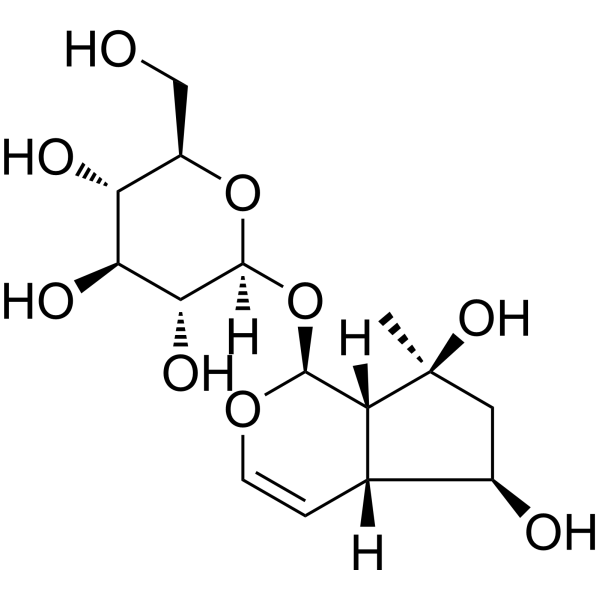
Ajugol is an orally active iridoid glycoside found in the traditional Chinese medicine Leonurus japonicus. Ajugol is an autophagy activator. Ajugol activates TFEB-mediated autophagy and lysosomal biogenesis. Ajugol also has anti-inflammatory effects. Ajugol has great potential in the research of asthma, non-alcoholic fatty liver disease (NAFLD), and osteoarthritis.
For research use only. We do not sell to patients.
- Purity : 99.61%
- CAS No.: 52949-83-4
- Formula: C15H24O9
- Molecular Weight:348.35
-
Storage:Powder -20°C, 3 years , 4°C, 2 years ; In solvent -80°C, 6 months , -20°C, 1 month

To place orders, for customer services and technical support, please contact: MedChemExpress USA
Tel: 609-228-6898 E-mail: [email protected] [email protected]


-
 Biological Activity
-
Chemical Information
-
Solvent & Solubility
- Protocols
- Purity & Documentation
- References
-
 Help & FAQs



Publications Citing Use of MedChemExpress (MCE) Ajugol
MoreAll Parasite Isoforms
More

Biological Activity
Description
IC50 & Target
|
Trypanosoma |
Cellular Effect
|
Cell Line

|
Type | Value | Description | References |
|---|---|---|---|---|
| A2780 | IC50 |
>10 μM
Compound: 11
|
Cytotoxicity against human A2780 cells by MTT assay
Cytotoxicity against human A2780 cells by MTT assay
|
[PMID: 26859776] |
| A549 | IC50 |
>10 μM
Compound: 11
|
Cytotoxicity against human A549 cells by MTT assay
Cytotoxicity against human A549 cells by MTT assay
|
[PMID: 26859776] |
| Bel-7402 | IC50 |
>10 μM
Compound: 11
|
Cytotoxicity against human Bel7402 cells by MTT assay
Cytotoxicity against human Bel7402 cells by MTT assay
|
[PMID: 26859776] |
| BGC-823 | IC50 |
>10 μM
Compound: 11
|
Cytotoxicity against human BGC823 cells by MTT assay
Cytotoxicity against human BGC823 cells by MTT assay
|
[PMID: 26859776] |
| HT-29 | IC50 |
>10 μM
Compound: 11
|
Cytotoxicity against human HT-29 cells by MTT assay
Cytotoxicity against human HT-29 cells by MTT assay
|
[PMID: 26859776] |
In Vitro
Ajugol has antiprotozoal activity against Trypanosoma b. rhodesiense (IC50: 31.8 μg/ml) and Trypanosoma b. rhodesiense (IC50: 7.2 μg/ml)[1].
Ajugol (0-100 μM, 0-72 h) in tert-butyl hydroperoxide (TBHP)-induced mouse primary chondrocytes restores TBHP-induced proliferation restriction and reduces chondrocyte apoptosis, ECM degradation and ROS accumulation without cytotoxicity (≤50 μM)[2].
Ajugol (50 μM) in Palmitate (HY-N0830)-induced mouse hepatocytes significantly reduces cellular triglyceride (TG) and total cholesterol (TC) content and plays a protective role in Palmitate-induced lipid accumulation without cytotoxicity[3].
Ajugol (25,50 μM) activates TFEB-mediated autophagy and promotes TFEB nuclear translocation by regulating mTOR dephosphorylation, enhancing lysosomal biogenesis, alleviating endoplasmic reticulum (ER) stress and lipid degradation in TBHP-induced mouse primary chondrocytes and Alpha Mouse Liver-12 (AML12) cells[2][3].
Ajugol attenuates its protective effects against lipid accumulation and ER stress and ECM after autophagy is blocked by Chloroquine (HY-17589A), indicating that it is dependent on the autophagy pathway to exert its effects[2][3].
MedChemExpress (MCE) has not independently confirmed the accuracy of these methods. They are for reference only.
-
Cell Line:Primary mouse hepatocytes, AML12 cells
-
Concentration:50 μM
-
Incubation Time:24 h
-
Result:Increased LC3-II (an autophagosome marker) and decreased p62 (an autophagy substrate), indicating enhanced autophagic activity.
Increased nuclear TFEB and upregulated expression of lysosome-related proteins (LAMP2, ATP6V1A).
Reduced p-mTOR, p-S6K, and p-4EBP1 levels, indicated that it inhibited mTORC1 activity.
Parmacokinetics
| Species | Dose | Route | AUC | MRT | T1/2 | Clearance (CL) |
|---|---|---|---|---|---|---|
| Rat[4] | 2 mg/kg | i.v. | 5743.547 mg·h/L | 0.804 h | 0.746 h | 0.354 L/h/kg |
In Vivo
Ajugol (50 mg/kg, p.o., 12 weeks) improves HFD-induced hepatic steatosis and lipid metabolism disorders by promoting autophagic flux in a high-fat diet (HFD)-fed mouse model[3].
MedChemExpress (MCE) has not independently confirmed the accuracy of these methods. They are for reference only.
-
Animal Model:C57BL/6 mice (male aged 10 weeks) the osteoarthritis (OA) model was established using the DMM technique[2]
-
Dosage:25, 50 mg/kg
-
Administration:i.p., once a day, 8 weeks
-
Result:Had a protective effect on the cartilage of knee joint tissue, reduced the expression of TFEB and type II collagen, while increasing the expression of CHOP and ATF4.
Showed good efficacy in delaying OA progression in the DMM mice model.
-
Animal Model:C57BL/6 mice (male, aged 6 weeks, 20-23 g) fed HFD[3]
-
Dosage:50 mg/kg
-
Administration:p.o. 12 weeks
-
Result:Lowered blood glucose and improved insulin resistance in HFD-fed obese mice and also prevented HFD-induced liver injury, with significant decreases in serum AST and ALT levels.
Reduced serum TG, LDL-C, TC, FFA and liver FFA levels as well as LDL-C/HDL-C.
Increased LC3-II levels and decreased p62 levels, demonstrated protection against hepatic steatosis by improving autophagic flux.


Chemical Information
-
CAS No. 52949-83-4
-
Appearance Solid
-
Molecular Weight 348.35
-
Formula C15H24O9
-
Color White to off-white
-
SMILES
O[C@H]1[C@](O[C@H](CO)[C@@H](O)[C@@H]1O)([H])O[C@H](OC=C2)[C@@]3([H])[C@]2([H])[C@H](O)C[C@@]3(O)C
-
Structure Classification
-
Shipping
Room temperature in continental US; may vary elsewhere.
-
Storage
Powder -20°C 3 years 4°C 2 years In solvent -80°C 6 months -20°C 1 month


Publications (3)
-
Journal Impact Factor
-
Most Recent
-
Chin Med
Ajugol's upregulation of TFEB-mediated autophagy alleviates endoplasmic reticulum stress in chondrocytes and retards osteoarthritis progression in a mouse model. [Abstract]2023 Sep 7;18(1):113. PMID: 37679844 -
J Ethnopharmacol
Radix Rehmanniae Praeparata promoted zebrafish fin regeneration through aryl hydrocarbon receptor-dependent autophagy. [Abstract]2024 Sep 15:331:118272. PMID: 38710459 -
Neuropharmacology
Ajugol ameliorates mitochondrial dysfunction and cognitive decline in Alzheimer's Disease via BNIP3-dependent mitophagy. [Abstract]2026 Jun 15:291:110923. PMID: 41819485


Solvent & Solubility
In Vitro:
DMSO : 100 mg/mL (287.07 mM; Need ultrasonic; Hygroscopic DMSO has a significant impact on the solubility of product, please use newly opened DMSO)
Please refer to the solubility information to select the appropriate solvent. Once prepared, please aliquot and store the solution to prevent product inactivation from repeated freeze-thaw cycles.
Storage method and period of stock solution: -80°C, 6 months; -20°C, 1 month. When stored at -80°C, please use it within 6 months. When stored at -20°C, please use it within 1 month.
Please refer to the solubility information to select the appropriate solvent. Once prepared, please aliquot and store the solution to prevent product inactivation from repeated freeze-thaw cycles.
Storage method and period of stock solution: -80°C, 6 months; -20°C, 1 month. When stored at -80°C, please use it within 6 months. When stored at -20°C, please use it within 1 month.
Concentration (start) × Volume (start) = Concentration (final) × Volume (final)
In Vivo:
Select the appropriate dissolution method based on your experimental animal and administration route.
- For the following dissolution methods, please ensure to first prepare a clear stock solution using an In Vitro approach and then sequentially add co-solvents:
- To ensure reliable experimental results, the clarified stock solution can be appropriately stored based on storage conditions. As for the working solution for In Vivo experiments, it is recommended to prepare freshly and use it on the same day.
- The percentages shown for the solvents indicate their volumetric ratio in the final prepared solution. If precipitation or phase separation occurs during preparation, heat and/or sonication can be used to aid dissolution.
Add each solvent one by one: 10% DMSO 40% PEG300 5% Tween-80 45% Saline
Solubility: ≥ 2.5 mg/mL (7.18 mM); Clear solution
This protocol yields a clear solution of ≥ 2.5 mg/mL (saturation unknown).
Taking 1 mL working solution as an example, add 100 μL DMSO stock solution (25.0 mg/mL) to 400 μL PEG300, and mix evenly; then add 50 μL Tween-80 and mix evenly; then add 450 μL Saline to adjust the volume to 1 mL.
Preparation of Saline: Dissolve 0.9 g sodium chloride in ddH₂O and dilute to 100 mL to obtain a clear Saline solution.
Add each solvent one by one: 10% DMSO 90% (20% SBE-β-CD in Saline)
Solubility: ≥ 2.5 mg/mL (7.18 mM); Clear solution
This protocol yields a clear solution of ≥ 2.5 mg/mL (saturation unknown).
Taking 1 mL working solution as an example, add 100 μL DMSO stock solution (25.0 mg/mL) to 900 μL 20% SBE-β-CD in Saline, and mix evenly.
Preparation of 20% SBE-β-CD in Saline (4°C, storage for one week): 2 g SBE-β-CD powder is dissolved in 10 mL Saline, completely dissolve until clear.
In Vivo Dissolution Calculator
Please enter the basic information of animal experiments:
-
-
-
-
Recommended: Prepare an additional quantity of animals to account for potential losses during experiments.
Please enter your animal formula composition:
-
%DMSO +
Recommended: Keep the proportion of DMSO in working solution below 2% if your animal is weak.
-
%+
-
+%Tween-80 + +
-
%Saline +
The co-solvents required include: DMSO, . All of co-solvents are available by MedChemExpress (MCE). , Tween 80. All of co-solvents are available by MedChemExpress (MCE).
Working solution concentration: 0.22 mg/mL
Method for preparing stock solution: mg drug dissolved in μL DMSO. Stock solution concentration: mg/mL.
1. Take μL DMSO stock solution;
2. Add μL .
μL , mix evenly;
3. Then add μL Tween 80, mix evenly;
4. Then add μL
Please ensure that the stock solution in the first step is dissolved to a clear state, and add co-solvents in sequence. You can use ultrasonic heating (ultrasonic cleaner, recommended frequency 20-40 kHz), vortexing, etc. to assist dissolution.


Purity & Documentation
-
Data Sheet (286 KB)
-
SDS (393 KB)
- English - EN (393 KB)
- Français - FR (393 KB)
- Deutsch - DE (393 KB)
- Norwegian - NO (393 KB)
- Español - ES (393 KB)
- Swedish - SV (393 KB)
- Italian - IT (393 KB)
- Korean - KR (393 KB)
- Portuguese - PT (393 KB)
-
Handling Instructions (2659 KB)
References
[1]. Deniz Tasdemir, et al. Anti-protozoal and plasmodial FabI enzyme inhibiting metabolites of Scrophularia lepidota roots. Phytochemistry. 2005 Feb;66(3):355-62. [Content Brief]
[2]. Wu J, et al. Ajugol's upregulation of TFEB-mediated autophagy alleviates endoplasmic reticulum stress in chondrocytes and retards osteoarthritis progression in a mouse model. Chin Med. 2023 Sep 7;18(1):113. [Content Brief]
[3]. Zhang H, et al. Ajugol enhances TFEB-mediated lysosome biogenesis and lipophagy to alleviate non-alcoholic fatty liver disease. Pharmacol Res. 2021 Dec;174:105964. [Content Brief]
[4]. Yi L, et al.A novel iridoid glycoside leonuride (ajugol) attenuates airway inflammation and remodeling through inhibiting type-2 high cytokine/chemokine activity in OVA-induced asthmatic mice. Phytomedicine. 2022 Oct;105:154345. [Content Brief]
[5]. Xue B, et al. Pharmacokinetics and tissue distribution of Aucubin, Ajugol and Catalpol in rats using a validated simultaneous LC-ESI-MS/MS assay. J Chromatogr B Analyt Technol Biomed Life Sci. 2015 Oct 1;1002:245-53. [Content Brief]


Complete Stock Solution Preparation Table
Please refer to the solubility information to select the appropriate solvent. Once prepared, please aliquot and store the solution to prevent product inactivation from repeated freeze-thaw cycles.
Storage method and period of stock solution: -80°C, 6 months; -20°C, 1 month. When stored at -80°C, please use it within 6 months. When stored at -20°C, please use it within 1 month.
| Optional Solvent | Concentration Solvent Mass | 1 mg | 5 mg | 10 mg | 25 mg |
|---|---|---|---|---|---|
| DMSO | 1 mM | 2.8707 mL | 14.3534 mL | 28.7068 mL | 71.7669 mL |
| 5 mM | 0.5741 mL | 2.8707 mL | 5.7414 mL | 14.3534 mL | |
| 10 mM | 0.2871 mL | 1.4353 mL | 2.8707 mL | 7.1767 mL | |
| 15 mM | 0.1914 mL | 0.9569 mL | 1.9138 mL | 4.7845 mL | |
| 20 mM | 0.1435 mL | 0.7177 mL | 1.4353 mL | 3.5883 mL | |
| 25 mM | 0.1148 mL | 0.5741 mL | 1.1483 mL | 2.8707 mL | |
| 30 mM | 0.0957 mL | 0.4784 mL | 0.9569 mL | 2.3922 mL | |
| 40 mM | 0.0718 mL | 0.3588 mL | 0.7177 mL | 1.7942 mL | |
| 50 mM | 0.0574 mL | 0.2871 mL | 0.5741 mL | 1.4353 mL | |
| 60 mM | 0.0478 mL | 0.2392 mL | 0.4784 mL | 1.1961 mL | |
| 80 mM | 0.0359 mL | 0.1794 mL | 0.3588 mL | 0.8971 mL | |
| 100 mM | 0.0287 mL | 0.1435 mL | 0.2871 mL | 0.7177 mL |


Ajugol Related Classifications
HY-N0914 Related Classifications
 Powered by Bioz