



Oleocanthal

Based on 1 Customer Validation
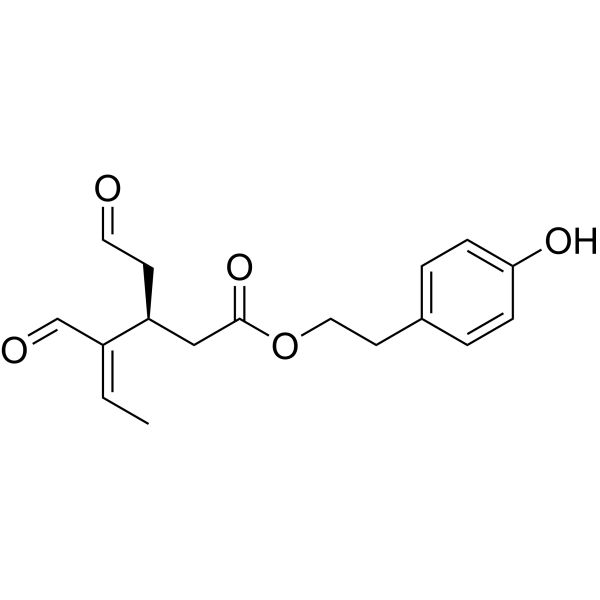
Oleocanthal is an orally active phenolic seciridoid compound. Oleocanthal can be extracted from olive oil. Oleocanthal inhibits COX-1 and COX-2, reduces ROS and NO, and upregulates Nrf-2 and HO-1. Oleocanthal reduces Aβ deposition. Oleocanthal exhibits anti-Leishmania activity against promastigotes and amastigotes of L. major, with IC50 values of 18.7 and 87 μg/mL, respectively. Oleocanthal exhibits anticancer activity against colon, breast, liver, and melanoma cancers. Oleocanthal also exhibits anti-inflammatory and neuroprotective properties. Oleocanthal can be used in Alzheimer's disease research.
For research use only. We do not sell to patients.
- Purity : 95.04%
- CAS No.: 289030-99-5
- Formula: C17H20O5
- Molecular Weight:304.34
-
Storage:
-20°C, protect from light, stored under nitrogen
* In solvent : -80°C, 6 months; -20°C, 1 month (protect from light, stored under nitrogen)

To place orders, for customer services and technical support, please contact: MedChemExpress USA
Tel: 609-228-6898 E-mail: [email protected] [email protected]


-
 Biological Activity
-
Chemical Information
- Protocols
- Purity & Documentation
- References
-
 Help & FAQs


All Parasite Isoforms
More

Biological Activity
Description
|
COX-1 |
COX-2 |
Leishmania |
HO-1 |
Cellular Effect
|
Cell Line

|
Type | Value | Description | References |
|---|---|---|---|---|
| A549 | IC50 |
10 μM
Compound: 50
|
Antiproliferative activity against human A549 cells assessed as reduction in cell viability incubated for 24 hrs by MTT assay
Antiproliferative activity against human A549 cells assessed as reduction in cell viability incubated for 24 hrs by MTT assay
|
[PMID: 38733884] |
| MDA-MB-231 | IC50 |
15 μM
Compound: 1
|
Cytotoxicity against human MDA-MB-231 cells after 24 hrs by MTT assay
Cytotoxicity against human MDA-MB-231 cells after 24 hrs by MTT assay
|
[PMID: 23403296] |
| MDA-MB-231 | IC50 |
7.5 μM
Compound: 1
|
Antimigratory activity against human MDA-MB-231 cells after 24 hrs by wound healing assay
Antimigratory activity against human MDA-MB-231 cells after 24 hrs by wound healing assay
|
[PMID: 23403296] |
| NCI-H322M | IC50 |
26.3 μM
Compound: 50
|
Antiproliferative activity against human NCI-H322M cells assessed as cell growth inhibition incubated for 72 hrs by MTT assay
Antiproliferative activity against human NCI-H322M cells assessed as cell growth inhibition incubated for 72 hrs by MTT assay
|
[PMID: 38733884] |
In Vitro
Oleocanthal (25-100 μM) reduces ROS, nitrites, and pro-inflammatory cytokines levels in LPS-stimulated murine peritoneal macrophages[1].
Oleocanthal (1-25 μM; 12 h) decreases LPS-induced NOS2 synthesis and NO production in ATDC-5 chondrocytes[2].
Oleocanthal (0-200 μg/mL; 48-60 h) inhibits the growth of L. major promastigotes and amastigotes, presenting IC50 values of 18.7 and 87 μg/mL, respectively[5].
Oleocanthal shows inhibitory activity against COX-1 and COX-2 enzymes[6].
MedChemExpress (MCE) has not independently confirmed the accuracy of these methods. They are for reference only. Further protocols information, click here.
-
Cell Line:murine peritoneal macrophages
-
Concentration:25 μM, 50 μM, 100 μM
-
Incubation Time:30 min
-
Result:Upregulated protein expression of Nrf-2 (25 μM: 1.57; 50 μM: 1.54; 100 μM: 1.63) and HO-1 (25 μM: 2.12; 50 μM: 2.24; 100 μM: 1.92).
In Vivo
Oleocanthal (5 mg/kg b.w.; i.p.; 3 times/week; 16 total doses) suppresses footpad thickness, decreases parasite load, and induces Th1-type immunity in L. major-infected BALB/c mice[5].
MedChemExpress (MCE) has not independently confirmed the accuracy of these methods. They are for reference only.
-
Animal Model:Male wild-type C57BL/6J and 5xFAD mice (4 and 9 months of age)[3]
-
Dosage:10 mg/kg
-
Administration:Oral gavage, daily, for 3 months
-
Result:Improved metabolic parameters (body weight, food and water intake, energy expenditure, etc.) and behavioral parameters (sleep patterns, anxiety-like behavior).
Reduced brain Aβ levels and IgG extravasation (improved BBB function).
Increased sleep hours and decreased movement related to anxiety-like behavior.
Clinical Trial
| NCT Number | Sponsor | Condition | Start Date |
Phase
|
|---|---|---|---|---|
| NCT01329991 | Plexxikon| | 2011-05 | PHASE1 |


Chemical Information
-
CAS No. 289030-99-5
-
Appearance Solid
-
Molecular Weight 304.34
-
Formula C17H20O5
-
Color White to off-white
-
SMILES
C/C=C([C@H](CC(OCCC1=CC=C(C=C1)O)=O)CC=O)/C=O
-
Structure Classification
-
Initial Source
-
Shipping
Room temperature in continental US; may vary elsewhere.
-
Storage
-20°C, protect from light, stored under nitrogen
* In solvent : -80°C, 6 months; -20°C, 1 month (protect from light, stored under nitrogen)

Protocols
-
ROS/oxidative-stress fluorescent staining
ROS/oxidative-stress fluorescent staining uses cell-permeant fluorogenic probes that become fluorescent after oxidation inside cells or tissues; commonly used examples include DCFH-DA/DCFDA for broad cellular oxidant detection, DHE for superoxide-related signal detection, MitoSOX for mitochondrial superoxide-related signal detection, and CellROX probes for oxidative-stress-associated fluorescence readouts. The assay detects probe oxidation rather than a single ROS species unless the probe and analysis method have been chemically validated for that species. DCFH-DA enters cells, is deacetylated by intracellular esterases to DCFH, and produces fluorescent DCF after oxidation, so the readout is used as an operational measure of total cellular oxidative stress rather than a species-specific ROS measurement. DHE and MitoSOX can report superoxide-related oxidation, but red fluorescence alone can include non-specific ethidium-like oxidation products; HPLC or optimized spectral approaches are
-
Research Protocol for Inflammation-related Diseases
The NLRP3 inflammasome is a cytosolic innate immune signaling platform that integrates priming signals and danger-signal activation to promote caspase-1 activation, maturation of IL-1β and IL-18, and gasdermin D-mediated pyroptotic cell death. The core experimental logic is to determine whether inflammatory disease phenotypes are driven by increased NLRP3 expression, ASC-containing inflammasome assembly, caspase-1 cleavage, GSDMD cleavage, and extracellular release of IL-1β/IL-18 rather than by nonspecific cell injury alone. The pathway is strongly linked to inflammation-related disease phenotypes because monosodium urate crystals activate NALP3/NLRP3 inflammasome signaling in gout-like crystal inflammation, cholesterol crystals activate NLRP3 inflammasomes in atherogenesis models, and DSS-induced intestinal inflammation has been reported to involve NLRP3 inflammasome activity. However, experimental colitis studies also show context-dependent protective effects of NLRP3 inflammasome co
-
Alzheimer’s Disease Modeling
Alzheimer’s Disease (AD) is a neurodegenerative disorder characterized by a progressive decline in cognitive functions and loss of specific types of neurons and synapses. Alzheimer's symptoms can be simulated in mice by injecting drugs (such as Aβ) or genetically modified.


Purity & Documentation
-
Data Sheet (273 KB)
-
SDS (394 KB)
- English - EN (394 KB)
- Français - FR (394 KB)
- Deutsch - DE (394 KB)
- Norwegian - NO (394 KB)
- Español - ES (394 KB)
- Swedish - SV (394 KB)
- Italian - IT (394 KB)
- Korean - KR (394 KB)
- Portuguese - PT (394 KB)
-
Handling Instructions (2659 KB)
References
[1]. Montoya T, et al. Oleocanthal Modulates LPS-Induced Murine Peritoneal Macrophages Activation via Regulation of Inflammasome, Nrf-2/HO-1, and MAPKs Signaling Pathways. J Agric Food Chem. 2019 May 15;67(19):5552-5559. [Content Brief]
[2]. Iacono A, et al. Effect of oleocanthal and its derivatives on inflammatory response induced by lipopolysaccharide in a murine chondrocyte cell line. Arthritis Rheum. 2010 Jun;62(6):1675-82. [Content Brief]
[3]. Yang E, et al. Oleocanthal Ameliorates Metabolic and Behavioral Phenotypes in a Mouse Model of Alzheimer's Disease. Molecules. 2023 Jul 23;28(14):5592. [Content Brief]
[5]. Karampetsou K, et al. Exploring the Immunotherapeutic Potential of Oleocanthal against Murine Cutaneous Leishmaniasis. Planta Med. 2022 Aug;88(9-10):783-793. [Content Brief]
[6]. Costa V, et al. Anti-Inflammatory Activity of Olive Oil Polyphenols-The Role of Oleacein and Its Metabolites. Biomedicines. 2022 Nov 21;10(11):2990. [Content Brief]

Calculators
Concentration (start) × Volume (start) = Concentration (final) × Volume (final)


Oleocanthal Related Classifications
HY-124481 Related Classifications
 Powered by Bioz