



ICRF-196
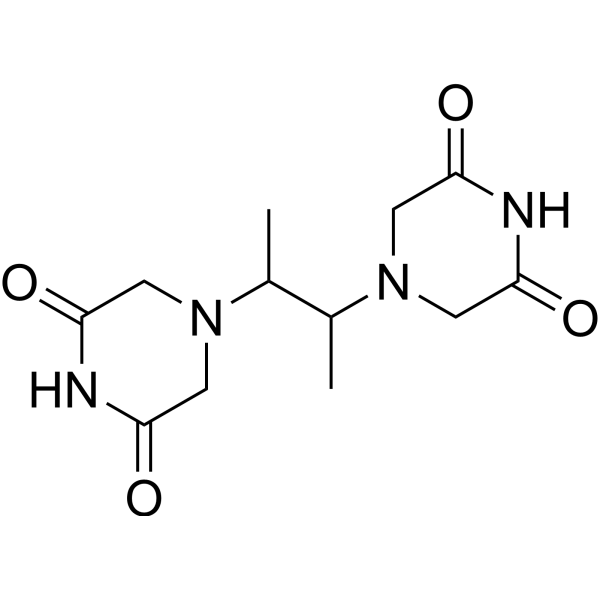
ICRF-196 is an racemic mixture of the (S,S)- and (R,R)-isomers of ICRF-193 (HY-118590). ICRF-193 is a DNA Topoisomerase II inhibitor. ICRF-193 can inhibit DNA syntheses and induces apoptosis. ICRF-193 exhibits anti-cancer and anti-inflammation effects. ICRF-193 shows cardioprotective effect against anthracycline toxicity to cardiomyocytes. ICRF-193 can be used for the researches of cancer, infection, inflammation and cardiovascular disease, such as acute promyelocytic leukemia.
Nos produits utilisent uniquement pour la recherche. Nous ne vendons pas aux patients.
- CAS No.: 21416-68-2
- Formule: C12H18N4O4
- Masse moléculaire:282.30
-
Stockage:
Please store the product under the recommended conditions in the Certificate of Analysis.

To place orders, for customer services and technical support, please contact: MedChemExpress USA
Tel: 609-228-6898 E-mail: [email protected] [email protected]


-
 Activité biologique
-
Chemical Information
- Protocole
- Pureté et documentation
- Références
-
 Help & FAQs


Voir tous les produits spécifiques à Isoform Topoisomerase
MoreVoir tous les produits spécifiques à Isoform DNA/RNA Synthesis
More

Activité biologique
Description
IC50 & Target
[1]|
Topoisomerase II |
In Vitro
ICRF-193 (10-100 μM, 2 h) induces mitotic defects in fission yeast cells expressing histone H2A-RFP, α-tubulin Atb2-GFP and spindle pole body protein Sid4-GFP[1].
ICRF-193 (100 μM. 2 h) inhibits its own induced snapped spindles and induces unequal chromosome segregation and unequal chromosome segregation in fission yeast cells[1].
ICRF-193 (100 μM, 4 h) alters nuclear morphology and DNA content in cdc11-123 fission yeast mutant[1].
ICRF-193 (100 μM, 8 h) reduces cell viability in wild-type fission yeast[1].
ICRF-193 (5 days) inhibits the growth of human acute promyelocytic leukemia (APL) cell lines (NB4, HT-93) and other myeloid leukemia cell lines (HL-60, U937) with IC50 of 0.21-0.26 μM[2].
ICRF-193 (0.1-0.2 μM, 5 days) induces granulocytic differentiation of NB4, HT-93, HL-60, and U937 cells[2].
ICRF-193 (0.2 μM, 48 h) significantly downregulates the level of PML-RAR fusion protein and upregulates p21 and RARβ levels in NB4 cells[2].
ICRF-193 (10 μM) inhibits cells arrested at the quiescent (G0) phase reentry into the S phase and inhibits DNA syntheses in murine spleen cells[3].
ICRF-193 (150 nM, 72 h) inhibits LPS (HY-D1056)-induced IL-1β secretion in human macrophage[4].
ICRF-193 decreases DNA fragmentation induced by Etoposide (HY-13629) and induces apoptosis in murine thymocytes[6].
MedChemExpress (MCE) has not independently confirmed the accuracy of these methods. They are for reference only.


Chemical Information
-
CAS No. 21416-68-2
-
Masse moléculaire 282.30
-
Formule C12H18N4O4
-
SMILES
CC(N(C1)CC(NC1=O)=O)C(N(C2)CC(NC2=O)=O)C
-
Livraison
Room temperature in continental US; may vary elsewhere.
-
Stockage
Please store the product under the recommended conditions in the Certificate of Analysis.


Pureté et documentation
Références
[1]. Nakazawa N, et al. ICRF-193, an anticancer topoisomerase II inhibitor, induces arched telophase spindles that snap, leading to a ploidy increase in fission yeast. Genes Cells. 2016 Sep;21(9):978-93. [Content Brief]
[2]. Niitsu N, et al. The catalytic DNA topoisomerase II inhibitor ICRF-193 and all-trans retinoic acid cooperatively induce granulocytic differentiation of acute promyelocytic leukemia cells: candidate drugs for chemo-differentiation therapy against acute promyelocytic leukemia. Exp Hematol. 2002 Nov;30(11):1273-82. [Content Brief]
[3]. Hossain MS, et al. ICRF-193, a catalytic inhibitor of DNA topoisomerase II, inhibits re-entry into the cell division cycle from quiescent state in mammalian cells. Genes Cells. 2002 Mar;7(3):285-94 [Content Brief]
[4]. Brindle A, et al. The Bisdioxopiperazine ICRF-193 Attenuates LPS-induced IL-1β Secretion by Macrophages. Inflammation. 2024 Feb;47(1):84-98. [Content Brief]
[5]. Jirkovská A, et al. Structure-Activity Relationship Study of Dexrazoxane Analogues Reveals ICRF-193 as the Most Potent Bisdioxopiperazine against Anthracycline Toxicity to Cardiomyocytes Due to Its Strong Topoisomerase IIβ Interactions. J Med Chem. 2021 Apr 8;64(7):3997-4019. [Content Brief]
[6]. Tanimoto C, et al. ICRF-193 modifies etoposide-induced apoptosis in thymocytes. Acta Med Okayama. 1995 Dec;49(6):281-6. [Content Brief]

Calculators
Concentration (start) × Volume (start) = Concentration (final) × Volume (final)


ICRF-196 Related Classifications
HY-118590A Related Classifications
 Powered by Bioz