



Dapsone-13C12

Based on 1 Customer Validation
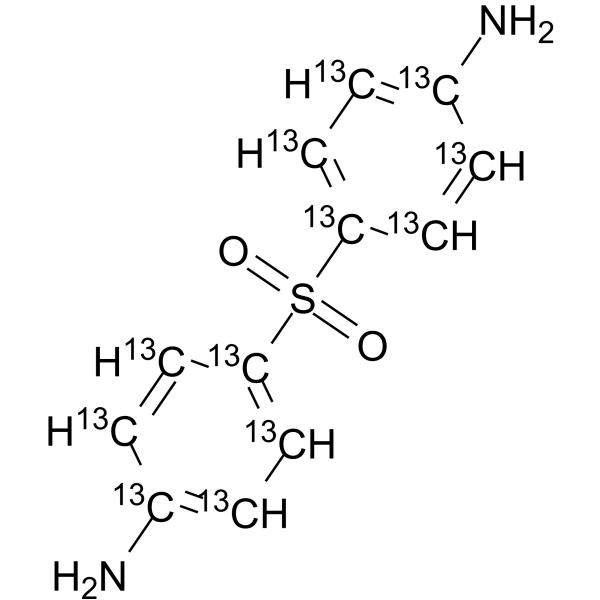
Dapsone-13C12 is the 13C12 labeled Dapsone (HY-B0688). Dapsone (4,4′-Diaminodiphenyl sulfone) is an orally active and blood-brain penetrant sulfonamide antibiotic with bacteriostatic, antimycobacterial and antiprotozoal activities. Dapsone exerts effective antileprosy activity and inhibits folate synthesis in cell extracts of M. leprae. Dapsone is used for dermatologic disorder research, including leprosy, dermatitis herpetiformis, acne vulgaris et al.
For research use only. We do not sell to patients.
- Purity : 99.42%
- CAS No.: 1632119-29-9
- Formula: 13C12H12N2O2S
- Molecular Weight:260.21
-
Storage:Powder -20°C, 3 years , 4°C, 2 years ; In solvent -80°C, 6 months , -20°C, 1 month

To place orders, for customer services and technical support, please contact: MedChemExpress USA
Tel: 609-228-6898 E-mail: [email protected] [email protected]


-
 Biological Activity
-
Chemical Information
- Protocols
- Purity & Documentation
- References
-
 Help & FAQs




Biological Activity
Description
In Vitro
Stable heavy isotopes of hydrogen, carbon, and other elements have been incorporated into drug molecules, largely as tracers for quantitation during the drug development process. Deuteration has gained attention because of its potential to affect the pharmacokinetic and metabolic profiles of drugs[1].
MedChemExpress (MCE) has not independently confirmed the accuracy of these methods. They are for reference only.
Application
1. This compound can be used as a tracer
2. This compound can be used as an internal standard for quantitative analysis by NMR, GC-MS, or LC-MS.


Chemical Information
-
CAS No. 1632119-29-9
-
Unlabeled CAS 80-08-0
-
Appearance Solid
-
Molecular Weight 260.21
-
Formula 13C12H12N2O2S
-
Color White to off-white
-
SMILES
O=S([13C]1=[13CH][13CH]=[13C]([13CH]=[13CH]1)N)([13C]2=[13CH][13CH]=[13C]([13CH]=[13CH]2)N)=O
-
Synonyms
4,4′-Diaminodiphenyl sulfone-13C12; DDS-13C12
-
Shipping
Room temperature in continental US; may vary elsewhere.
-
Storage
Powder -20°C 3 years 4°C 2 years In solvent -80°C 6 months -20°C 1 month


Purity & Documentation
-
Data Sheet (276 KB)
-
SDS (392 KB)
- English - EN (392 KB)
- Français - FR (392 KB)
- Deutsch - DE (392 KB)
- Norwegian - NO (392 KB)
- Español - ES (392 KB)
- Swedish - SV (392 KB)
- Italian - IT (392 KB)
- Korean - KR (392 KB)
- Portuguese - PT (392 KB)
-
Handling Instructions (2659 KB)
References
[1]. Russak EM, et al. Impact of Deuterium Substitution on the Pharmacokinetics of Pharmaceuticals. Ann Pharmacother. 2019 Feb;53(2):211-216. [Content Brief]
[2]. Y I Zhu, et al. Dapsone and sulfones in dermatology: overview and update. J Am Acad Dermatol [Content Brief]
[3]. Dapsone, Drug.com
[4]. D Voeller, et al. Interaction of Pneumocystis carinii dihydropteroate synthase with sulfonamides and diaminodiphenyl sulfone (dapsone).J Infect Dis. 1994 Feb;169(2):456-9. [Content Brief]
[5]. Esther Moreno, et al. Evaluation of Skin Permeation and Retention of Topical Dapsone in Murine Cutaneous Leishmaniasis Lesions.Pharmaceutics. 2019 Nov 13;11(11):607. [Content Brief]

Calculators
Concentration (start) × Volume (start) = Concentration (final) × Volume (final)


Dapsone-13C12 Related Classifications
HY-B0688S2 Related Classifications
 Powered by Bioz