



dBRD9 dihydrochloride
Based on 2 publication(s) in Google Scholar
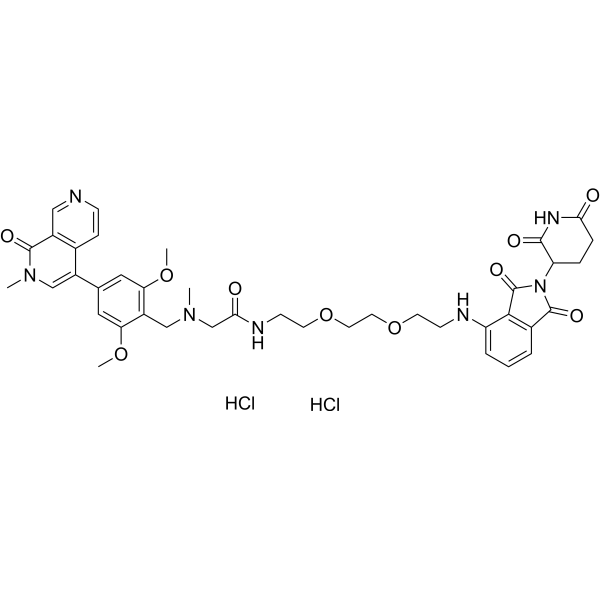
dBRD9 dihydrochloride is a BRD9 PROTAC degrader. dBRD9 dihydrochloride reduces the binding of the ISGF3 complex to ISG promoters, decreases the level of ISG induction downstream of IFNAR signaling, and reduces the chromatin binding of BRD4 at BRD9 co-binding sites. dBRD9 dihydrochloride can be used in research related to acute myeloid leukemia.
(Pink: BRD9 ligand (HY-100351); Blue: Cereblon ligand (HY-14658); Black: linker (HY-128833)).
For research use only. We do not sell to patients.
- Purity : 99.91%
- CAS No.: 2341840-98-8
- Formula: C40H47Cl2N7O10
- Molecular Weight:856.75
-
Storage:
4°C, sealed storage, away from moisture
* In solvent : -80°C, 6 months; -20°C, 1 month (sealed storage, away from moisture)

To place orders, for customer services and technical support, please contact: MedChemExpress USA
Tel: 609-228-6898 E-mail: [email protected] [email protected]


-
 Biological Activity
-
Chemical Information
-
Solvent & Solubility
- Purity & Documentation
- References
-
 Help & FAQs


Publications Citing Use of MedChemExpress (MCE) dBRD9 dihydrochloride
MoreAll PROTACs Isoforms
More

Biological Activity
Description
IC50 & Target
|
BRD9 |
In Vitro
dBRD9 (0.5-5000 nM; 4 h) hydrochloride induces dose-dependent degradation of BRD9 in MOLM-13 cells, with no off-target degradation of BRD4 or BRD7 detected[1].
dBRD9 (7 days potently inhibits the proliferation of EOL-1 and MOLM-13 acute myeloid leukemia (AML) hydrochloride cells, with an efficacy 10 to 100 times higher than that of non-degradable BRD9 probes[1].
dBRD9 (3 μM; 24 h) hydrochloride selectively reduces the induction of IFNAR-dependent secondary response genes (including interferon-stimulated genes) hydrochloride in Lipid A-stimulated mouse bone marrow-derived macrophages, without affecting primary response genes or IFN-β production[2].
dBRD9 (3 μM; 24 h) hydrochloride induces widespread loss of BRD9 chromatin binding as well as partial loss of BRD4 binding in Lipid A-stimulated mouse bone marrow-derived macrophages, which correlates with reduced ISGF3 complex binding and downregulation of interferon-stimulated genes[2].
dBRD9 (3 μM; 24 h) hydrochloride does not impair the induction of IRF9 and STAT2 proteins in Lipid A-stimulated mouse bone marrow-derived macrophages[2].
MedChemExpress (MCE) has not independently confirmed the accuracy of these methods. They are for reference only.
-
Cell Line:human acute myeloid leukemia (MOLM-13) cells
-
Concentration:0.5, 5, 50, 500 and 5000 nM
-
Incubation Time:4 h
-
Result:Observed marked dose-dependent BRD9 loss across the tested concentrations.
Detected no off-target degradation of BRD4 or BRD7 at any tested concentration, unlike a comparator degrader.


Chemical Information
-
CAS No. 2341840-98-8
-
Appearance Solid
-
Molecular Weight 856.75
-
Formula C40H47Cl2N7O10
-
Color Light yellow to yellow
-
SMILES
O=C(NCCOCCOCCNC1=CC=CC(C(N2C(CC3)C(NC3=O)=O)=O)=C1C2=O)CN(CC4=C(OC)C=C(C(C5=CC=NC=C65)=CN(C)C6=O)C=C4OC)C.Cl.Cl
-
Shipping
Room temperature in continental US; may vary elsewhere.
-
Storage
4°C, sealed storage, away from moisture
* In solvent : -80°C, 6 months; -20°C, 1 month (sealed storage, away from moisture)


Publications (2)
-
Journal Impact Factor
-
Most Recent
-
-
Nat Commun
ARID1A loss drives gastric signet ring cell carcinoma by regulating mucin production and secretion. [Abstract]2026 Jun 2. PMID: 42230634


Solvent & Solubility
In Vitro:
DMSO : 50 mg/mL (58.36 mM; Need ultrasonic; Hygroscopic DMSO has a significant impact on the solubility of product, please use newly opened DMSO)
Please refer to the solubility information to select the appropriate solvent. Once prepared, please aliquot and store the solution to prevent product inactivation from repeated freeze-thaw cycles.
Storage method and period of stock solution: -80°C, 6 months; -20°C, 1 month (sealed storage, away from moisture). When stored at -80°C, please use it within 6 months. When stored at -20°C, please use it within 1 month.
Please refer to the solubility information to select the appropriate solvent. Once prepared, please aliquot and store the solution to prevent product inactivation from repeated freeze-thaw cycles.
Storage method and period of stock solution: -80°C, 6 months; -20°C, 1 month (sealed storage, away from moisture). When stored at -80°C, please use it within 6 months. When stored at -20°C, please use it within 1 month.
Concentration (start) × Volume (start) = Concentration (final) × Volume (final)


Purity & Documentation
-
Data Sheet (273 KB)
-
SDS (252 KB)
- English - EN (252 KB)
- Français - FR (252 KB)
- Deutsch - DE (252 KB)
- Norwegian - NO (252 KB)
- Español - ES (252 KB)
- Swedish - SV (252 KB)
- Italian - IT (252 KB)
- Korean - KR (252 KB)
- Portuguese - PT (252 KB)
-
Handling Instructions (2659 KB)
References
[1]. Remillard D, et al. Degradation of the BAF Complex Factor BRD9 by Heterobifunctional Ligands. Angewandte Chemie (International ed. in English). 2017 May 15;56(21):5738-5743. [Content Brief]
[2]. Ahmed NS, et al. BRD9 regulates interferon-stimulated genes during macrophage activation via cooperation with BET protein BRD4. Proceedings of the National Academy of Sciences of the United States of America. 2022 Jan 04;119(1):e2110812119. [Content Brief]


Complete Stock Solution Preparation Table
Please refer to the solubility information to select the appropriate solvent. Once prepared, please aliquot and store the solution to prevent product inactivation from repeated freeze-thaw cycles.
Storage method and period of stock solution: -80°C, 6 months; -20°C, 1 month (sealed storage, away from moisture). When stored at -80°C, please use it within 6 months. When stored at -20°C, please use it within 1 month.
| Optional Solvent | Concentration Solvent Mass | 1 mg | 5 mg | 10 mg | 25 mg |
|---|---|---|---|---|---|
| DMSO | 1 mM | 1.1672 mL | 5.8360 mL | 11.6720 mL | 29.1800 mL |
| 5 mM | 0.2334 mL | 1.1672 mL | 2.3344 mL | 5.8360 mL | |
| 10 mM | 0.1167 mL | 0.5836 mL | 1.1672 mL | 2.9180 mL | |
| 15 mM | 0.0778 mL | 0.3891 mL | 0.7781 mL | 1.9453 mL | |
| 20 mM | 0.0584 mL | 0.2918 mL | 0.5836 mL | 1.4590 mL | |
| 25 mM | 0.0467 mL | 0.2334 mL | 0.4669 mL | 1.1672 mL | |
| 30 mM | 0.0389 mL | 0.1945 mL | 0.3891 mL | 0.9727 mL | |
| 40 mM | 0.0292 mL | 0.1459 mL | 0.2918 mL | 0.7295 mL | |
| 50 mM | 0.0233 mL | 0.1167 mL | 0.2334 mL | 0.5836 mL |


dBRD9 dihydrochloride Related Classifications
HY-117690A Related Classifications
 Powered by Bioz