



CTS-1027
Based on 4 publication(s) in Google Scholar
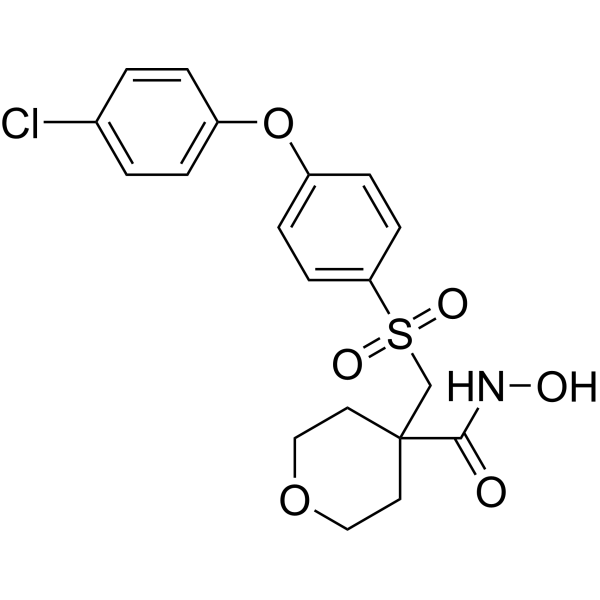
CTS-1027 is a potent small molecule inhibitor of MMPs, with IC50s of 0.3 nM, 0.5 nM for MMP2, MMP13, respectively, and has > 1,000 fold selectivity over MMP1.
For research use only. We do not sell to patients.
- Purity: 99.24%
- CAS No.: 193022-04-7
- Formula: C19H20ClNO6S
- Molecular Weight:425.88
-
Storage:Powder -20°C, 3 years , 4°C, 2 years ; In solvent -80°C, 2 years , -20°C, 1 year

To place orders, for customer services and technical support, please contact: MedChemExpress USA
Tel: 609-228-6898 E-mail: [email protected] [email protected]


-
 Biological Activity
-
Chemical Information
-
Solvent & Solubility
- Protocol
- Purity & Documentation
- References
-
 Help & FAQs
-

Immunology/Inflammation Compound Library
HY-L007
-
Metabolism/Protease Compound Library
HY-L012
-
Clinical Compound Library
HY-L026
-
Drug Repurposing Compound Library
HY-L035
-
Differentiation Inducing Compound Library
HY-L038
-
Anti-Pancreatic Cancer Compound Library
HY-L077
-
Angiogenesis-Related Compound Library
HY-L088
-
Anti-Pulmonary Fibrosis Compound Library
HY-L125
-
Heterocyclic Compound Library
HY-L138
-
Pain-Related Compound Library
HY-L139
-
Protease Inhibitor Library
HY-L147
-
Bioactive Compound Library Max
HY-L181
-
MCE Bioactive Compound Library
HY-L001V
-
Drug Repurposing Compound Library Plus
HY-L035P
-
Clinical Compound Library Plus
HY-L026P
-
Bioactive Compound Library
HY-L001
-
Anti-Fibrosis Compound Library
HY-L185
-
High-Throughput Bioactive Compound Library
HY-L205


Publications Citing Use of MedChemExpress (MCE) CTS-1027
More

Biological Activity
IC50: 0.2 nM (MMP2), 0.5 nM (MMP13), 0.7 nM (MMP12), 0.9 nM (MMP8), 9.5 nM (MMP3), 15 nM (MMP14)
MedChemExpress (MCE) has not independently confirmed the accuracy of these methods. They are for reference only.
| NCT Number | Sponsor | Condition | Start Date |
Phase

|
|---|---|---|---|---|
| NCT01329991 | Plexxikon| | 2011-05 | PHASE1 |


Chemical Information
-
CAS No. 193022-04-7
-
Appearance Solid
-
Molecular Weight 425.88
-
Formula C19H20ClNO6S
-
Color White to off-white
-
SMILES
O=C(NO)C1(CCOCC1)CS(=O)(C2=CC=C(C=C2)OC3=CC=C(C=C3)Cl)=O
-
Synonyms
Ro 1130830; RS 130830
-
Shipping
Room temperature in continental US; may vary elsewhere.
-
Storage
Powder -20°C 3 years 4°C 2 years In solvent -80°C 2 years -20°C 1 year


Publications (4)
-
Journal Impact Factor
-
Most Recent
-
Virulence
Monkeypox virus replication and host response in vaginal and ectocervical epithelial cells. [Abstract]2026 Mar 25:2649986. PMID: 41880196 -
-
-
ACS Comb Sci
Benzimidazolyl-pyrazolo[3,4- b]pyridinones, Selective Inhibitors of MOLT-4 Leukemia Cell Growth and Sea Urchin Embryo Spiculogenesis: Target Quest. [Abstract]2019 Dec 9;21(12):805-816. PMID: 31689077


Solvent & Solubility
DMSO : ≥ 100 mg/mL (234.81 mM; Hygroscopic DMSO has a significant impact on the solubility of product, please use newly opened DMSO)
* "≥" means soluble, but saturation unknown.
Please refer to the solubility information to select the appropriate solvent. Once prepared, please aliquot and store the solution to prevent product inactivation from repeated freeze-thaw cycles.
Storage method and period of stock solution: -80°C, 2 years; -20°C, 1 year. When stored at -80°C, please use it within 2 years. When stored at -20°C, please use it within 1 year.
Please refer to the solubility information to select the appropriate solvent. Once prepared, please aliquot and store the solution to prevent product inactivation from repeated freeze-thaw cycles.
Storage method and period of stock solution: -80°C, 2 years; -20°C, 1 year. When stored at -80°C, please use it within 2 years. When stored at -20°C, please use it within 1 year.
Concentration (start) × Volume (start) = Concentration (final) × Volume (final)
Select the appropriate dissolution method based on your experimental animal and administration route.
- For the following dissolution methods, please ensure to first prepare a clear stock solution using an In Vitro approach and then sequentially add co-solvents:
- To ensure reliable experimental results, the clarified stock solution can be appropriately stored based on storage conditions. As for the working solution for In Vivo experiments, it is recommended to prepare freshly and use it on the same day.
- The percentages shown for the solvents indicate their volumetric ratio in the final prepared solution. If precipitation or phase separation occurs during preparation, heat and/or sonication can be used to aid dissolution.
Add each solvent one by one: 10% DMSO 40% PEG300 5% Tween-80 45% Saline
Solubility: ≥ 2.5 mg/mL (5.87 mM); Clear solution
This protocol yields a clear solution of ≥ 2.5 mg/mL (saturation unknown).
Taking 1 mL working solution as an example, add 100 μL DMSO stock solution (25.0 mg/mL) to 400 μL PEG300, and mix evenly; then add 50 μL Tween-80 and mix evenly; then add 450 μL Saline to adjust the volume to 1 mL.
Preparation of Saline: Dissolve 0.9 g sodium chloride in ddH₂O and dilute to 100 mL to obtain a clear Saline solution.
Add each solvent one by one: 10% DMSO 90% (20% SBE-β-CD in Saline)
Solubility: ≥ 2.5 mg/mL (5.87 mM); Clear solution
This protocol yields a clear solution of ≥ 2.5 mg/mL (saturation unknown).
Taking 1 mL working solution as an example, add 100 μL DMSO stock solution (25.0 mg/mL) to 900 μL 20% SBE-β-CD in Saline, and mix evenly.
Preparation of 20% SBE-β-CD in Saline (4°C, storage for one week): 2 g SBE-β-CD powder is dissolved in 10 mL Saline, completely dissolve until clear.
Please enter the basic information of animal experiments:
-
-
-
-
Recommended: Prepare an additional quantity of animals to account for potential losses during experiments.
Please enter your animal formula composition:
-
%DMSO +
Recommended: Keep the proportion of DMSO in working solution below 2% if your animal is weak.
-
%+
-
+%Tween-80 + +
-
%Saline +
The co-solvents required include: DMSO, . All of co-solvents are available by MedChemExpress (MCE). , Tween 80. All of co-solvents are available by MedChemExpress (MCE).
Working solution concentration: 0.22 mg/mL
Method for preparing stock solution: mg drug dissolved in μL DMSO. Stock solution concentration: mg/mL.
1. Take μL DMSO stock solution;
2. Add μL .
μL , mix evenly;
3. Then add μL Tween 80, mix evenly;
4. Then add μL
Please ensure that the stock solution in the first step is dissolved to a clear state, and add co-solvents in sequence. You can use ultrasonic heating (ultrasonic cleaner, recommended frequency 20-40 kHz), vortexing, etc. to assist dissolution.

Protocol
For experimental procedures, mice are anesthetized with ketamine 60 mg/kg plus xylazine 10 mg/kg body weight by intraperitoneal injection. After a midline upper-abdominal incision, the peritoneal cavity is opened, the abdominal wall retracted, and the common hepatic bile duct is double-ligated below the bifurcation and transected between the ligatures as previously described by us in detail. Sham-operated mice, used as controls, also underwent similar laparotomy with exposure but without ligation of the common bile duct. The fascia and skin of the midline abdominal incision are closed with sterile surgical 5-0 sutures. Either CTS-1027 or the vector carboxymethylcellulose are administered by gavage in a dose of 10 mg/kg body weight once a day. Drugs are prepared freshly on the day of the study. After 14 days of BDL and gavage, mice are re-anesthetized, sacrificed and blood is obtained from the inferior vena cava for serum total bilirubin and ALT determinations and the liver is removed, cut into small pieces and either snap-frozen in liquid nitrogen for storage at −80°C or fixed in freshly prepared 4% paraformaldehyde in phosphate-buffered saline (PBS) for 48 hours at 4°C for additional studies. Liver tissue is also subjected to RNA extraction using the Trizol reagent. Serum bilirubin and ALT determinations are performed as previously described.
MedChemExpress (MCE) has not independently confirmed the accuracy of these methods. They are for reference only.


Purity & Documentation
-
Data Sheet (278 KB)
-
SDS (393 KB)
- English - EN (393 KB)
- Français - FR (393 KB)
- Deutsch - DE (393 KB)
- Norwegian - NO (393 KB)
- Español - ES (393 KB)
- Swedish - SV (393 KB)
- Italian - IT (393 KB)
- Korean - KR (393 KB)
- Portuguese - PT (393 KB)
-
Handling Instructions (2659 KB)
References
[1]. Kahraman A, et al. Matrix metalloproteinase inhibitor, CTS-1027, attenuates liver injury and fibrosis in the bile duct-ligated mouse. Hepatol Res. 2009 Aug;39(8):805-813. [Content Brief]
[2]. Johnson JL, et al. Effect of broad-spectrum matrix metalloproteinase inhibition on atherosclerotic plaque stability. Cardiovasc Res. 2006 Aug 1;71(3):586-595. [Content Brief]


Complete Stock Solution Preparation Table
Please refer to the solubility information to select the appropriate solvent. Once prepared, please aliquot and store the solution to prevent product inactivation from repeated freeze-thaw cycles.
Storage method and period of stock solution: -80°C, 2 years; -20°C, 1 year. When stored at -80°C, please use it within 2 years. When stored at -20°C, please use it within 1 year.
| Optional Solvent | Concentration Solvent Mass | 1 mg | 5 mg | 10 mg | 25 mg |
|---|---|---|---|---|---|
| DMSO | 1 mM | 2.3481 mL | 11.7403 mL | 23.4806 mL | 58.7015 mL |
| 5 mM | 0.4696 mL | 2.3481 mL | 4.6961 mL | 11.7403 mL | |
| 10 mM | 0.2348 mL | 1.1740 mL | 2.3481 mL | 5.8702 mL | |
| 15 mM | 0.1565 mL | 0.7827 mL | 1.5654 mL | 3.9134 mL | |
| 20 mM | 0.1174 mL | 0.5870 mL | 1.1740 mL | 2.9351 mL | |
| 25 mM | 0.0939 mL | 0.4696 mL | 0.9392 mL | 2.3481 mL | |
| 30 mM | 0.0783 mL | 0.3913 mL | 0.7827 mL | 1.9567 mL | |
| 40 mM | 0.0587 mL | 0.2935 mL | 0.5870 mL | 1.4675 mL | |
| 50 mM | 0.0470 mL | 0.2348 mL | 0.4696 mL | 1.1740 mL | |
| 60 mM | 0.0391 mL | 0.1957 mL | 0.3913 mL | 0.9784 mL | |
| 80 mM | 0.0294 mL | 0.1468 mL | 0.2935 mL | 0.7338 mL | |
| 100 mM | 0.0235 mL | 0.1174 mL | 0.2348 mL | 0.5870 mL |


CTS-1027 Related Classifications
HY-10398 Related Classifications
 Powered by Bioz