



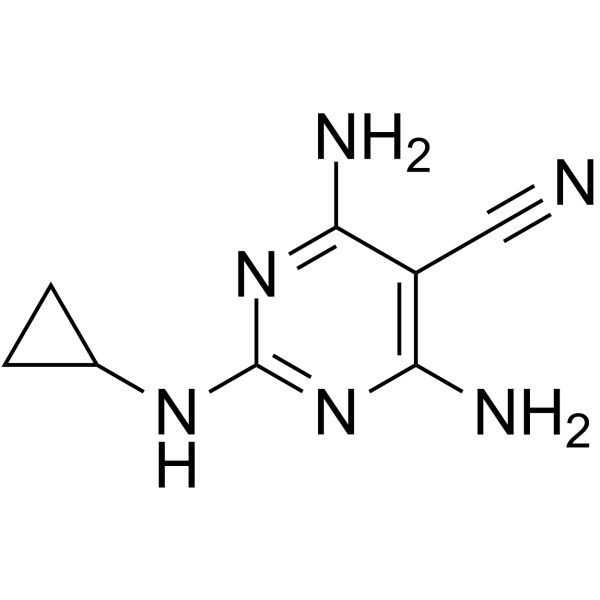
Dicyclanil

Based on 1 Customer Validation
Dicyclanil is an orally active insect growth regulator. Dicyclanil upregulates hepatic OGG1 DNA repair gene expression and Cyp1a1 expression, and generates reactive oxygen species (ROS) during microsomal oxidation. Dicyclanil induces oxidative stress, oxidative DNA damage, and female-specific hepatocellular proliferation. Dicyclanil can be used in research on hepatocellular carcinoma and myiasis.
연구목적의 판매만을 진행합니다. 환자를 대상으로 한 판매는 하지 않습니다.
- Purity : 99.18%
- CAS No.: 112636-83-6
- 화학식: C8H10N6
- 분자량:190.21
-
보관:
4°C, protect from light
* In solvent : -80°C, 6 months; -20°C, 1 month (protect from light)

To place orders, for customer services and technical support, please contact: MedChemExpress USA
Tel: 609-228-6898 E-mail: [email protected] [email protected]


-
 Biological Activity
-
Chemical Information
-
용액&용해도
- Protocol
- 순도&문서
- References
-
 Help & FAQs



All DNA/RNA Synthesis Isoforms
More

Biological Activity
제품 설명
|
CYP1A1 |
OGG1 |
In Vitro
MedChemExpress (MCE) has not independently confirmed the accuracy of these methods. They are for reference only.
In Vivo
Dicyclanil (1,500 ppm; p.o.; continuous administration; day 10 to the end of the study) combined with Clonorchis sinensis and NDMA produces proliferative bile ducts, extensive fibrosis, and grayish-white nodules in C3H/He mice, but no cholangiocarcinoma[4].
MedChemExpress (MCE) has not independently confirmed the accuracy of these methods. They are for reference only.
-
Animal Model:ICR (male, 5 weeks old at study start)[1]
-
Dosage:1,500 ppm in powdered diet
-
Administration:oral; continuous; 13 or 26 weeks
-
Result:Promoted GGT-positive foci and oxidative DNA damage in the livers of mice subjected to DMN initiation followed by partial hepatectomy.
-
Animal Model:ICR (male, 5 weeks old at study start)[1]
-
Dosage:1,500 ppm in powdered diet
-
Administration:oral; continuous; 13 or 26 weeks
-
Result:Induced GGT-positive foci and oxidative DNA damage in the livers of uninitiated mice after 26 weeks.
-
Animal Model:C3H/He (male, 4-5 weeks old, approximately 20 g)[4]
-
Dosage:1,500 ppm
-
Administration:p.o. (drinking water); continuous; day 10 to end of study
-
Result:One cystic mass-forming lesion was found in the caudate lobe, with a volume of 280.6 mm3; it was diagnosed as peliosis from dilated sinusoids.
The lesion center showed coagulative necrosis without inflammatory cells, and blood-filled cavities were present.
Bile duct dilatation and proliferation of ductal epithelial cells were observed in C. sinensis-infected groups.
Only 1 adult C. sinensis worm was recovered from a mouse.
No cholangiocarcinoma developed.
-
Animal Model:C3H/He (male, 4-5 weeks old, approximately 20 g)[4]
-
Dosage:1,500 ppm
-
Administration:p.o. (drinking water); continuous; day 10 to end of study
-
Result:Gray-white nodule prevalence was 21.4%, and the highest mean intensity of gray-white nodules was 1.7.
Histopathology showed hyperproliferation of bile ducts with fibrotic changes and extensive fibrosis.
No cholangiocarcinoma developed.
-
Animal Model:ICR (male, 5 weeks old at study start)[5]
-
Dosage:1500 ppm
-
Administration:p.o.; continuous; weeks 1-8 (7 weeks)
-
Result:Slight centrilobular hypertrophy of hepatocytes and diffuse small necrotic foci were observed.
Lipofuscin deposition was equivocal in 1/5, slight in 3/5, and absent in 1/5 mice.
Real-time RT-PCR showed up-regulation of Cyp1a1, Cyp1a2, Por, Ogg1, and Gstm6, down-regulation of Gadd45a, and a contradictory tendency for p53.
Activated NF-kB concentration showed a slight increase.


Chemical Information
-
CAS No. 112636-83-6
-
Appearance Solid
-
분자량 190.21
-
화학식 C8H10N6
-
Color White to off-white
-
SMILES
N#CC1=C(N)N=C(NC2CC2)N=C1N
-
선적
Room temperature in continental US; may vary elsewhere.
-
보관
4°C, protect from light
* In solvent : -80°C, 6 months; -20°C, 1 month (protect from light)


용액&용해도
In Vitro:
DMSO : 62.5 mg/mL (328.58 mM; Need ultrasonic; Hygroscopic DMSO has a significant impact on the solubility of product, please use newly opened DMSO)
Please refer to the solubility information to select the appropriate solvent. Once prepared, please aliquot and store the solution to prevent product inactivation from repeated freeze-thaw cycles.
Storage method and period of stock solution: -80°C, 6 months; -20°C, 1 month (protect from light). When stored at -80°C, please use it within 6 months. When stored at -20°C, please use it within 1 month.
Concentration (start) × Volume (start) = Concentration (final) × Volume (final)
In Vivo Dissolution Calculator
Please enter the basic information of animal experiments:
-
-
-
-
Recommended: Prepare an additional quantity of animals to account for potential losses during experiments.
Working solution concentration: 0.22 mg/mL


순도&문서
-
Data Sheet (283 KB)
-
SDS (393 KB)
- English - EN (393 KB)
- Français - FR (393 KB)
- Deutsch - DE (393 KB)
- Norwegian - NO (393 KB)
- Español - ES (393 KB)
- Swedish - SV (393 KB)
- Italian - IT (393 KB)
- Korean - KR (393 KB)
- Portuguese - PT (393 KB)
-
Handling Instructions (2659 KB)
References


Complete Stock Solution Preparation Table
Please refer to the solubility information to select the appropriate solvent. Once prepared, please aliquot and store the solution to prevent product inactivation from repeated freeze-thaw cycles.
Storage method and period of stock solution: -80°C, 6 months; -20°C, 1 month (protect from light). When stored at -80°C, please use it within 6 months. When stored at -20°C, please use it within 1 month.
| Optional Solvent | Concentration Solvent Mass | 1 mg | 5 mg | 10 mg | 25 mg |
|---|---|---|---|---|---|
| DMSO | 1 mM | 5.2573 mL | 26.2867 mL | 52.5735 mL | 131.4337 mL |
| 5 mM | 1.0515 mL | 5.2573 mL | 10.5147 mL | 26.2867 mL | |
| 10 mM | 0.5257 mL | 2.6287 mL | 5.2573 mL | 13.1434 mL | |
| 15 mM | 0.3505 mL | 1.7524 mL | 3.5049 mL | 8.7622 mL | |
| 20 mM | 0.2629 mL | 1.3143 mL | 2.6287 mL | 6.5717 mL | |
| 25 mM | 0.2103 mL | 1.0515 mL | 2.1029 mL | 5.2573 mL | |
| 30 mM | 0.1752 mL | 0.8762 mL | 1.7524 mL | 4.3811 mL | |
| 40 mM | 0.1314 mL | 0.6572 mL | 1.3143 mL | 3.2858 mL | |
| 50 mM | 0.1051 mL | 0.5257 mL | 1.0515 mL | 2.6287 mL | |
| 60 mM | 0.0876 mL | 0.4381 mL | 0.8762 mL | 2.1906 mL | |
| 80 mM | 0.0657 mL | 0.3286 mL | 0.6572 mL | 1.6429 mL | |
| 100 mM | 0.0526 mL | 0.2629 mL | 0.5257 mL | 1.3143 mL |


Dicyclanil Related Classifications
HY-121263 Related Classifications
 Powered by Bioz