



Development of Intestinal Organoid
2022-07-28
Organoid technology is based on stem cell technology as well as classical developmental biology and cell-mixing experiments. Intestinal epithelium is the most vigorously self-renewing tissue in adult mammals. Since 2007, Hans Clevers' laboratory has been working on different organoids development. They discovered that the Wnt target gene Lgr5 (also called GPR49), a leucine-rich orphan G protein-coupled receptor was identified in lineage-tracing studies as a potential marker of stem cells i.e. the crypt-base columnar cells (CBCs) between the Paneth cells in the mouse small intestine [1][2].
In 2009, Hans Clevers and Toshiro Sato created the first mini-gut organoids from adult stem cells derived from the mouse gut, opening a "new era" in the development of organoid technology [3].
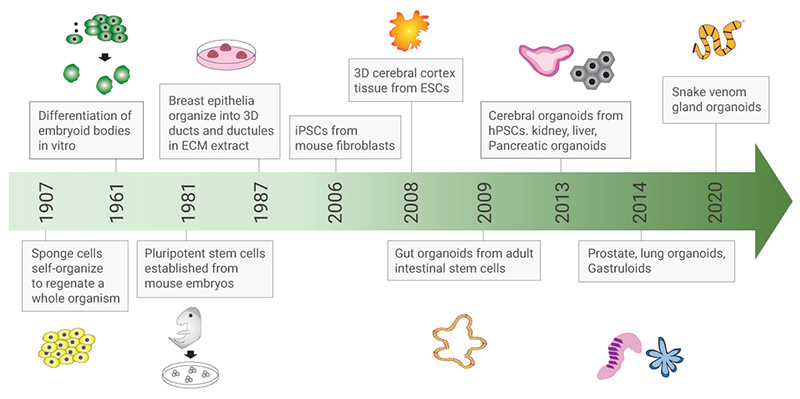
Organoids have been broadly used in a variety of fields, including disease models, drug discovery and screening, host-microbe interactions, and gut biology and development etc[4].
Furthermore, there are studies which described combining genome editing technologies, such as CRISPR/Cas9, with organoid culture systems to make organoids easy for genetic manipulation and transform it to a multi-functional system. Therefore, intestinal organoid culture system started a new generation of in vitro modeling of the intestinal epithelium, with promising applications in personalized and regenerative medicine [4].
3D intestinal organoids are composed of a closed circulating cavity, with an inner layer of intestinal epithelial cell line. Differentiated cell lineages of the intestinal epithelium include enterocytes, entero-endocrine cells, goblet cells, and Paneth cells arranged in villus region.
Intestinal organoids can be derived from both organ-restricted adult stem cells (ASCs) and pluripotent stem cells (PSCs). Organoids generated from these two stem cell sources contain all intestinal epithelial cell types found in vivo, in similar proportions and arrangements[5].
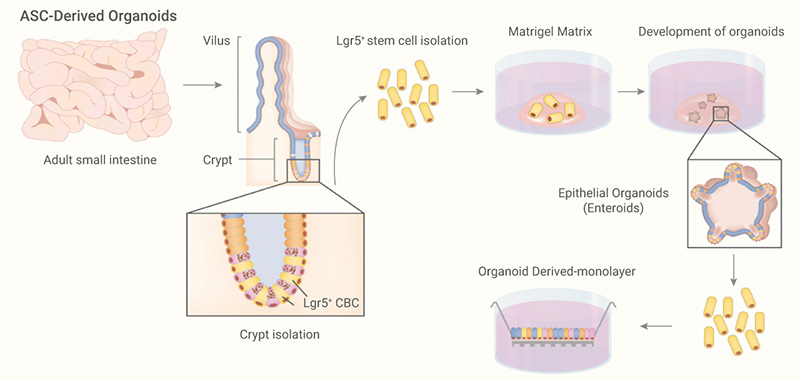
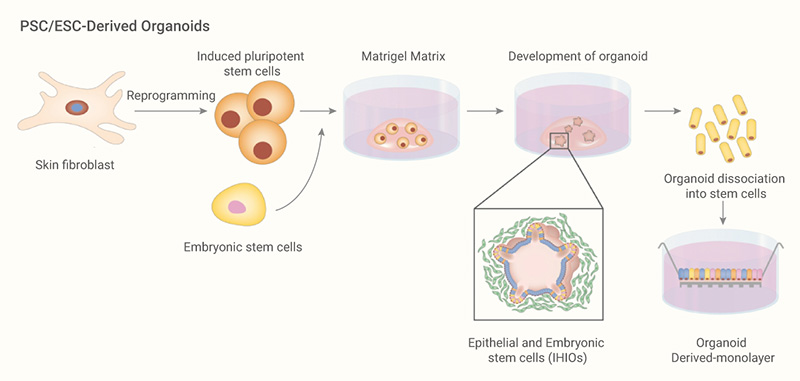
The main components for culturing organoids are extracellular matrix (ECM) and medium supplemented with growth factors that promote intestinal development. The ECM provides the necessary structural support and biochemical signals needed for the adhesion, growth and differentiation of stem cells. The formation and growth of organoids are largely dependent on components present in the media, which should mimic the signaling pathways in the in vivo stem cell niche, to maintain stem cell functions and facilitate their expansion and differentiation into organ-specific cells type[4].
Key components of intestinal organoid culture medium include Wnt-3a (W), epidermal growth factor (EGF) {E}, Noggin (N), and R-spondin-1 (R), collectively named as WENR. Adding these growth factors to the culture medium in order could modulate stem cell niche signaling pathways, including Wnt, bone morphogenetic protein (BMP) and Notch signaling pathways, and induce intestinal stem cells (ISCs) self-renewal, proliferation, and differentiation[4].
There are also some studies showing that the addition of other components to ENR medium (supplemented with EGF + Noggin + R-spondin-1) induces differentiation of stem cells toward specific fates. For example, introducing a combination of two small molecules, such as “CHIR99021 + Valproic acid” OR “LDN-193189 + CHIR99021”, can synergistically promote the maintenance of Lgr5+ ISCs in a self-renewing and undifferentiated state, resulting in ISCs-enriched cultures. A differentiated phenotype can be obtained by culturing in ENR medium supplemented with “DAPT + CHIR99021”, “Valproic acid + IWP-2” or “DAPT + IWP-2”. These molecules cooperate to induce the direct differentiation of ISCs into paneth cells, goblet cells, enterocytes and secretory cell lineage (entero-endocrine cells). It has also been suggested that the addition of DAPT or BMP is sufficient to promote the differentiation of ISCs and generate multi-lineage intestinal organoids[4].
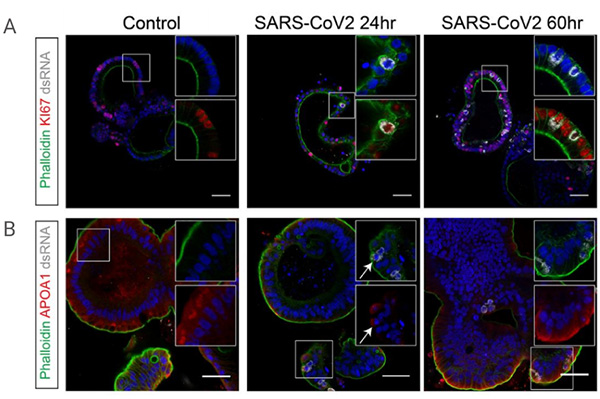
In March 2020, the Hans Clevers' research group published an article in Science; SARS-CoV-2 productively infects human gut enterocytes, visually revealing the effective infection of the human gut by SARS-CoV-2. hSIO (human small intestinal organoids) were established from primary intestinal epithelial stem cells. They set four different culture conditions (EXP, DIF, DIF-BMP, and EEC)[6]:
EXP: hSIOs grown in Wnt high-expansion (EXP) medium overwhelmingly consisted of stem cells and enterocyte progenitors, and instead of Wnt conditioned media, the medium was supplemented with Wnt surrogate (U-Protein Express).
DIF: General differentiation was achieved in ENR medium, called DIF, and organoids grown in DIF medium were enterocytes, goblet cells, and low number of entero-endocrine cells (EECs).
DIF-BMP: Removed Noggin from ‘ENR’ and supplied with BMP-2 and BMP-4 to activate BMP pathway which led to further maturation.
EEC: In the culture medium of "DIF-BMP", the expression of NeuroG3 was induced by doxycycline to increase the number of EECs.
Exposing hSIO grown in four different culture conditions (EXP, DIF, DIF-BMP, and EEC) to SARS-CoV and SARS-CoV-2, infectious particles and RNAs of both viruses increased in all conditions.

To identify the viral target cell type, confocal analyses of hSIOs cultured in EXP, DIF, or EEC conditions were performed, and results showed that the target cells of SARS-CoV-2 were proliferating in intestinal epithelial progenitor cells (under EXP conditions) and post-mitotic enterocytes (under DIF conditions), whereas secretory endocrine cells were hardly infected.
| Product Name | Cat. No | Function |
|---|---|---|
| Gastrin | HY-P1097 | A hormone with mitogenic effect on gastric cells. Used in stomach organoids culture. |
| CHIR-99021 | HY-10182 | A selective GSK3 inhibitor that can be used for the generation of organoid. |
| Y-27632 | HY-10583 | A ROCK inhibitor; used to increase the proliferation and reduce apoptosis of progenitor cells. |
| A 83-01 | HY-10432 | An inhibitor of TGF-β type I receptor ALK5, the Activin/Nodal receptor ALK4 and ALK7. |
| SB-431542 | HY-10431 | A selective TGF-β type I Receptor inhibitor; the addition of SB431542 in the culture medium prevents spontaneous differentiation of mouse embryonic stem cells. |
[2] Claudia Corrò, Vivian S.W. Li, et al. A brief history of organoids. Am J Physiol Cell Physiol. 2020 Jul 1;319(1):C151-C165.
[3] Sara Rahmani, Tohid F. Didar, et al. Intestinal organoids: A new paradigm for engineering intestinal epithelium in vitro. Biomaterials. 2019 Feb;194:195-214.
[4] Aliya Fatehullah, Nick Barker, et al. Organoids as an in vitro model of human development and disease.
[5] Mo Li, Juan C Izpisua Belmonte. Organoids — Preclinical Models of Human Disease. N Engl J Med. 2019 Feb 7;380(6):569-579.
[6] Joseph Azar, Mohamed Al-Sayegh, Wassim Abou-Kheir, et al. The Use of Stem Cell-Derived Organoids in Disease Modeling: An Update. Int J Mol Sci. 2021 Jul 17;22(14):7667.
[7] HansClevers. Modeling Development and Disease with Organoids. Cell. 2016 Jun 16;165(7):1586-1597.
[8] Kathryn L Fair, Jennifer Colquhoun, Nicholas R F Hannan. Intestinal organoids for modelling intestinal development and disease. Philos Trans R Soc Lond B Biol Sci. 2018 Jul 5;373(1750):20170217.
[9] Toshiro Sato, Hans Clevers, et al. Single Lgr5 stem cells build crypt-villus structures in vitro without a mesenchymal niche. Nature. 2009 May 14;459(7244):262-5.
[10] Madeline A Lancaster, Juergen A Knoblich. Organogenesis in a dish: modeling development and disease using organoid technologies. Science. 2014 Jul 18;345(6194):1247125.
[11] Mo Li, Juan C Izpisua Belmonte. Organoids - Preclinical Models of Human Disease. N Engl J Med. 2019 Feb 7;380(6):569-579.
[12] Mart M Lamers, Hans Clevers, et al. SARS-CoV-2 productively infects human gut enterocytes. Science . 2020 Jul 3;369(6499):50-54.
 LinkedIn
 Researchgate
 Instagram
 X
X Facebook
 WhatsApp
 Reddit
 Mail
Mail