



Pirlimycin
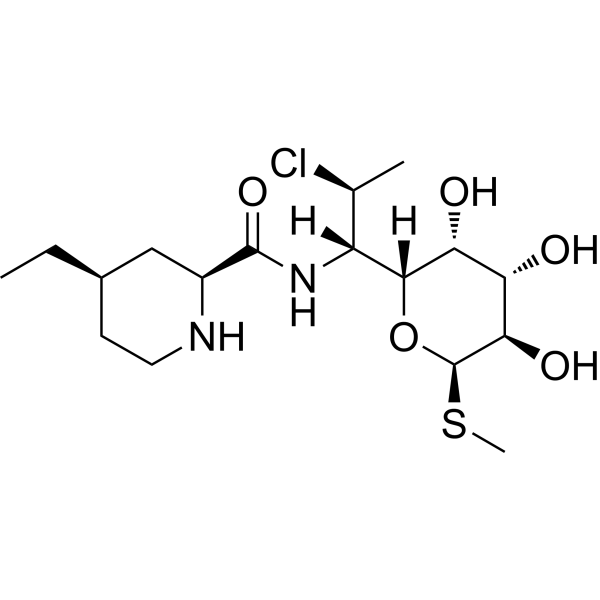
Pirlimycin is an orally active lincosamide Antibiotic, Clindamycin (HY-B1455) analog, and antimalarial agent. Pirlimycin inhibits Plasmodium growth. Pirlimycin exhibits antibacterial activity against various aerobic bacteria, particularly Staphylococcus and Streptococcus species. Pirlimycin can be used for research on bovine mastitis.
For research use only. We do not sell to patients.
- CAS No.: 79548-73-5
- Formula: C17H31ClN2O5S
- Molecular Weight:410.96
-
Storage:
Please store the product under the recommended conditions in the Certificate of Analysis.

To place orders, for customer services and technical support, please contact: MedChemExpress USA
Tel: 609-228-6898 E-mail: [email protected] [email protected]


-
 Biological Activity
-
Chemical Information
- Protocols
- Purity & Documentation
- References
-
 Help & FAQs


-
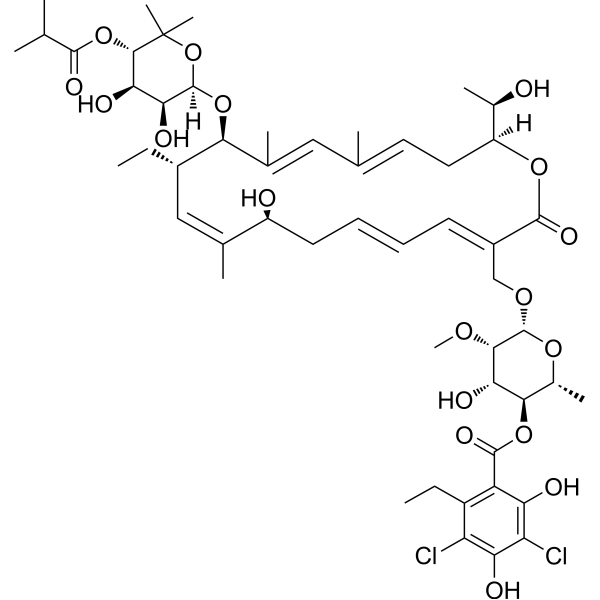
HY-17580
FidaxomicinAntibacterial Agent -
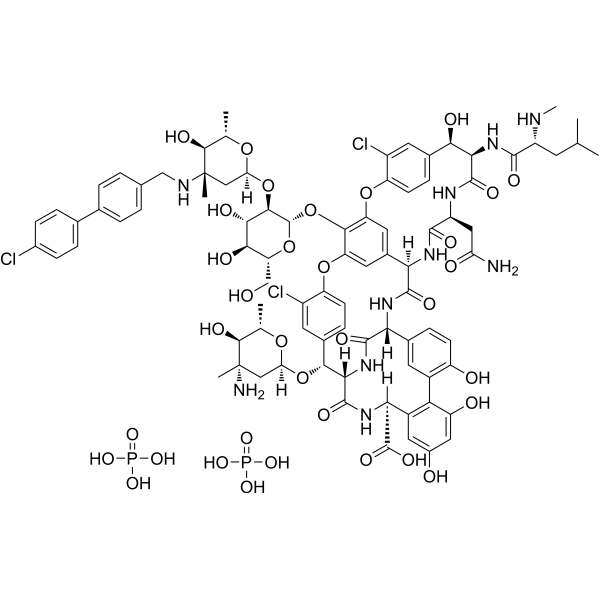
HY-B1831A
Oritavancin diphosphateAntibiotic, ArlS Kinase Inhibitor -
HY-P3078
AmphomycinLipopeptide Antibiotic -
HY-N6686
Virginiamycin M1Antibiotic -

HY-17580R
Fidaxomicin (Standard)Antibacterial Agent -

HY-B1831AR
Oritavancin diphosphate (Standard)Antibiotic, ArlS Kinase Inhibitor -

HY-N6686R
Virginiamycin M1 (Standard)Antibiotic


Biological Activity
Description
In Vitro
Pirlimycin (0.5-4.0 μg/mL; 20-24 h) exhibits high overall in vitro activity against Streptococcus agalactiae isolates from bovine mastitis (83.7% susceptible, overall MIC50 = 0.5 μg/mL; MIC90 >4 μg/mL)[3].
Pirlimycin (0.5-4.0 μg/mL; 20-24 h) is susceptible to both Cluster Ia and Cluster II Streptococcus agalactiae isolates (MIC50 and MIC90 = 0.5 μg/mL), whereas Cluster Ib isolates show significantly reduced susceptibility[3].
Pirlimycin exhibits in vitro antibacterial activity against a variety of aerobic bacteria, particularly Staphylococcus and Streptococcus species, with MIC values ranging from ≤0.012 to >25 μg/mL[4].
MedChemExpress (MCE) has not independently confirmed the accuracy of these methods. They are for reference only. Further protocols information, click here.
In Vivo
Pirlimycin (intramammary injection; 1 h post-infection) combined with rhTNF-α significantly reduces intramammary S. aureus bacterial counts, exhibiting an additive effect compared with either agent alone in a mouse model of staphylococcal mastitis[6].
MedChemExpress (MCE) has not independently confirmed the accuracy of these methods. They are for reference only.
-
Animal Model:CF-1 (male, 18-20 g)[4]
-
Dosage:0.4 mg/kg (S. aureus, s.c.); 2.9 mg/kg (S. aureus, p.o.); 0.25 mg/kg (S. pyogenes, s.c.); 2.9 mg/kg (S. pyogenes, p.o.); 1.7 mg/kg (S. pneumoniae I, s.c.); 20.3 mg/kg (S. pneumoniae I, p.o.); 2.7 mg/kg (S. pneumoniae III, s.c.); 17.7 mg/kg (S. pneumoniae III, p.o.); <6.25 mg/kg (B. fragilis, s.c.); 16 mg/kg (P. berghei, s.c.); >50 mg/kg (P. berghei, p.o.)
-
Administration:s.c. or p.o.; daily; 4 days
-
Result:Demonstrated superior activity to clindamycin against S. aureus, S. pyogenes, and S. pneumoniae.
Achieved CD50 of 0.4 mg/kg (s.c.) and 2.9 mg/kg (p.o.) against S. aureus UC 76.
Achieved CD50 of 0.25 mg/kg (s.c.) and 2.9 mg/kg (p.o.) against S. pyogenes UC 152.
Achieved CD50 of 1.7 mg/kg (s.c.) and 20.3 mg/kg (p.o.) against S. pneumoniae I UC 41.
Achieved CD50 of 2.7 mg/kg (s.c.) and 17.7 mg/kg (p.o.) against S. pneumoniae III UC 3213.
Achieved CD50 of <6.25 mg/kg (s.c.) against Bacteroides fragilis UC 6428.
Achieved CD50 of 16 mg/kg (s.c.) and >50 mg/kg (p.o.) against Plasmodium berghei.
Was inactive at the highest levels tested against K. pneumoniae, P. vulgaris, E. coli, and P. multocida.
-
Animal Model:CF1 mice (female, second or third lactation dams with approximately 10 pups each, pups 1-4 d old)[6]
-
Dosage:A certain dosage
-
Administration:intramammary; 1 h postinfection
-
Result:Reduced bacterial counts in the mammary gland to 4.8 log10 cfu/g at 18 h postinfection.
Reduced bacterial counts to 2.8 log10 cfu/g when combined with rhTNF-α (10,000 ng per mouse), which was significantly greater than either agent alone.


Chemical Information
-
CAS No. 79548-73-5
-
Molecular Weight 410.96
-
Formula C17H31ClN2O5S
-
SMILES
O=C([C@@H]1C[C@@H](CCN1)CC)N[C@]([C@@]2([H])O[C@@H]([C@H](O)[C@@H](O)[C@H]2O)SC)([H])[C@@H](Cl)C
-
Shipping
Room temperature in continental US; may vary elsewhere.
-
Storage
Please store the product under the recommended conditions in the Certificate of Analysis.

Protocols
-
Research Protocol for Infectious Diseases
Infectious-disease experiments test how pathogens interact with host barriers, innate immune receptors, inflammatory signaling, pathogen replication, and tissue injury; pattern-recognition receptors such as TLRs, RIG-I-like receptors, NOD-like receptors, and inflammasomes detect microbial molecules and activate NF-κB, interferon, and cytokine responses. The central hypothesis is that infection severity reflects the balance between pathogen burden and host response: protective inflammation restricts pathogen growth, whereas excessive or mislocalized inflammation contributes to tissue damage and disease phenotype. Unresolved questions include which host pathways are protective versus pathogenic, why some infection models fail to translate to human disease, and which combined readouts best predict clinically relevant infection outcomes.
-
Aerobic Bacterial Batch Culture on Broth/Agar
Aerobic bacterial batch culture grows a closed inoculated population in broth or on agar without continuous medium replacement; growth readouts include turbidity/OD for total suspended biomass and colony-forming units for viable cells able to form colonies on agar. OD-based growth curves reflect light scattering by cells, but OD is instrument-, pathlength-, species-, cell-size-, and density-dependent, so OD should be calibrated or interpreted alongside viable counts when quantitative cell density is required.
-
Bacterial live/dead nucleic-acid viability staining
The LIVE/DEAD bacterial viability staining method is based on differential permeability of nucleic-acid-binding fluorescent dyes, most commonly SYTO 9 and propidium iodide (PI), which enables discrimination of bacterial populations with intact versus compromised cytoplasmic membranes. SYTO 9 penetrates both intact and damaged bacterial membranes and binds nucleic acids to produce green fluorescence, whereas propidium iodide penetrates only cells with compromised membranes and fluoresces red while also reducing SYTO 9 signal through competitive binding and fluorescence interactions. The resulting fluorescence pattern is interpreted as a proxy for membrane integrity, which is widely used as an indicator of bacterial viability in microscopy, flow cytometry, and spectroscopic platforms. However, mechanistic studies show that SYTO 9 and PI interactions involve displacement and fluorescence resonance energy transfer effects, which can influence signal interpretation depending on dye ratios a


Purity & Documentation
References

Calculators
Concentration (start) × Volume (start) = Concentration (final) × Volume (final)


Pirlimycin Related Classifications
HY-106597 Related Classifications
 Powered by Bioz