



RGB-286147

Based on 1 Customer Validation
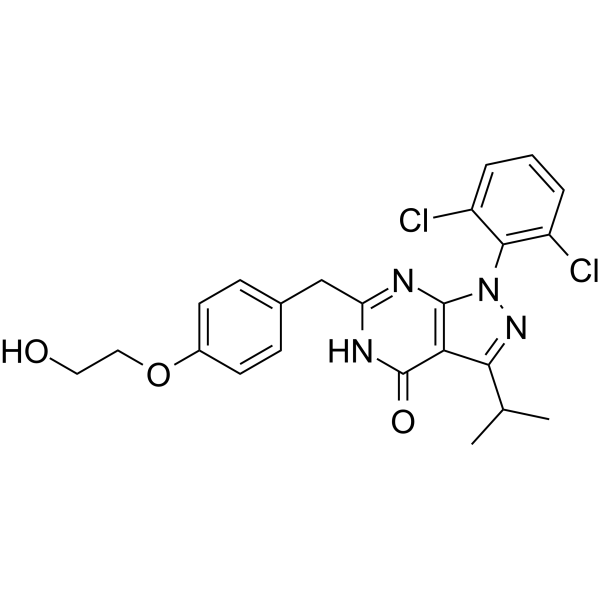
RGB-286147 is a selective and ATP-competitive CDK and CDK-related kinases (CRK) inhibitor with IC50 values ranging from 9-839 nM. RGB-286147 shows less active against other non-CDK/CRK kinases. RGB-286147 induces cell apoptosis, and exhibits anti-tumor activity.
For research use only. We do not sell to patients.
- Purity : 98.60%
- CAS No.: 784211-09-2
- Formula: C23H22Cl2N4O3
- Molecular Weight:473.35
-
Storage:
-20°C, sealed storage, away from moisture
* In solvent : -80°C, 6 months; -20°C, 1 month (sealed storage, away from moisture)

To place orders, for customer services and technical support, please contact: MedChemExpress USA
Tel: 609-228-6898 E-mail: [email protected] [email protected]


-
 Biological Activity
-
Chemical Information
-
Solvent & Solubility
- Protocols
- Purity & Documentation
- References
-
 Help & FAQs




Biological Activity
Description
IC50 & Target
[1]|
CDK1/cyclinB 48 nM (IC50) |
CDK2/E 15 nM (IC50) |
CDK4/D1 839 nM (IC50) |
cdk6/cyclin D3 232 nM (IC50) |
In Vitro
RGB-286147 (50-100 nM; 24-48 hr) induces cell cycle arrest in the G1 phase, causes a marked inhibition of DNA replication, and induces apoptosis in HCT116 cells[1].
RGB-286147 (100 nM; 48 hr) results in proteolytic cleavage of PARP in HCT116 cells[1].
RGB-286147 (24-72 hr) shows potent and irreversible cell killing activity in HCT116 cells. The IC50 value for inhibition of colony formation by RGB-286147 is 57 nM[1].
RGB-286147 (48 hr) exhibits broad anti-tumor activity with an average GI50 value of <10 nM for 60 tumorigenic cell lines. And also inhibits growth of non-cycling HCT116 cells with an IC50 value of 40 nM[1].
MedChemExpress (MCE) has not independently confirmed the accuracy of these methods. They are for reference only.
-
Cell Line:HCT116 cells
-
Concentration:50 nM and 100 nM
-
Incubation Time:24 or 48 hr
-
Result:Caused a marked inhibition of DNA replication and induced cell cycle arrest.
-
Cell Line:HCT116 cells
-
Concentration:100 nM
-
Incubation Time:48 hr
-
Result:Resulted in proteolytic cleavage of PARP.


Chemical Information
-
CAS No. 784211-09-2
-
Appearance Solid
-
Molecular Weight 473.35
-
Formula C23H22Cl2N4O3
-
Color White to off-white
-
SMILES
O=C1C2=C(N(C3=C(Cl)C=CC=C3Cl)N=C2C(C)C)N=C(CC4=CC=C(OCCO)C=C4)N1
-
Shipping
Room temperature in continental US; may vary elsewhere.
-
Storage
-20°C, sealed storage, away from moisture
* In solvent : -80°C, 6 months; -20°C, 1 month (sealed storage, away from moisture)


Solvent & Solubility
In Vitro:
DMSO : 30 mg/mL (63.38 mM; Need ultrasonic and warming; Hygroscopic DMSO has a significant impact on the solubility of product, please use newly opened DMSO)
Please refer to the solubility information to select the appropriate solvent. Once prepared, please aliquot and store the solution to prevent product inactivation from repeated freeze-thaw cycles.
Storage method and period of stock solution: -80°C, 6 months; -20°C, 1 month (sealed storage, away from moisture). When stored at -80°C, please use it within 6 months. When stored at -20°C, please use it within 1 month.
Please refer to the solubility information to select the appropriate solvent. Once prepared, please aliquot and store the solution to prevent product inactivation from repeated freeze-thaw cycles.
Storage method and period of stock solution: -80°C, 6 months; -20°C, 1 month (sealed storage, away from moisture). When stored at -80°C, please use it within 6 months. When stored at -20°C, please use it within 1 month.
Concentration (start) × Volume (start) = Concentration (final) × Volume (final)


Purity & Documentation
-
Data Sheet (273 KB)
-
SDS (252 KB)
- English - EN (252 KB)
- Français - FR (252 KB)
- Deutsch - DE (252 KB)
- Norwegian - NO (252 KB)
- Español - ES (252 KB)
- Swedish - SV (252 KB)
- Italian - IT (252 KB)
- Korean - KR (252 KB)
- Portuguese - PT (252 KB)
-
Handling Instructions (2659 KB)
References


Complete Stock Solution Preparation Table
Please refer to the solubility information to select the appropriate solvent. Once prepared, please aliquot and store the solution to prevent product inactivation from repeated freeze-thaw cycles.
Storage method and period of stock solution: -80°C, 6 months; -20°C, 1 month (sealed storage, away from moisture). When stored at -80°C, please use it within 6 months. When stored at -20°C, please use it within 1 month.
| Optional Solvent | Concentration Solvent Mass | 1 mg | 5 mg | 10 mg | 25 mg |
|---|---|---|---|---|---|
| DMSO | 1 mM | 2.1126 mL | 10.5630 mL | 21.1260 mL | 52.8150 mL |
| 5 mM | 0.4225 mL | 2.1126 mL | 4.2252 mL | 10.5630 mL | |
| 10 mM | 0.2113 mL | 1.0563 mL | 2.1126 mL | 5.2815 mL | |
| 15 mM | 0.1408 mL | 0.7042 mL | 1.4084 mL | 3.5210 mL | |
| 20 mM | 0.1056 mL | 0.5282 mL | 1.0563 mL | 2.6408 mL | |
| 25 mM | 0.0845 mL | 0.4225 mL | 0.8450 mL | 2.1126 mL | |
| 30 mM | 0.0704 mL | 0.3521 mL | 0.7042 mL | 1.7605 mL | |
| 40 mM | 0.0528 mL | 0.2641 mL | 0.5282 mL | 1.3204 mL | |
| 50 mM | 0.0423 mL | 0.2113 mL | 0.4225 mL | 1.0563 mL | |
| 60 mM | 0.0352 mL | 0.1761 mL | 0.3521 mL | 0.8803 mL |


RGB-286147 Related Classifications
HY-112346 Related Classifications
 Powered by Bioz