1. Search Result
Search Result
Results for "

free amino acids

" in MedChemExpress (MCE) Product Catalog:

49

Inhibitors & Agonists

2

Screening Libraries

2

Biochemical Assay Reagents

3

Peptides

3

Natural
Products

2

Isotope-Labeled Compounds

1

Click Chemistry

Cat. No. Product Name Target Research Areas Chemical Structure
  • HY-14520
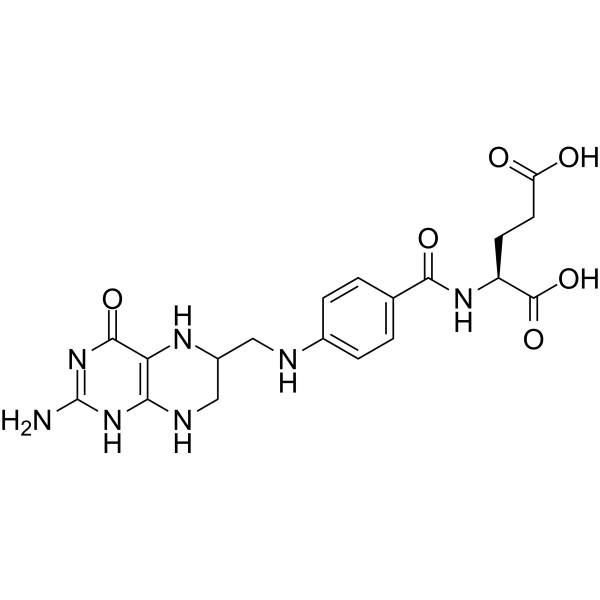
    Tetrahydrofolic acid
    5+ Cited Publications

    L-5,6,7,8-Tetrahydrofolic acid; L-Tetrahydrofolic acid

    Endogenous Metabolite Metabolic Disease
    Tetrahydrofolic acid (L-5,6,7,8-Tetrahydrofolic acid) is the biologically active vitamin B9 folate derivative. Tetrahydrofolic acid is a donor of one-carbon groups for amino acids, nucleic acids, and lipids. Tetrahydrofolic acid serves as an acceptor of free formaldehyde, producing 5,10-methylenetetrahydrofolate-Tetrahydrofolic acid .
    Tetrahydrofolic acid
  • HY-153126

    Biochemical Assay Reagents Bacterial Infection Metabolic Disease
    Yeast extract is a concentrate of the soluble components of yeast, especially Saccharomyces cerevisiae. Yeast extract is rich in nutritional components such as partially hydrolyzed proteins, free amino acids, B vitamins, and minerals. As a food ingredient, Yeast extract has both nutritional and flavoring properties. Yeast extract can also promote wound healing .
    Yeast extract
  • HY-NP008

    Lipocalin Family Inflammation/Immunology
    β-Lactoglobulin, a major whey protein, is a small globular protein from the lipocalin family. β-Lactoglobulin is an important source of the essential and branched-chain amino acids (leucine, isoleucine, and valine). β-Lactoglobulin shows antioxidant properties, because it contains two disulfide bonds and one free thiol group. β-Lactoglobulin is a ligand transport agent. β-Lactoglobulin is one of the major allergens in milk and can be utilized in the research for developing safe hypoallergenic dairy products .
    β-Lactoglobulin
  • HY-P2746

    EC 3.4.2.2

    Endogenous Metabolite Metabolic Disease
    Carboxypeptidase B, Porcine pancreas (EC 3.4.2.2) is a peptide exonuclease that can specifically degrade peptide chains. Carboxypeptidase B is progressively degraded from the C-terminal to release free amino acids. Carboxypeptidase B hydrolyzes only peptide bonds with basic amino acids (such as arginine and lysine) as C-terminal residues .
    Carboxypeptidase B, Porcine pancreas
  • HY-E70201

    EC 3.4.2.2 (MS grade)

    Endogenous Metabolite Others
    Carboxypeptidase B (MS grade) is a peptide exonuclease that can specifically degrade peptide chains. Carboxypeptidase B (MS grade) is progressively degraded from the C-terminal to release free amino acids. Carboxypeptidase B (MS grade) hydrolyzes only peptide bonds with basic amino acids (such as arginine and lysine) as C-terminal residues .
    Carboxypeptidase B (MS grade)
  • HY-14520S

    Isotope-Labeled Compounds Endogenous Metabolite Metabolic Disease
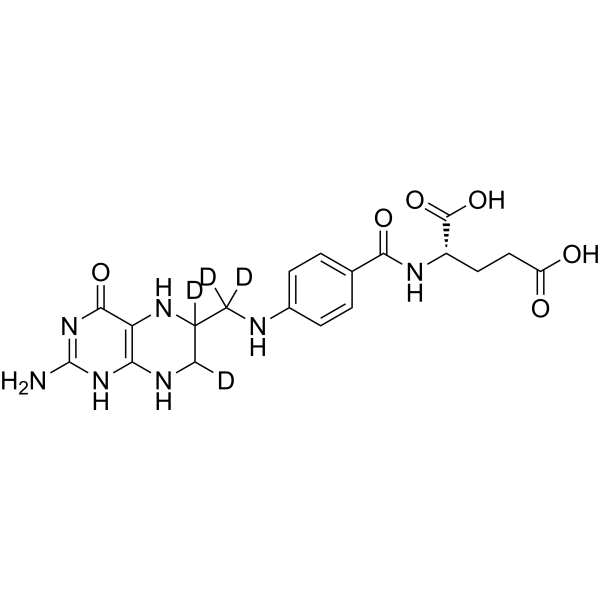
    Tetrahydrofolic acid-d4 is the deuterium labeled Tetrahydrofolic acid. Tetrahydrofolic acid (L-5,6,7,8-Tetrahydrofolic acid) is the biologically active vitamin B9 folate derivative. Tetrahydrofolic acid is a donor of one-carbon groups for amino acids, nucleic acids, and lipids. Tetrahydrofolic acid serves as an acceptor of free formaldehyde, producing 5,10-methylenetetrahydrofolate-Tetrahydrofolic acid .
    Tetrahydrofolic acid-d4
  • HY-W012001

    PROTAC Linkers Cancer
    Boc-7-Aminoheptanoic acid can be used as a PROTAC linker in the synthesis of PROTACs and other conjugation applications. Boc-7-Aminoheptanoic acid is an alkane chain with terminal carboxlic acid and Boc-protected amino groups. The terminal carboxylic acid can react with primary amine groups in the presence of activators (e.g. EDC, or HATU) to form a stable amide bond. The Boc group can be deprotected under mild acidic conditions to form the free amine.
    N-Boc-7-aminoheptanoic acid
  • HY-42773

    1-Boc-1,8-diaminooctane

    PROTAC Linkers Cancer
    tert-Butyl (8-aminooctyl)carbamate (1-Boc-1,8-diaminooctane) can be used as a PROTAC linker in the synthesis of PROTACs. tert-butyl (8-aminooctyl)carbamate is an alkane chain with terminal amine and Boc-protected amino groups. Amine group is reactive with carboxylic acids, activated NHS esters, carbonyls (ketone, aldehyde) etc. The Boc group can be deprotected under mild acidic conditions to form the free amine.
    tert-Butyl (8-aminooctyl)carbamate
  • HY-W013494R

    Reference Standards Endogenous Metabolite Metabolic Disease Cancer
    L-Carnosine (Standard) is the analytical standard of L-Carnosine. This product is intended for research and analytical applications. L-Carnosine is a dipeptide of the amino acids beta-alanine and histidine and has the potential to suppress many of the biochemical changes that accompany aging. In Vitro: L-Carnosine is a dipeptide of the amino acids beta-alanine and histidine and has the potential to suppress many of the biochemical changes that accompany aging .
    L-Carnosine also exhibits some antioxidant effects. The antioxidant mechanism of L-Carnosine is attributed to its chelating effect against metal ions, superoxide dismutase (SOD)-like activity, and ROS and free radicals scavenging ability .
    L-Carnosine (Standard)
  • HY-W041856

    Boc-8-aminooctanoic acid

    PROTAC Linkers Cancer
    N-Boc-8-amino-octanoic acid (Boc-8-aminooctanoic acid) can be used as a PROTAC linker in the synthesis of PROTACs. N-Boc-8-amino-octanoic acid is an alkane chain with terminal carboxlic acid and Boc-protected amino groups. The terminal carboxylic acid can react with primary amine groups in the presence of activators (e.g. EDC, or HATU) to form a stable amide bond. The Boc group can be deprotected under mild acidic conditions to form the free amine.
    N-Boc-8-amino-octanoic acid
  • HY-14520S1

    L-5,6,7,8-Tetrahydrofolic acid-13C5; L-Tetrahydrofolic acid-13C5

    Isotope-Labeled Compounds Endogenous Metabolite Metabolic Disease
    Tetrahydrofolic acid- 13C5 (L-5,6,7,8-Tetrahydrofolic acid- 13C5) is 13C labeled Tetrahydrofolic acid. Tetrahydrofolic acid (L-5,6,7,8-Tetrahydrofolic acid) is the biologically active vitamin B9 folate derivative. Tetrahydrofolic acid is a donor of one-carbon groups for amino acids, nucleic acids, and lipids. Tetrahydrofolic acid serves as an acceptor of free formaldehyde, producing 5,10-methylenetetrahydrofolate-Tetrahydrofolic acid .
    Tetrahydrofolic acid-13C5
  • HY-W047688

    1-Boc-1,10-diaminodecane

    PROTAC Linkers Cancer
    tert-Butyl (10-aminodecyl) carbamate (1-Boc-1,10-diaminodecane) is a synthetic intermediate that serves as a PROTAC linker in PROTAC synthesis and other conjugation applications. tert-Butyl (10-aminodecyl) carbamate is an alkane chain with a terminal amine and a Boc-protected amino group. The amine group can react with carboxylic acids, active NHS esters, carbonyl groups (ketones, aldehydes), etc. The Boc group can be deprotected under mild acidic conditions to form a free amine .
    tert-Butyl (10-aminodecyl)carbamate
  • HY-W039729

    Biochemical Assay Reagents Others
    5-(Boc-amino)-1-pentanol is a linker containing a hydroxyl group and Boc-protected amino group. The hydroxyl group enables further derivatization or replacement with other reactive functional groups. The Boc group can be deprotected under mild acidic conditions to form the free amine.
    5-(Boc-amino)-1-pentanol
  • HY-W005828

    PROTAC Linkers Cancer
    9-(Boc-amino)nonanoic Acid is an alkane chain with terminal carboxlic acid and Boc-protected amino groups. 9-(Boc-amino)nonanoic acid can be used as a PROTAC linker in the synthesis of PROTACs. The terminal carboxylic acid can react with primary amine groups in the presence of activators (e.g. EDC, or HATU) to form a stable amide bond. The Boc group can be deprotected under mild acidic conditions to form the free amine.
    9-(Boc-amino)nonanoic acid
  • HY-42222

    Biochemical Assay Reagents Others
    N1,N5-Bis-Boc-spermidine is a linker containing an amino group with two Boc-protected amino groups. The amino group is reactive with carboxylic acids, activated NHS esters, carbonyls (ketone, aldehyde) etc. The Boc group can be deprotected under mild acidic conditions to form the free amine.
    N1,N5-Bis-boc-spermidine
  • HY-W879040

    Biochemical Assay Reagents Others
    Sulfo-DBCO-NHS ester is a click chemistry reagent containing an azide group. The DBCO group is commonly used for copper-free Click Chemistry reactions due to its strain promoted high energy. NHS ester can bind to amino acids or other molecules containing amino groups .
    Sulfo-DBCO-NHS ester
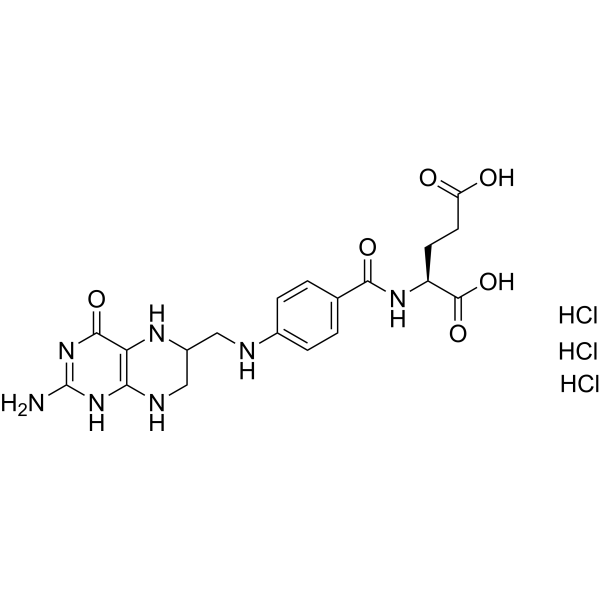
  • HY-14520B

    L-5,6,7,8-Tetrahydrofolic acid trihydrochloride; L-Tetrahydrofolic acid trihydrochloride

    Endogenous Metabolite Metabolic Disease
    Tetrahydrofolic acid (L-5,6,7,8-Tetrahydrofolic acid) trihydrochloride is the biologically active vitamin B9 folate derivative. Tetrahydrofolic acid trihydrochloride is a donor of one-carbon groups for amino acids, nucleic acids, and lipids. Tetrahydrofolic acid trihydrochloride serves as an acceptor of free formaldehyde, producing 5,10-methylenetetrahydrofolate-Tetrahydrofolic acid .
    Tetrahydrofolic acid trihydrochloride
  • HY-165595

    5 alpha Reductase Endocrinology
    The glutamic acid-alanine-glycine mixture is an orally active activator of testosterone 5α-reductase (5α-reductase). It promotes prostate function by enhancing the activity of 5α-reductase and increasing the levels of free amino acids. However, when combined with testosterone and estradiol (HY-B0141R), the glutamic acid-alanine-glycine mixture inhibits 5α-reductase activity and decreases the levels of free amino acids. The glutamic acid-alanine-glycine mixture can be used in research related to prostate function and endocrine disorders .
    Glutamic acid-alanine-glycine mixture
  • HY-W101722

    PROTAC Linkers Cancer
    tert-Butyl (9-aminononyl)carbamate is an alkane chain with terminal amine and Boc-protected amino groups. The compound can be used as a PROTAC linker in the synthesis of PROTACs and other conjugation applications. Amine group is reactive with carboxylic acids, activated NHS esters, carbonyls (ketone, aldehyde) etc. The Boc group can be deprotected under mild acidic conditions to form the free amine.
    tert-Butyl (9-aminononyl)carbamate
  • HY-W089232

    PROTAC Linkers Cancer
    Boc-10-Aminodecanoic acid can be used as a PROTAC linker in the synthesis of PROTACs and other conjugation applications. Boc-10-Aminodecanoic acid is an alkane chain with terminal carboxlic acid and Boc-protected amino groups. The terminal carboxylic acid can react with primary amine groups in the presence of activators (e.g. EDC, or HATU) to form a stable amide bond. The Boc group can be deprotected under mild acidic conditions to form the free amine.
    Boc-10-Aminodecanoic acid
  • HY-W101723

    PROTAC Linkers Cancer
    Boc-12-Ado-OH can be used as a PROTAC linker in the synthesis of PROTACs. Boc-12-Ado-OH is an alkane chain with terminal carboxlic acid and Boc-protected amino groups. The terminal carboxylic acid can react with primary amine groups in the presence of activators (e.g. EDC, or HATU) to form a stable amide bond. The Boc group can be deprotected under mild acidic conditions to form the free amine.
    Boc-12-Ado-OH
  • HY-P10972

    Glucose-dependent Insulinotropic Peptide (22-51) (human)

    NF-κB MMP Calcium Channel Cardiovascular Disease Neurological Disease
    GIP (22-51) human (Glucose-dependent Insulinotropic Peptide (22-51) human) is a potent proatherosclerotic peptide hormone consisting of 30 amino acids. GIP (22-51) human can activate the NF-κB signaling pathway, promote the expression of MMP-8, and induce the expression of proinflammatory and proatherosclerotic proteins. GIP (22-51) human can also increase the level of intracellular free Ca 2+ in THP-1-induced macrophages. GIP (22-51) human can be used in the research of atherosclerosis .
    GIP (22-51) human
  • HY-42213

    Biochemical Assay Reagents Others
    N1,N4-Bis-Boc-spermidine is a linker containing an amino group with two Boc-protected amino groups. The amino group is reactive with carboxylic acids, activated NHS esters, carbonyls (ketone, aldehyde) etc. The Boc group can be deprotected under mild acidic conditions to form the free amine.
    N1,N4-Bis-Boc-spermidine
  • HY-W092176

    Biochemical Assay Reagents Others
    1,9-Bis-Boc-1,5,9-triazanonane is a linker containing two Boc-protected amino groups. The Boc groups can be deprotected under mild acidic conditions to form the free amines.
    1,9-Bis-boc-1,5,9-triazanonane
  • HY-W190905

    Biochemical Assay Reagents Others
    N4, N9-di-Boc-spermine is a spermine linker containing two a Boc-protected amino groups and two amine groups. The Boc groups can be deprotected under mild acidic conditions to form the free amine. The amino groups are reactive with carboxylic acids, activated NHS esters, carbonyls (ketone, aldehyde) etc. Spermidine is a polyamine that modulates various cellular activities like cellular development and differentiation, stability of DNA, and apoptosis.
    N4,N9-di-Boc-spermine
  • HY-P10279

    Human atrial natriuretic factor (102–126)

    Natriuretic Peptide Receptor (NPR) Cardiovascular Disease Others
    Anaritide is a synthetic form of atrial natriuretic peptide (ANP) composed of 25 amino acids. Anaritide increases glomerular filtration rate by dilating into and contracting out the bulbar arterioles. Anaritide can be used to study the effects on patients with acute tubular necrosis, particularly in improving dialysis free survival .
    Anaritide
  • HY-W800828

    Biochemical Assay Reagents Others
    Iodoacetamido-PEG3-NHS ester is a PEG reagent containing an Iodoacetamide group and a Boc-protected amino group. The iodoacetamide group is an alkylating agent that can be used to bind covalently with the thiol group. The Boc group can be deprotected under mild acidic conditions to form the free amine.
    Iodoacetamido-PEG3-NHS ester
  • HY-W131541

    PROTAC Linkers Cancer
    tert-Butyl (11-aminoundecyl)carbamate is an alkane chain with terminal amine and Boc-protected amino groups. tert-Butyl (11-aminoundecyl)carbamate can be used as a PROTAC linker in the synthesis of PROTACs and other conjugation applications. Amine group is reactive with carboxylic acids, activated NHS esters, carbonyls (ketone, aldehyde) etc. The Boc group can be deprotected under mild acidic conditions to form the free amine.
    N-Boc-undecane-1,11-diamine
  • HY-W286613

    Biochemical Assay Reagents Others
    N-Boc-Biocytin is a biotin PEG linker containing a carboxylic group and Boc-protected amine. Reaction of carboxylic with primary amino (-NH2) forms stable, irreversible amide bonds. The Boc group can be deprotected under acidic condition to obtain the free amine which can be used for further conjugations.
    N-Boc-Biocytin
  • HY-W591964

    Biochemical Assay Reagents Others
    t-Boc-Aminooxy-pentane-azide is a linker containing an azide group and Boc-protected amino group. The azide group can react with alkyne, BCN, DBCO via Click Chemistry to yield a stable triazole linkage. The Boc group can be deprotected under mild acidic conditions to form the free amine.
    t-Boc-aminooxy-pentane-azide
  • HY-W190958

    Biochemical Assay Reagents Others
    Boc-NH-Tri-(carbonylethoxymethyl)-methane is a branched PEG linker with a Boc-protected amino and three terminal carboxilic acid groups. The Boc group can be deprotected under mild acidic conditions to form the free amine. The terminal carboxylic acid groups can react with primary amine groups in the presence of activators (e.g. EDC, or HATU) to form a stable amide bond.
    Boc-NH-Tri-(carbonylethoxymethyl)-methane
  • HY-W591982

    Biochemical Assay Reagents Others
    t-Boc-N-amido-PEG12-acid is a PEG linker containing a terminal carboxylic acid and Boc-protected amino group. The hydrophilic PEG spacer increases solubility in aqueous media. The terminal carboxylic acid can react with primary amine groups in the presence of activators (e.g. EDC, or HATU) to form a stable amide bond. The Boc group can be deprotected under mild acidic conditions to form the free amine.
    t-Boc-N-amido-PEG12-acid
  • HY-W591967

    PROTAC Linkers Cancer
    N-Boc-15-aminopentadecanoic acid is an alkane chain with terminal carboxlic acid and Boc-protected amino groups. N-Boc-15-aminopentadecanoic acid can be used as a PROTAC linker in the synthesis of PROTACs. The terminal carboxylic acid can react with primary amine groups in the presence of activators (e.g. EDC, or HATU) to form a stable amide bond. The Boc group can be deprotected under mild acidic conditions to form the free amine.
    N-Boc-15-aminopentadecanoic acid
  • HY-N8078

    Others Others
    Baohuosu is an extract found in abalone cooking broth. Baohuosu contains soluble polysaccharides, polypeptides, free amino acids, various vitamins and minerals.
    Baohuosu
  • HY-WAA0302

    Biochemical Assay Reagents Others
    1,4-Bis-Boc-1,4,7-triazaheptane is a PEG derivative containing an amino group with two Boc-protected amino groups. The amino group is reactive with carboxylic acids, activated NHS esters, carbonyls (ketone, aldehyde) etc. The Boc group can be deprotected under mild acidic conditions to form the free amine.
    1,4-Bis-boc-1,4,7-triazaheptane
  • HY-W154175

    Biochemical Assay Reagents Others
    Boc-DODA is a linker containing a Boc-protected amino group and a terminal amine. The Boc group can be deprotected under mild acidic conditions to form the free amine. The terminal amine is reactive with carboxylic acids, activated NHS esters, carbonyls (ketone, aldehyde) etc.
    Boc-DODA
  • HY-W092344

    Biochemical Assay Reagents Others
    1,5-Bis-Boc-1,5,9-triazanonane is a linker containing two Boc-protected amino groups and a terminal amine. The Boc groups can be deprotected under mild acidic conditions to form the free amines. The terminal amine is reactive with carboxylic acids, activated NHS esters, carbonyls (ketone, aldehyde) etc.
    1,5-Bis-boc-1,5,9-triazanonane
  • HY-W598191

    Biochemical Assay Reagents Others
    tert-Butyl (3-azidopropyl)carbamate is a reagent containing an azide group and Boc-protected amino group. It is reactive with alkyne, BCN, DBCO via Click Chemistry. The Boc group can be deprotected under mild acidic conditions to form the free amine.
    tert-Butyl (3-azidopropyl)carbamate
  • HY-E70964A

    Aminopeptidase Metabolic Disease
    Leucine Aminopeptidase, Porcine (EC 3.4.11.1) is a proteolytic enzyme which hydrolyzes the peptide bond adjacent to a free amino group. Leucine Aminopeptidase, Porcine (EC 3.4.11.1) rapidly catalyzes the hydrolysis of leucine containing peptides and also catalyzes the hydrolytic release of other amino acids located at the N-terminal end of various peptides and proteins.
    Leucine Aminopeptidase, Porcine
  • HY-W092078

    Biochemical Assay Reagents Others
    tert-Butyl (4-iodobutyl)carbamate is a four carbon linker containing a Boc-protected amino group and an iodine group. The Boc group can be deprotected under mild acidic conditions to form the free amine. Iodine (I) is a very good leaving group for nucleophilic substitution reactions.
    tert-Butyl (4-iodobutyl)carbamate
  • HY-W479025

    Biochemical Assay Reagents Others
    Fmoc-DODA hydrochloride is a linker with an Fmoc-protected amine and a terminal amine group. The Fmoc group can be deprotected under basic condition to obtain the free amine which can be used for further conjugations. The amino group is reactive with carboxylic acids, activated NHS esters, carbonyls (ketone, aldehyde) etc.
    Fmoc-DODA hydrochloride
  • HY-W590588

    Biochemical Assay Reagents Others
    Diethyl acetal-PEG4-amine is a PEG reagent containing an amino (NH2) group and a terminal diethyl acetal protecting group, which can be deprotected to form the free aldehyde. NH2 group is reactive with carboxylic acids, activated NHS esters, carbonyls (ketone, aldehyde), etc.
    Diethyl acetal-PEG4-amine
  • HY-W190953

    Biochemical Assay Reagents Others
    N1,N12-Di-boc-spermine is a spermine linker containing two a Boc-protected amino groups. The Boc groups can be deprotected under mild acidic conditions to form the free amine. Spermidine is a polyamine that modulates various cellular activities like cellular development and differentiation, stability of DNA, and apoptosis.
    N1,N12-Di-Boc-spermine
  • HY-W800813

    Biochemical Assay Reagents Others
    Carboxy-Amido-PEG5-N-Boc is a PEG linker containing a terminal carboxylic acid and Boc-protected amino group. The hydrophilic PEG spacer increases solubility in aqueous media. The terminal carboxylic acid can react with primary amine groups in the presence of activators (e.g. EDC, HATU) to form a stable amide bond. The Boc group can be deprotected under mild acidic conditions to form the free amine.
    Carboxy-Amido-PEG5-N-Boc
  • HY-400361

    Biochemical Assay Reagents Others
    BocNH-PEG2-CH2COONHS ester is a PEG linker containing a terminal carboxylic acid and Boc-protected amino group. The hydrophilic PEG spacer increases solubility in aqueous media. The terminal carboxylic acid can react with primary amine groups in the presence of activators (e.g. EDC, HATU) to form a stable amide bond. The Boc group can be deprotected under mild acidic conditions to form the free amine.
    BocNH-PEG2-CH2COONHS
  • HY-W190753

    Biochemical Assay Reagents Others
    BocNH-PEG8-CH2CH2COONHS is a PEG linker containing an NHS ester and a Boc-protected amino group. The hydrophilic PEG spacer increases the water solubility of a compound in aqueous media. The Boc group can be deprotected under mild acidic conditions to form a free amine. The NHS ester can be used to label the primary amines (-NH2) of proteins, amine-modified oligonucleotides, and other amine-containing molecules.
    BocNH-PEG8-CH2CH2COONHS
  • HY-182000

    Xanthine Oxidase BCRP GLUT Metabolic Disease
    Xanthine oxidase-IN-23 (Compound BPF) is an orally active, reversible, mixed-type Xanthine oxidase inhibitor with an IC50 of 3.33 μM. Xanthine oxidase-IN-23 directly binds to XOD in a reversible mixed-type manner to inhibit its catalytic activity. Xanthine oxidase-IN-23 upregulates ABCG2 and downregulates GLUT9 to promote renal urate excretion. Xanthine oxidase-IN-23 reduces serum urate levels and improves renal function in hyperuricemic mice. Xanthine oxidase-IN-23 can be used in the research of hyperuricemia .
    Xanthine oxidase-IN-23
  • HY-181353

    Glycosidase Metabolic Disease Cancer
    α-Glucosidase-IN-112 is an α-glucosidase inhibitor with an IC50 of 2.03 μM and a Ki of 0.44 μM. α-Glucosidase-IN-112 exerts antioxidant effects by scavenging ABTS + free radicals. α-Glucosidase-IN-112 exerts antiproliferative effects by inhibiting the proliferation of bladder cancer cells. α-Glucosidase-IN-112 can be used in research related to type 2 diabetes and bladder cancer .
    α-Glucosidase-IN-112
  • HY-P2973A

    Aspergillus acid protease (Xeno-free)

    Fungal Endogenous Metabolite Infection
    Aspergillopepsin I (Xeno-free) is an acid protease and aspartic protease. Aspergillopepsin I (Xeno-free) is derived from the marine fungus Aspergillus tubingensis. Aspergillopepsin I from Aspergillus tubingensis hydrolyzes glycinin, especially the 7S globulin .
    Aspergillopepsin I (Xeno-free)

Inquiry Online

Your information is safe with us. * Required Fields.

Salutation


Country or Region *

Applicant Name *


Organization Name *

Department *


Email Address *


Product Name *

Cat. No.


Requested quantity *

Phone Number *


Remarks

Inquiry Online

Inquiry Information

Product Name:
Cat. No.:
Quantity:
MCE Japan Authorized Agent:

