



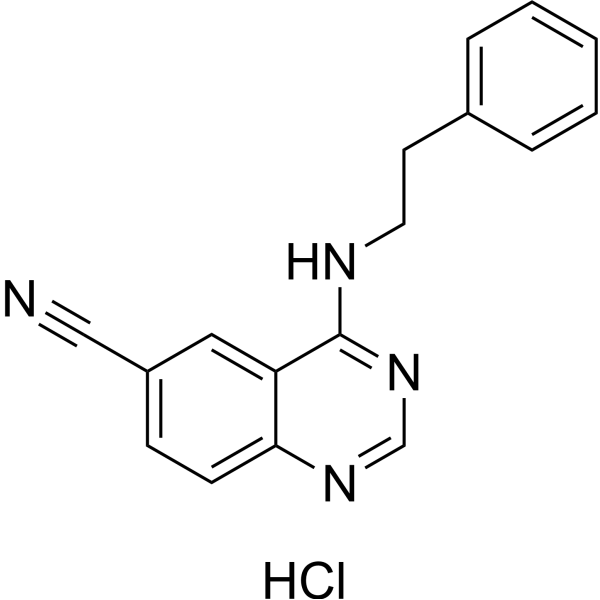
Senexin A hydrochloride
Based on 9 publication(s) in Google Scholar
Senexin A hydrochloride is an inhibitor of CDK8/19 (IC50: 280 nM, CDK8) and an inhibitor downstream of p21 transcription. It only inhibits p21-induced transcription but does not inhibit other biological effects of p21. Senexin A hydrochloride inhibits CMV-GFP induction as well as the p21 stimulatory activity of the consensus NF-κB-dependent promoters.
Nur für Forschungszwecke. Wir verkaufen nicht an Patienten.
- CAS. Nr.: 1780390-76-2
- Formel: C17H15ClN4
- Molecular Weight:310.78
-
Speicherung:
Please store the product under the recommended conditions in the Certificate of Analysis.

To place orders, for customer services and technical support, please contact: MedChemExpress USA
Tel: 609-228-6898 E-mail: [email protected] [email protected]


-
 Biologische Aktivität
-
Chemical Information
- Protokoll
- Reinheit & Dokumentation
- Verweise
-
 Help & FAQs


Publications Citing Use of MedChemExpress (MCE) Senexin A hydrochloride
More- Nucleic Acids Res. 2021 Feb 22;49(3):1470-1484. [Abstract]
- Cell Death Dis. 2020 Sep 15;11(9):754. [Abstract]
- Int J Biol Sci. 2025 Jan 1;21(2):685-707. [Abstract]
- Biochem Pharmacol. 2025 Jul:237:116959. [Abstract]
- Mol Med Rep. 2020 Dec;22(6):4868-4876. [Abstract]
- Viruses. 2020 Jun 17;12(6):654. [Abstract]
- FEBS Lett. 2021 Jul;595(14):1933-1948. [Abstract]
- J Cell Biochem. 2019 Aug;120(8):14095-14106. [Abstract]
- bioRxiv. 2025 Dec 9.


Biologische Aktivität
Beschreibung
IC50 & Target
[2]|
CDK8 280 nM (IC50) |
CDK8 0.83 μM (Kd) |
CDK19 0.31 μM (Kd) |
In Vitro
Senexin A hydrochloride inhibits CDK8 and CDK19 ATP site binding with Kd50 of 0.83 μM and 0.31 μM, respectively[1].
Senexin A hydrochloride inhibits β-catenin-dependent transcription in HCT116 colon cancer cells[1].
In HT1080 cells, Senexin A hydrochloride strongly inhibits the induction of the transcription factor EGR1 upon serum starvation[1].
Senexin A hydrochloride also reduces the expression of many secreted tumor-promoting factors in doxorubicin-treated wild-type HCT116 cells[1].
MedChemExpress (MCE) has not independently confirmed the accuracy of these methods. They are for reference only. Further protocols information, click here.
In Vivo
MedChemExpress (MCE) has not independently confirmed the accuracy of these methods. They are for reference only.


Chemical Information
-
CAS. Nr. 1780390-76-2
-
Molecular Weight 310.78
-
Formel C17H15ClN4
-
SMILES
N#CC1=CC=C2C(C(NCCC3=CC=CC=C3)=NC=N2)=C1.Cl
-
Versand
Room temperature in continental US; may vary elsewhere.
-
Speicherung
Please store the product under the recommended conditions in the Certificate of Analysis.


Publications (9)
-
Journal Impact Factor
-
Most Recent
-
Nucleic Acids Res
Loss of Mediator complex subunit 13 (MED13) promotes resistance to alkylation through cyclin D1 upregulation. [Abstract]2021 Feb 22;49(3):1470-1484. PMID: 33444446 -
Cell Death Dis
2020 Sep 15;11(9):754. PMID: 32934219 -
Int J Biol Sci
The Cyclin-Dependent Kinase 8 Inhibitor E966-0530-45418 Attenuates Pulmonary Fibrosis In Vitro and In Vivo. [Abstract]2025 Jan 1;21(2):685-707. PMID: 39781457 -
Biochem Pharmacol
Identification of pyrazole scaffold inhibitors targeting cyclin-dependent kinase 8 for potential use in pulmonary fibrosis. [Abstract]2025 Jul:237:116959. PMID: 40280247 -
Mol Med Rep
Capsaicin suppresses breast cancer cell viability by regulating the CDK8/PI3K/Akt/Wnt/β‑catenin signaling pathway. [Abstract]2020 Dec;22(6):4868-4876. PMID: 33173974 -
Viruses
Cyclin-Dependent Kinases 8 and 19 Regulate Host Cell Metabolism during Dengue Virus Serotype 2 Infection. [Abstract]2020 Jun 17;12(6):654. PMID: 32560467 -
FEBS Lett
MED12 interacts with the heat-shock transcription factor HSF1 and recruits CDK8 to promote the heat-shock response in mammalian cells. [Abstract]2021 Jul;595(14):1933-1948. PMID: 34056708 -
J Cell Biochem
The microRNA-141-3p/ CDK8 pathway regulates the chemosensitivity of breast cancer cells to trastuzumab. [Abstract]2019 Aug;120(8):14095-14106. PMID: 31087707 -

Protokoll
-
Cell Cytotoxicity Assay
Cytotoxicity assays are usually based on the assessment of cell membrane damage, which can also be indirectly detected by measuring cell viability. Detection methods include MTT assay, CKK-8 assay, LDH assay and ATP assay, etc.
-
Research Protocol for Inflammation-related Diseases
The NLRP3 inflammasome is a cytosolic innate immune signaling platform that integrates priming signals and danger-signal activation to promote caspase-1 activation, maturation of IL-1β and IL-18, and gasdermin D-mediated pyroptotic cell death. The core experimental logic is to determine whether inflammatory disease phenotypes are driven by increased NLRP3 expression, ASC-containing inflammasome assembly, caspase-1 cleavage, GSDMD cleavage, and extracellular release of IL-1β/IL-18 rather than by nonspecific cell injury alone. The pathway is strongly linked to inflammation-related disease phenotypes because monosodium urate crystals activate NALP3/NLRP3 inflammasome signaling in gout-like crystal inflammation, cholesterol crystals activate NLRP3 inflammasomes in atherogenesis models, and DSS-induced intestinal inflammation has been reported to involve NLRP3 inflammasome activity. However, experimental colitis studies also show context-dependent protective effects of NLRP3 inflammasome co


Reinheit & Dokumentation
Verweise
[1]. Porter DC, et al. Cyclin-dependent kinase 8 mediates chemotherapy-induced tumor-promoting paracrine activities. Proc Natl Acad Sci U S A. 2012 Aug 21;109(34):13799-804. [Content Brief]
[2]. Ho TY, et al. The study of a novel CDK8 inhibitor E966-0530-45418 that inhibits prostate cancer metastasis in vitro and in vivo. Biomed Pharmacother. 2023 Jun;162:114667. [Content Brief]

Calculators
Konzentration (Stammlösung) × Volumen (Stammlösung) = Konzentration (Ziellösung) × Volumen (Ziellösung)


Senexin A hydrochloride Related Classifications
HY-15681A Related Classifications
 Powered by Bioz