



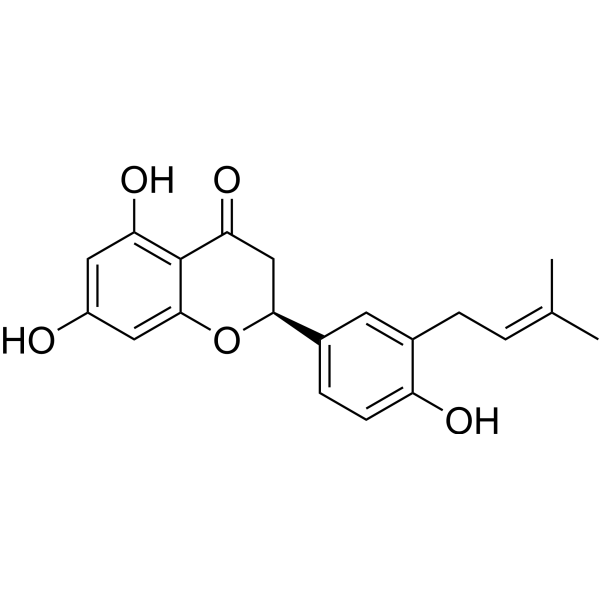
Licoflavanone
Licoflavanone (3′-Prenylnaringenin) is a flavanone with antioxidant, anti-inflammatory and anticancer activities. Licoflavanone can be isolated from the leaf extract of Glycyrrhiza glabra. Licoflavanone downregulates the mTOR/PI3K/AKT signaling pathway to inhibit the proliferation, migration and invasion of cancer cells, while activates Bax, Bad and multiple caspase enzymes to induce apoptosis. Its anti-inflammatory effect is manifested by reducing the nuclear translocation of NF-κB, decreasing the phosphorylation levels of p38, JNK and ERK1/2, thereby inhibiting the expression of nitric oxide, proinflammatory cytokines, COX-2 and iNOS. Licoflavanone is used in studies on nasopharyngeal carcinoma and related mechanisms.
For research use only. We do not sell to patients.
- CAS No.: 119240-82-3
- Formula: C20H20O5
- Molecular Weight:340.37
-
Storage:
Please store the product under the recommended conditions in the Certificate of Analysis.

To place orders, for customer services and technical support, please contact: MedChemExpress USA
Tel: 609-228-6898 E-mail: [email protected] [email protected]


-
 Biological Activity
-
Chemical Information
- Purity & Documentation
- References
-
 Help & FAQs


All Caspase Isoforms
More

Biological Activity
Description
IC50 & Target
|
iNOS |
COX-2 |
In Vitro
Licoflavanone (12.5-100 μM; 24 h) reduces the viability of human nasopharyngeal carcinoma HK1 cells in a concentration-dependent manner[1].
Licoflavanone (12.5-100 μM; 72 h) induces destructive morphological changes and apoptosis in human nasopharyngeal HK1 cancer cells following 72 h of treatment at concentrations of 12.5, 25, and 100 μM[1].
Licoflavanone (12.5-100 μM; 24 h) regulates the expression of apoptosis-related proteins, upregulates pro-apoptotic proteins and downregulates anti-apoptotic proteins in human nasopharyngeal HK1 cancer cells following 24 h of treatment at concentrations of 12.5, 25 and 100 μM[1].
Licoflavanone (12.5-100 μM; 24 h) inhibits the mTOR/PI3K/AKT pathway in human nasopharyngeal carcinoma HK1 cells in a concentration-dependent manner by downregulating the expression of phosphorylated mTOR, PI3K and AKT (treatment concentrations: 12.5, 25 and 100 μM, treatment duration: 24 h)[1].
Licoflavanone (12.5-100 μM; 24 h) inhibits the migration and invasion of human nasopharyngeal HK1 cancer cells in a concentration-dependent manner[1].
Licoflavanone inhibits NO production in LPS-stimulated RAW 264.7 mouse macrophages with an IC50 of 37.68 μM, and suppresses the phosphorylation and activation of p38, JNK and ERK1/2 MAPKs[2].
MedChemExpress (MCE) has not independently confirmed the accuracy of these methods. They are for reference only.
-
Cell Line:human nasopharyngeal HK1 carcinoma cells
-
Concentration:12.5-100 μM
-
Incubation Time:24 h
-
Result:Reduced cell viability in a concentration-dependent manner, with viability dropping to almost 10% at the highest concentration tested.
Showed statistically significant effects in triplicate experiments.
-
Cell Line:human nasopharyngeal HK1 carcinoma cells
-
Concentration:12.5, 25, 100 μM
-
Incubation Time:24 h
-
Result:Induced pro-apoptotic changes including membrane damage, chromatin condensation, nuclear disintegration, formation of apoptotic bodies, and loss of normal cell morphology, while control cells showed normal structure and intact nuclear membranes.
-
Cell Line:human nasopharyngeal HK1 carcinoma cells
-
Concentration:12.5-100 μM
-
Incubation Time:24 h
-
Result:Significantly up-regulated protein expression of pro-apoptotic caspase-3, caspase-8, caspase-9, cleaved caspase-3, Bax, and Bad.
Markedly down-regulated protein expression of anti-apoptotic Bcl-2, XIAP, and Bcl-2-xL.\nMarkedly and concentration-dependently down-regulated the expression levels of phosphorylated mTOR, PI3K, and AKT.
Maintained almost constant protein expression levels of non-phosphorylated mTOR, PI3K, and AKT.
Showed statistically significant effects in triplicate experiments.
-
Cell Line:RAW 264.7 murine macrophages
-
Concentration:IC50 concentration
-
Incubation Time:6 h
-
Result:Significantly decreased mRNA levels of inducible nitric oxide synthase (iNOS), cyclooxygenase 2 (COX-2), tumor necrosis factor alpha (TNF-α), interleukin 1 beta (IL-1β), and interleukin 6 (IL-6) (p < 0.001 for all targets).


Chemical Information
-
CAS No. 119240-82-3
-
Molecular Weight 340.37
-
Formula C20H20O5
-
SMILES
O=C1C[C@@H](C2=CC=C(O)C(C/C=C(C)\C)=C2)OC3=CC(O)=CC(O)=C13
-
Synonyms
3′-Prenylnaringenin
-
Structure Classification
-
Initial Source
-
Shipping
Room temperature in continental US; may vary elsewhere.
-
Storage
Please store the product under the recommended conditions in the Certificate of Analysis.


Purity & Documentation
References

Calculators
Concentration (start) × Volume (start) = Concentration (final) × Volume (final)


Licoflavanone Related Classifications
HY-N10133 Related Classifications
 Powered by Bioz