



TRP-601
Based on 1 publication(s) in Google Scholar
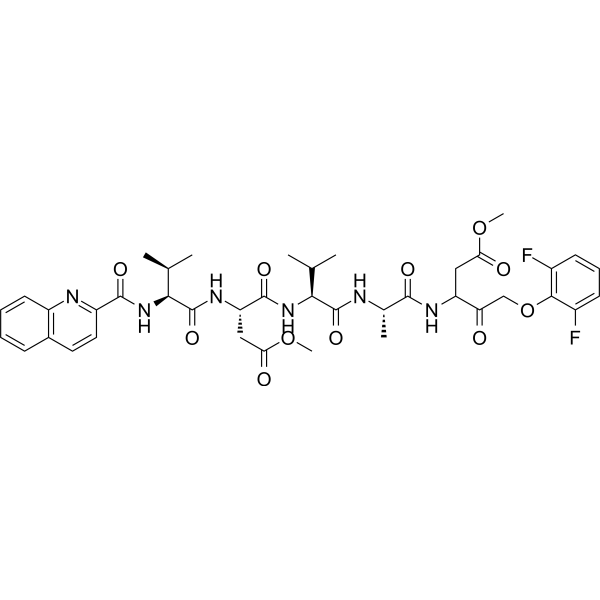
TRP-601 is a caspase inhibitor. TRP-601 reversed the increased expression of active caspase-2, the activation of endogenous apoptotic pathway and the up-regulation of key protein triggered by hyperoxia.
Nur für Forschungszwecke. Wir verkaufen nicht an Patienten.
- CAS. Nr.: 1094569-02-4
- Formel: C40H48F2N6O11
- Molecular Weight:826.84
-
Speicherung:
Please store the product under the recommended conditions in the Certificate of Analysis.

To place orders, for customer services and technical support, please contact: MedChemExpress USA
Tel: 609-228-6898 E-mail: [email protected] [email protected]


-
 Biologische Aktivität
-
Chemical Information
- Protokoll
- Reinheit & Dokumentation
- Verweise
-
 Help & FAQs


Publications Citing Use of MedChemExpress (MCE) TRP-601
MoreAlle Caspase Isoform-spezifische Produkte anzeigen
More

Biologische Aktivität
Beschreibung
IC50 & Target
|
Caspase-2 |
Caspase 3 |
Bcl-2 |
In Vivo
MedChemExpress (MCE) has not independently confirmed the accuracy of these methods. They are for reference only.
-
Animal Model:Wistar rats [1]
-
Dosage:1 mg/kg
-
Administration:Intraperitoneal injection (i.p.)
-
Result:Ameliorated the increase of caspase-3 activity and reduced protein expression of processed caspase-2 and enzymatic activity. Significantly reduced neuronal cell death and did not influence levels of physiological apoptosis. Decreased Apaf-1 protein expression to control levels. Increased mRNA expression of Bcl-2.


Chemical Information
-
CAS. Nr. 1094569-02-4
-
Molecular Weight 826.84
-
Formel C40H48F2N6O11
-
Versand
Room temperature in continental US; may vary elsewhere.
-
Speicherung
Please store the product under the recommended conditions in the Certificate of Analysis.


Publications (1)
-
Journal Impact Factor
-
Most Recent
-
Phytomedicine
The protective mechanism of Hydroxysafflor yellow A for the treatment of stroke - heart - syndrome via activating the ZBP1-NLRP3 signaling pathway. [Abstract]2025 Sep:145:157011. PMID: 40602292

Protokoll
-
RNA extraction experimental
By lysing cells, releasing RNA, and removing impurities such as proteins and DNA, high-purity RNA products are finally obtained. The commonly used traditional method is the guanidine isothiocyanate/phenol/chloroform method (Trizol), which is suitable for a variety of animal materials including animal tissues, microorganisms, cultured cells, etc., and most plant materials.
-
Detection of Apoptosis
Apoptosis, also called programmed cell death, is generally characterized by distinct morphological characteristics.
-
Apoptosis Solutions
Apoptosis is a regulated, generally non-lytic cell-death pathway that removes unwanted, damaged, infected, or abnormal cells through coordinated morphological changes, caspase activation, DNA fragmentation, and membrane remodeling. The intrinsic apoptosis pathway is controlled mainly by mitochondrial outer membrane permeabilization, BCL-2 family proteins, cytochrome c release, apoptosome formation, caspase-9 activation, and downstream executioner caspase-3/7 activation. The extrinsic apoptosis pathway is initiated by death receptors such as Fas, TNFR, and TRAIL receptors, which recruit adaptor proteins and activate caspase-8 before engaging executioner caspases or mitochondrial amplification through BID cleavage. Apoptosis is linked to many phenotypes, including cancer cell killing, tissue homeostasis, immune regulation, neurodegeneration, infection response, and treatment-induced cytotoxicity; unresolved questions include how apoptosis interacts with necroptosis, pyroptosis, ferroptos


Reinheit & Dokumentation
Verweise

Calculators
Konzentration (Stammlösung) × Volumen (Stammlösung) = Konzentration (Ziellösung) × Volumen (Ziellösung)


TRP-601 Related Classifications
HY-P2012 Related Classifications
 Powered by Bioz