



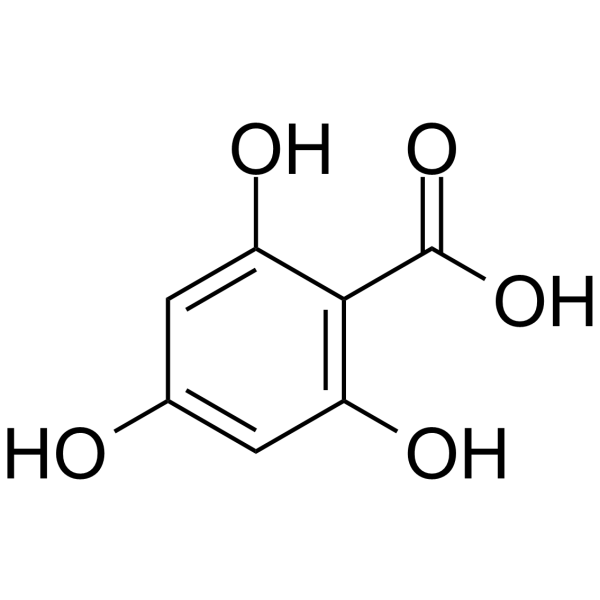
2,4,6-Trihydroxybenzoic acid

Based on 1 Customer Validation
2,4,6-Trihydroxybenzoic acid is a CDK inhibitor that dose-dependently inhibits recombinant CDK1, CDK2, and CDK4 with IC50 values of 580, 262, and 403 μM, respectively. 2,4,6-Trihydroxybenzoic acid is also a flavonoid metabolite. Cellular uptake of 2,4,6-Trihydroxybenzoic acid depends on functional SLC5A8. 2,4,6-Trihydroxybenzoic acid can be used in colorectal cancer-related research.
연구목적의 판매만을 진행합니다. 환자를 대상으로 한 판매는 하지 않습니다.
- Purity : 99.34%
- CAS No.: 83-30-7
- 화학식: C7H6O5
- 분자량:170.12
-
보관:Powder -20°C, 3 years , 4°C, 2 years ; In solvent -80°C, 6 months , -20°C, 1 month

To place orders, for customer services and technical support, please contact: MedChemExpress USA
Tel: 609-228-6898 E-mail: [email protected] [email protected]


-
 Biological Activity
-
Chemical Information
-
용액&용해도
- 순도&문서
- References
-
 Help & FAQs




Biological Activity
제품 설명
IC50 & Target
[1]|
CDK1 580 μM (IC50) |
CDK2 262 μM (IC50) |
CDK4 403 μM (IC50) |
Cellular Effect
|
Cell Line

|
Type | Value | Description | References |
|---|---|---|---|---|
| MDA-MB-231 | IC50 |
446 μM
|
Inhibition of colony formation in human breast cancer MDA-MB-231 cells assessed by clonogenic assay with 2,4,6-trihydroxybenzoic acid treatment for 14-21 days, with media refreshed every 5-6 days and colonies stained with crystal violet and quantified using ImageJ.
Inhibition of colony formation in human breast cancer MDA-MB-231 cells assessed by clonogenic assay with 2,4,6-trihydroxybenzoic acid treatment for 14-21 days, with media refreshed every 5-6 days and colonies stained with crystal violet and quantified using ImageJ.
|
30917530 |
In Vitro
2,4,6-Trihydroxybenzoic acid (62.5 μM-1 mM) dose-dependently inhibits the activity of recombinant CDK1 and CDK2 with IC50 values of 580 and 262 μM, respectively, and reduces the phosphorylation of H1 histone[1].
2,4,6-Trihydroxybenzoic acid (125 μM-1 mM) dose-dependently inhibits recombinant CDK4 activity with an IC50 of 403 μM and decreases retinoblastoma protein phosphorylation[1].
2,4,6-Trihydroxybenzoic acid (125-1000 μM; 72 h) upregulates p21Cip1 mRNA in SLC5A8-pLVX cells, with elevation observed at all tested concentrations, and upregulates p27Kip1 mRNA starting at 500 μM[1].
2,4,6-Trihydroxybenzoic acid (72 h) does not cause any notable shift or accumulation in any specific phase of the cell cycle in SLC5A8-pLVX cells[1].
2,4,6-Trihydroxybenzoic acid (72 h) does not increase the number of apoptotic cells in SLC5A8-pLVX cells[1].
2,4,6-Trihydroxybenzoic acid (125-1000 μM; 72 h) decreases cell density and cell number in SLC5A8-pLVX cells expressing functional SLC5A8, and all tested concentrations exhibit proliferation inhibition[1].
2,4,6-Trihydroxybenzoic acid (125-1000 μM; 72 h) shows no significant inhibition of proliferation in parental MDA-MB-231 cells at 125-750 μM, while it reduces cell numbers at 1000 μM[1].
2,4,6-Trihydroxybenzoic acid (14-21 days) dose-dependently decreases colony formation in SLC5A8-pLVX cells starting at 125 μM, reduces colony formation by 50% at approximately 400 μM, and decreases colony size[1].
2,4,6-Trihydroxybenzoic acid (14-21 days) decreases the number of colonies in MDA-MB-231 cells from 250 μM and reduces clonogenic formation by 50% at approximately 446 μM[1].
2,4,6-Trihydroxybenzoic acid (125-1000 μM; 72 h) upregulates p21Cip1 and p27Kip1 proteins in SLC5A8-pLVX cells; at ≥750 μM, it decreases CDK2 and cyclin B1, whereas CDK1, CDK4, cyclin A2, and cyclin D1 protein levels remain essentially unchanged[1].
2,4,6-Trihydroxybenzoic acid (125-1000 μM; 72 h) shows cellular uptake starting at 125 μM in SLC5A8-pLVX cells and increases linearly with increasing concentration up to 1000 μM; uptake is lower in parental MDA-MB-231 cells and is not detected in HCT-116 cells[1].
2,4,6-Trihydroxybenzoic acid (0.06-8.20 mg/L; 48 h; initial pH 6.5) inhibits the final yield of Pseudokirchneriella subcapitata, with an EC50 of 0.546 mg/L and a NOEC <0.057 mg/L[2].
2,4,6-Trihydroxybenzoic acid (0.06-8.20 mg/L; 48 h; initial pH 6.5) inhibits the growth rate of Pseudokirchneriella subcapitata, with an EC50 of 1.93 mg/L and a NOEC of 0.114 mg/L[2].
MedChemExpress (MCE) has not independently confirmed the accuracy of these methods. They are for reference only.
-
Cell Line:Human breast cancer MDA-MB-231 cells and SLC5A8-expressing MDA-MB-231 (SLC5A8-pLVX) cells
-
Concentration:125, 250, 500, 750, 1000 µM
-
Incubation Time:72 h
-
Result:Showed no significant inhibition of proliferation in parental MDA-MB-231 cells at 125-750 µM, with a reduction only at 1000 µM.
Upregulated p21Cip1 and p27Kip1 protein levels only at 1000 µM in parental MDA-MB-231 cells.
Induced a clear decrease in cell density and number in SLC5A8-pLVX cells at all tested concentrations, correlating with increased p21Cip1 and p27Kip1 protein levels.
Increased p21Cip1 mRNA levels at all concentrations in SLC5A8-pLVX cells.
Upregulated p27Kip1 mRNA starting at 500 µM in SLC5A8-pLVX cells.
Left protein levels of CDK1, CDK4, cyclin A2, and cyclin D1 unchanged in SLC5A8-pLVX cells.
Reduced CDK2 and cyclin B1 protein levels at concentrations ≥ 750 µM in SLC5A8-pLVX cells.
-
Cell Line:SLC5A8-pLVX
-
Concentration:125, 250, 500, 750, 1000 µM
-
Incubation Time:72 h
-
Result:Increased p21Cip1 mRNA at all tested concentrations.
Increased p27Kip1 mRNA beginning at 500 μM.
-
Cell Line:SLC5A8-pLVX
-
Concentration:125, 250, 500, 750, 1000 µM
-
Incubation Time:14-21 days
-
Result:Dose-dependently decreased colony formation beginning at 125 μM.
Reduced colony formation by approximately 50% at 400 μM.
Reduced colony size.
-
Cell Line:MDA-MB-231
-
Concentration:125, 250, 500, 750, 1000 µM
-
Incubation Time:14-21 days
-
Result:Decreased colony number above 250 μM.
Reduced colony formation by approximately 50% at 446 μM.


Chemical Information
-
CAS No. 83-30-7
-
Appearance Solid
-
분자량 170.12
-
화학식 C7H6O5
-
Color Off-white to light yellow
-
SMILES
O=C(O)C1=C(O)C=C(O)C=C1O
-
Structure Classification
-
Initial Source
-
선적
Room temperature in continental US; may vary elsewhere.
-
보관
Powder -20°C 3 years 4°C 2 years In solvent -80°C 6 months -20°C 1 month


용액&용해도
In Vitro:
DMSO : 100 mg/mL (587.82 mM; Need ultrasonic; Hygroscopic DMSO has a significant impact on the solubility of product, please use newly opened DMSO)
Please refer to the solubility information to select the appropriate solvent. Once prepared, please aliquot and store the solution to prevent product inactivation from repeated freeze-thaw cycles.
Storage method and period of stock solution: -80°C, 6 months; -20°C, 1 month. When stored at -80°C, please use it within 6 months. When stored at -20°C, please use it within 1 month.
Please refer to the solubility information to select the appropriate solvent. Once prepared, please aliquot and store the solution to prevent product inactivation from repeated freeze-thaw cycles.
Storage method and period of stock solution: -80°C, 6 months; -20°C, 1 month. When stored at -80°C, please use it within 6 months. When stored at -20°C, please use it within 1 month.
Concentration (start) × Volume (start) = Concentration (final) × Volume (final)
In Vivo:
Select the appropriate dissolution method based on your experimental animal and administration route.
- For the following dissolution methods, please ensure to first prepare a clear stock solution using an In Vitro approach and then sequentially add co-solvents:
- To ensure reliable experimental results, the clarified stock solution can be appropriately stored based on storage conditions. As for the working solution for In Vivo experiments, it is recommended to prepare freshly and use it on the same day.
- The percentages shown for the solvents indicate their volumetric ratio in the final prepared solution. If precipitation or phase separation occurs during preparation, heat and/or sonication can be used to aid dissolution.
Add each solvent one by one: 10% DMSO 40% PEG300 5% Tween-80 45% Saline
Solubility: ≥ 2.5 mg/mL (14.70 mM); Clear solution
This protocol yields a clear solution of ≥ 2.5 mg/mL (saturation unknown).
Taking 1 mL working solution as an example, add 100 μL DMSO stock solution (25.0 mg/mL) to 400 μL PEG300, and mix evenly; then add 50 μL Tween-80 and mix evenly; then add 450 μL Saline to adjust the volume to 1 mL.
Preparation of Saline: Dissolve 0.9 g sodium chloride in ddH₂O and dilute to 100 mL to obtain a clear Saline solution.
Add each solvent one by one: 10% DMSO 90% (20% SBE-β-CD in Saline)
Solubility: ≥ 2.5 mg/mL (14.70 mM); Clear solution
This protocol yields a clear solution of ≥ 2.5 mg/mL (saturation unknown).
Taking 1 mL working solution as an example, add 100 μL DMSO stock solution (25.0 mg/mL) to 900 μL 20% SBE-β-CD in Saline, and mix evenly.
Preparation of 20% SBE-β-CD in Saline (4°C, storage for one week): 2 g SBE-β-CD powder is dissolved in 10 mL Saline, completely dissolve until clear.
In Vivo Dissolution Calculator
Please enter the basic information of animal experiments:
-
-
-
-
Recommended: Prepare an additional quantity of animals to account for potential losses during experiments.
Please enter your animal formula composition:
-
%DMSO +
Recommended: Keep the proportion of DMSO in working solution below 2% if your animal is weak.
-
%+
-
+%Tween-80 + +
-
%Saline +
The co-solvents required include: DMSO, . All of co-solvents are available by MedChemExpress (MCE). , Tween 80. All of co-solvents are available by MedChemExpress (MCE).
Working solution concentration: 0.22 mg/mL
Method for preparing stock solution: mg drug dissolved in μL DMSO. Stock solution concentration: mg/mL.
1. Take μL DMSO stock solution;
2. Add μL .
μL , mix evenly;
3. Then add μL Tween 80, mix evenly;
4. Then add μL
Please ensure that the stock solution in the first step is dissolved to a clear state, and add co-solvents in sequence. You can use ultrasonic heating (ultrasonic cleaner, recommended frequency 20-40 kHz), vortexing, etc. to assist dissolution.


순도&문서
-
Data Sheet (290 KB)
-
SDS (394 KB)
- English - EN (394 KB)
- Français - FR (394 KB)
- Deutsch - DE (394 KB)
- Norwegian - NO (394 KB)
- Español - ES (394 KB)
- Swedish - SV (394 KB)
- Italian - IT (394 KB)
- Korean - KR (394 KB)
- Portuguese - PT (394 KB)
-
Handling Instructions (2659 KB)
References


Complete Stock Solution Preparation Table
Please refer to the solubility information to select the appropriate solvent. Once prepared, please aliquot and store the solution to prevent product inactivation from repeated freeze-thaw cycles.
Storage method and period of stock solution: -80°C, 6 months; -20°C, 1 month. When stored at -80°C, please use it within 6 months. When stored at -20°C, please use it within 1 month.
| Optional Solvent | Concentration Solvent Mass | 1 mg | 5 mg | 10 mg | 25 mg |
|---|---|---|---|---|---|
| DMSO | 1 mM | 5.8782 mL | 29.3910 mL | 58.7820 mL | 146.9551 mL |
| 5 mM | 1.1756 mL | 5.8782 mL | 11.7564 mL | 29.3910 mL | |
| 10 mM | 0.5878 mL | 2.9391 mL | 5.8782 mL | 14.6955 mL | |
| 15 mM | 0.3919 mL | 1.9594 mL | 3.9188 mL | 9.7970 mL | |
| 20 mM | 0.2939 mL | 1.4696 mL | 2.9391 mL | 7.3478 mL | |
| 25 mM | 0.2351 mL | 1.1756 mL | 2.3513 mL | 5.8782 mL | |
| 30 mM | 0.1959 mL | 0.9797 mL | 1.9594 mL | 4.8985 mL | |
| 40 mM | 0.1470 mL | 0.7348 mL | 1.4696 mL | 3.6739 mL | |
| 50 mM | 0.1176 mL | 0.5878 mL | 1.1756 mL | 2.9391 mL | |
| 60 mM | 0.0980 mL | 0.4899 mL | 0.9797 mL | 2.4493 mL | |
| 80 mM | 0.0735 mL | 0.3674 mL | 0.7348 mL | 1.8369 mL | |
| 100 mM | 0.0588 mL | 0.2939 mL | 0.5878 mL | 1.4696 mL |


2,4,6-Trihydroxybenzoic acid Related Classifications
HY-W077292 Related Classifications
 Powered by Bioz