



Balanol
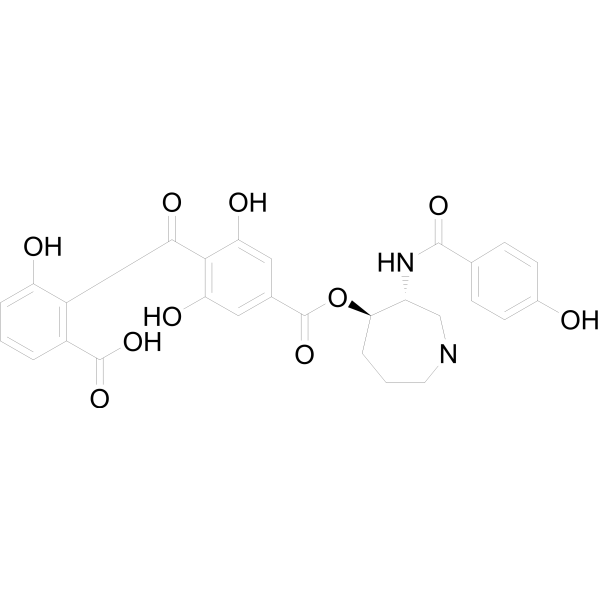
Balanol (Ophiocordin; Azepinostatin) is a potent and ATP competitive PKC/PKA inhibitor against human PKC isozymes α, β-I, β-II, γ, δ, ε, η (IC50s=4-9 nM) and ζ (IC50=150 nM). Balanol also blocks the phosphorylation of cyclic AMP response element-binding protein (CREB) and myristoylated alanine-rich C kinase substrate (MARCKS). Balanol can be isolated from the fungus Verticillium balanoides.
For research use only. We do not sell to patients.
- CAS No.: 63590-19-2
- Formula: C28H26N2O10
- Molecular Weight:550.51
-
Storage:
Please store the product under the recommended conditions in the Certificate of Analysis.

To place orders, for customer services and technical support, please contact: MedChemExpress USA
Tel: 609-228-6898 E-mail: [email protected] [email protected]


-
 Biological Activity
-
Chemical Information
- Protocols
- Purity & Documentation
- References
-
 Help & FAQs




Biological Activity
Description
IC50 & Target
[2]|
Human PKCα 4-9 nM () |
PKC-βI 4-9 nM () |
PKC-βII 4-9 nM () |
Human PKCγ 4-9 nM () |
Human PKCδ 4-9 nM () |
Human PKCε 4-9 nM () |
human PKCη 150 nM () |
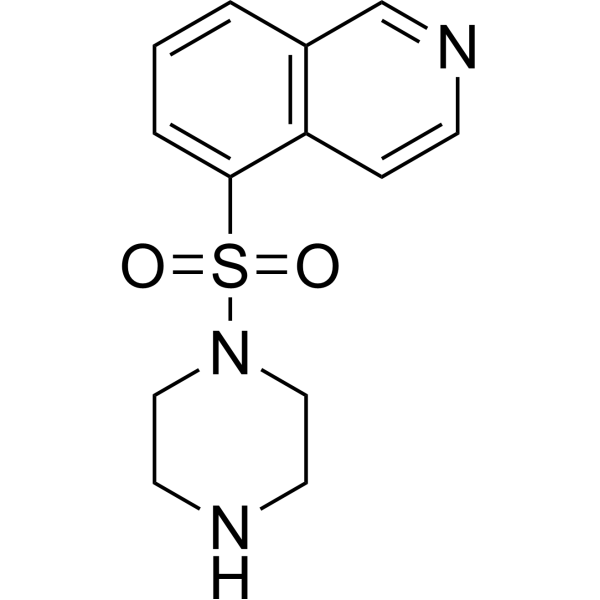
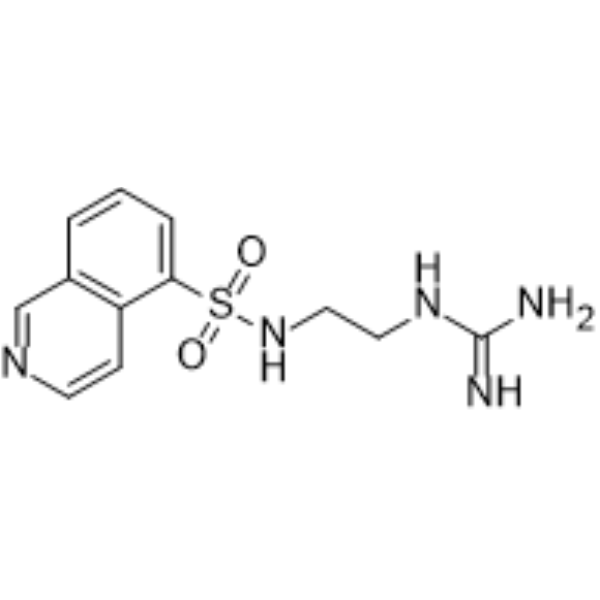
PKA |
In Vitro
Balanol (3 μM; 45 min) inhibits PKA, as inhibiting the induction of luciferase activity by Isoproterenol (HY-B0468) in neonatal rat myocytes A431 cells[1].
Balanol (10 μM; 45 min) inhibits the phosphorylation of CREB and MARCKS in A431 cells[1].
MedChemExpress (MCE) has not independently confirmed the accuracy of these methods. They are for reference only.


Chemical Information
-
CAS No. 63590-19-2
-
Molecular Weight 550.51
-
Formula C28H26N2O10
-
SMILES
O=C(C1=C(C=C(C(O[C@H]2[C@@H](CNCCC2)NC(C3=CC=C(O)C=C3)=O)=O)C=C1O)O)C4=C(C=CC=C4O)C(O)=O
-
Synonyms
Ophiocordin; Azepinostatin
-
Initial Source
V. balanoides
-
Shipping
Room temperature in continental US; may vary elsewhere.
-
Storage
Please store the product under the recommended conditions in the Certificate of Analysis.


Purity & Documentation
-
Data Sheet (279 KB)
-
SDS (252 KB)
- Français - FR (252 KB)
- Deutsch - DE (252 KB)
- Norwegian - NO (252 KB)
- Español - ES (252 KB)
- Swedish - SV (252 KB)
- Italian - IT (252 KB)
- Korean - KR (252 KB)
- Portuguese - PT (252 KB)
-
Handling Instructions (2659 KB)
References

Calculators
Concentration (start) × Volume (start) = Concentration (final) × Volume (final)


Balanol Related Classifications
HY-121197 Related Classifications
 Powered by Bioz