



DMTAP

Based on 1 Customer Validation
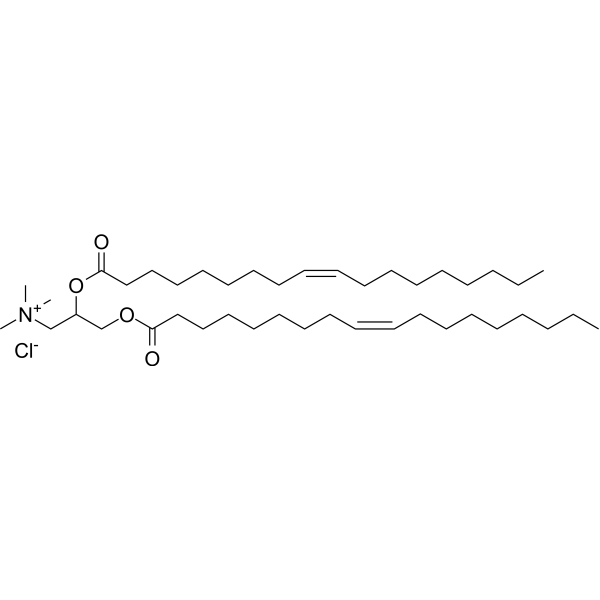
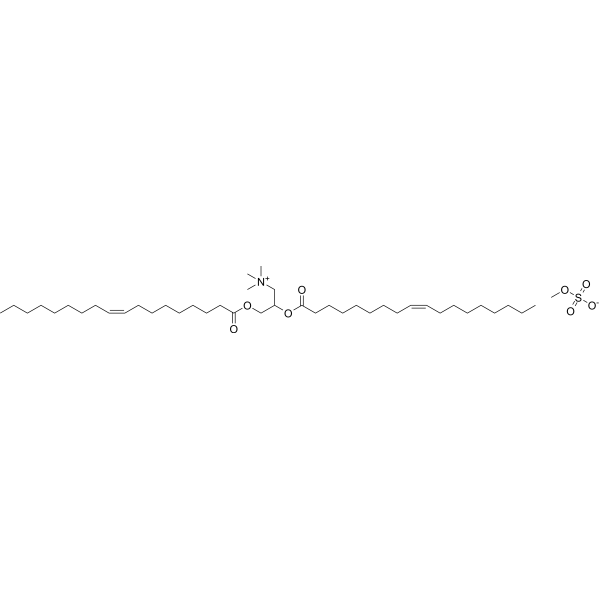
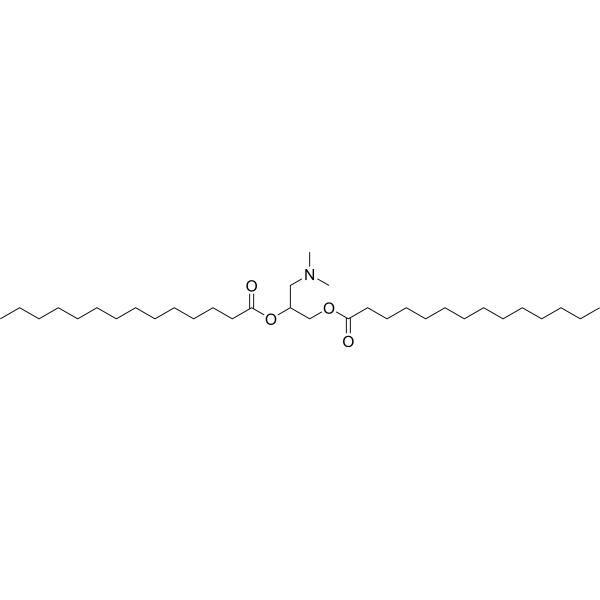
DMTAP is a cationic lipid. DMTAP inhibits PKC activity and reduces PKC-dependent cytokine secretion. DMTAP kills macrophages and monocyte-like cells, but not T lymphocytes. DMTAP induces CD80/CD86 in dendritic cells. DMTAP combined with DOPE (HY-112005)/DPPE inhibits nitric oxide, TNF-alpha, and Prostaglandin E2 (HY-101952). DMTAP can be used in research on inflammation and breast cancer.
Nur für Forschungszwecke. Wir verkaufen nicht an Patienten.
- Reinheit : 96.8%
- CAS. Nr.: 197974-74-6
- Formel: C34H68ClNO4
- Molecular Weight:590.36
-
Speicherung:
4°C, sealed storage, away from moisture
* In solvent : -80°C, 6 months; -20°C, 1 month (sealed storage, away from moisture)


To place orders, for customer services and technical support, please contact: MedChemExpress USA
Tel: 609-228-6898 E-mail: [email protected] [email protected]


-
 Biologische Aktivität
-
Chemical Information
-
Lösungsmittel & Löslichkeit
- Protokoll
- Reinheit & Dokumentation
- Verweise
-
 Help & FAQs



![Trimethyl[2,3-(dioleyloxy)propyl]ammonium chloride](https://file.medchemexpress.com/product_pic/hy-w127644.gif)
Alle TNF Receptor Isoform-spezifische Produkte anzeigen
More

Biologische Aktivität
Beschreibung
|
PKC |
CD80 |
CD86 |
TNF-alpha |
In Vitro
DMTAP liposomes induce CD80 and CD86 expression in mouse myeloid dendritic cells without affecting pro-inflammatory cytokine secretion[2].
DMTAP alone is toxic to macrophages, and DOPE synergistically enhances DMTAP toxicity[3].
DMTAP liposomes formulated with DOPE or DPPE inhibit LPS-induced nitric oxide, TNF-alpha, and prostaglandin E2 secretion in mouse macrophages while leaving interleukin-6 secretion unaffected[2].
DMTAP inhibits PKC activity in an acellular system[2].
DMTAP (87 μg/mL; 3 h) inhibits NO and TNF-α synthesis without affecting IL-6 production in LPS-activated peritoneal macrophages from CD1 mice[5].
MedChemExpress (MCE) has not independently confirmed the accuracy of these methods. They are for reference only. Further protocols information, click here.
In Vivo
DMTAP (i.p., s.c., or local (footpad) injection; 2 h before induction of inflammation) reduces SRBC-induced footpad inflammation in female CD1 mice[5].
MedChemExpress (MCE) has not independently confirmed the accuracy of these methods. They are for reference only.
-
Animal Model:CD1 (female)[5]
-
Dosage:60 mg/kg
-
Administration:i.p.; once; 2 h before Carrageenan injection
-
Result:Significantly reduced footpad volume at 3 h.
Maximum inhibition occurred at 48 h.
The reduction persisted for at least 72 h.


Chemical Information
-
CAS. Nr. 197974-74-6
-
Appearance Solid
-
Molecular Weight 590.36
-
Formel C34H68ClNO4
-
Color White to off-white
-
SMILES
CCCCCCCCCCCCCC(OCC(OC(CCCCCCCCCCCCC)=O)C[N+](C)(C)C)=O.[Cl-]
-
Versand
Room temperature in continental US; may vary elsewhere.
-
Speicherung
4°C, sealed storage, away from moisture
* In solvent : -80°C, 6 months; -20°C, 1 month (sealed storage, away from moisture)


Lösungsmittel & Löslichkeit
In Vitro:
Ethanol : 20 mg/mL (33.88 mM; Need ultrasonic)
DMSO : 2 mg/mL (3.39 mM; Need ultrasonic; Hygroscopic DMSO has a significant impact on the solubility of product, please use newly opened DMSO)
Please refer to the solubility information to select the appropriate solvent. Once prepared, please aliquot and store the solution to prevent product inactivation from repeated freeze-thaw cycles.
Storage method and period of stock solution: -80°C, 6 months; -20°C, 1 month (sealed storage, away from moisture). When stored at -80°C, please use it within 6 months. When stored at -20°C, please use it within 1 month.
Please refer to the solubility information to select the appropriate solvent. Once prepared, please aliquot and store the solution to prevent product inactivation from repeated freeze-thaw cycles.
Storage method and period of stock solution: -80°C, 6 months; -20°C, 1 month (sealed storage, away from moisture). When stored at -80°C, please use it within 6 months. When stored at -20°C, please use it within 1 month.
Konzentration (Stammlösung) × Volumen (Stammlösung) = Konzentration (Ziellösung) × Volumen (Ziellösung)

Protokoll
-
Research Protocol for Inflammation-related Diseases
The NLRP3 inflammasome is a cytosolic innate immune signaling platform that integrates priming signals and danger-signal activation to promote caspase-1 activation, maturation of IL-1β and IL-18, and gasdermin D-mediated pyroptotic cell death. The core experimental logic is to determine whether inflammatory disease phenotypes are driven by increased NLRP3 expression, ASC-containing inflammasome assembly, caspase-1 cleavage, GSDMD cleavage, and extracellular release of IL-1β/IL-18 rather than by nonspecific cell injury alone. The pathway is strongly linked to inflammation-related disease phenotypes because monosodium urate crystals activate NALP3/NLRP3 inflammasome signaling in gout-like crystal inflammation, cholesterol crystals activate NLRP3 inflammasomes in atherogenesis models, and DSS-induced intestinal inflammation has been reported to involve NLRP3 inflammasome activity. However, experimental colitis studies also show context-dependent protective effects of NLRP3 inflammasome co
-
Monocyte-derived dendritic cell differentiation
Human monocyte-derived dendritic cells are generated by isolating PBMC-derived monocytes and culturing them with GM-CSF plus IL-4, which produces cells with dendritic-cell antigen-presenting properties, reduced monocyte phenotype, and increased dendritic-cell functional readouts such as antigen uptake, allogeneic T-cell stimulation, and expression of markers including HLA-DR, CD80, CD86, CD83, CD1a, or CD209 depending on protocol and maturation state. The main readout is phenotypic and functional differentiation: immature MoDCs are commonly evaluated by loss or reduction of CD14 with acquisition of dendritic-cell markers and antigen uptake capacity, whereas mature MoDCs are evaluated by increased CD83, CD80, CD86, HLA-DR, and T-cell stimulatory function after exposure to maturation stimuli such as TNF-α or a cytokine/PGE2 cocktail.
-
Breast Cancer Modeling
Breast cancer is a heterogeneous cancer, and it has been distinguished into four subtypes: luminal A, luminal B, HER2-positive and basal-like. Molecular mutations, epigenetic alterations, hormone exposure and immune microenvironment are related to the progression of breast cancer.


Reinheit & Dokumentation
-
Data Sheet (274 KB)
-
SDS (393 KB)
- English - EN (393 KB)
- Français - FR (393 KB)
- Deutsch - DE (393 KB)
- Norwegian - NO (393 KB)
- Español - ES (393 KB)
- Swedish - SV (393 KB)
- Italian - IT (393 KB)
- Korean - KR (393 KB)
- Portuguese - PT (393 KB)
-
Handling Instructions (2659 KB)
Verweise


Complete Stock Solution Preparation Table
Please refer to the solubility information to select the appropriate solvent. Once prepared, please aliquot and store the solution to prevent product inactivation from repeated freeze-thaw cycles.
Storage method and period of stock solution: -80°C, 6 months; -20°C, 1 month (sealed storage, away from moisture). When stored at -80°C, please use it within 6 months. When stored at -20°C, please use it within 1 month.
| Optional Solvent | Concentration Solvent Mass | 1 mg | 5 mg | 10 mg | 25 mg |
|---|---|---|---|---|---|
| DMSO / Ethanol | 1 mM | 1.6939 mL | 8.4694 mL | 16.9388 mL | 42.3470 mL |
| Ethanol | 5 mM | 0.3388 mL | 1.6939 mL | 3.3878 mL | 8.4694 mL |
| 10 mM | 0.1694 mL | 0.8469 mL | 1.6939 mL | 4.2347 mL | |
| 15 mM | 0.1129 mL | 0.5646 mL | 1.1293 mL | 2.8231 mL | |
| 20 mM | 0.0847 mL | 0.4235 mL | 0.8469 mL | 2.1174 mL | |
| 25 mM | 0.0678 mL | 0.3388 mL | 0.6776 mL | 1.6939 mL | |
| 30 mM | 0.0565 mL | 0.2823 mL | 0.5646 mL | 1.4116 mL |


DMTAP Related Classifications
HY-112523A Related Classifications
 Powered by Bioz