



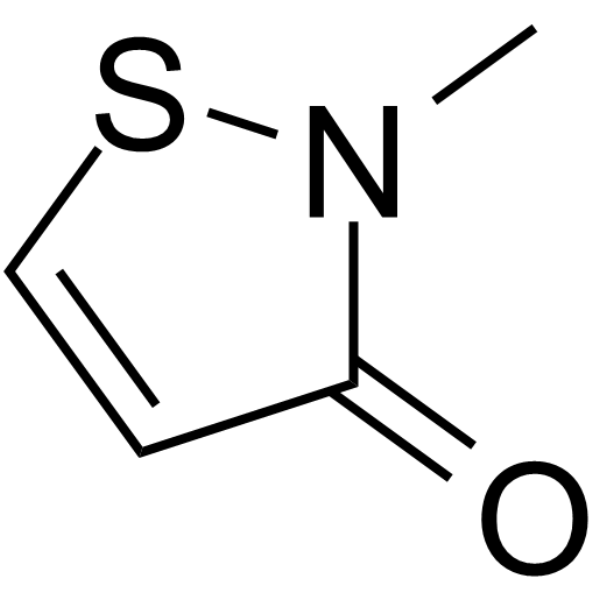
Methylisothiazolinone

Based on 1 Customer Validation
Methylothiazolinone is a bacterial and fungal inhibitor and preservative, as well as a sensitizer. Methylisothiazolinone can activate matrix metalloproteinases (MMPs) in human bronchial epithelial cells to induce apoptosis and inflammatory response. Methylisothiazolinone can promote the development of atopic dermatitis in mice by disrupting Th2/Th17 related immune responses. Methylisothiazolinone can cause mitochondrial damage in the endothelium of rat cerebral blood vessels.
Nur für Forschungszwecke. Wir verkaufen nicht an Patienten.
- Reinheit: 99.07%
- CAS. Nr.: 2682-20-4
- Formel: C4H5NOS
- Molecular Weight:115.15
-
Speicherung:Powder -20°C, 3 years , 4°C, 2 years ; In solvent -80°C, 6 months , -20°C, 1 month

To place orders, for customer services and technical support, please contact: MedChemExpress USA
Tel: 609-228-6898 E-mail: [email protected] [email protected]


-
 Biologische Aktivität
-
Chemical Information
-
Lösungsmittel & Löslichkeit
- Reinheit & Dokumentation
- Verweise
-
 Help & FAQs
-

Anti-Infection Compound Library
HY-L002
-
Apoptosis Compound Library
HY-L003
-
Immunology/Inflammation Compound Library
HY-L007
-
Metabolism/Protease Compound Library
HY-L012
-
Antifungal Compound Library
HY-L048
-
Antibacterial Compound Library
HY-L049
-
Anti-Pancreatic Cancer Compound Library
HY-L077
-
Angiogenesis-Related Compound Library
HY-L088
-
Human Metabolite Library
HY-L123
-
Pain-Related Compound Library
HY-L139
-
Cell Death Library
HY-L162
-
Multi-Target Compound Library
HY-L176
-
Bioactive Compound Library Max
HY-L181
-
MCE Bioactive Compound Library
HY-L001V
-
Bioactive Compound Library
HY-L001
-
Pesticide Compound Library
HY-L183
-
Structurally Diverse Fragment Library
HY-L187
-
Non-Alcoholic Fatty Liver Disease (NAFLD) Compound Library
HY-L199
-
High-Throughput Bioactive Compound Library
HY-L205
-
Mass Spectrometry Human Metabolite Library
HY-L215
-
Cosmetic Ingredient Compound Library
HY-L221




Biologische Aktivität
Methylisothiazolinone (0-8 μg/mL, 24 h) induces cell apoptosis and inflammatory response by activating matrix metalloproteinases (MMPs) in human bronchial epithelial cells[1]. Methylisothiazolinone (0-2.5 μg/mL, 1 h) can cause mitochondrial damage in brain endothelial cells[2].
MedChemExpress (MCE) has not independently confirmed the accuracy of these methods. They are for reference only.
-
Cell Line:Bronchial epithelial cells (BEAS-2B cells)
-
Concentration:0, 2, 4, 8 μg/mL
-
Incubation Time:24 h
-
Result:Caused a decrease in cell viability to 81.0%, 67.9%, and 35.1% at doses of 2, 4, and 8 μg/mL, respectively.
-
Cell Line:bEND.3 cell
-
Concentration:0, 1, 2.5 μg/mL CMIT/MIT
-
Incubation Time:1 h
-
Result:Increased the level of Drp-1 phosphorylated protein and decreased the level of Mfn-1 phosphorylated protein.
MedChemExpress (MCE) has not independently confirmed the accuracy of these methods. They are for reference only.
-
Animal Model:Male SD rats (230-300 g and 7-8 weeks of age)[2].
-
Dosage:0.15 mg/kg
-
Administration:Intravenous injection (i.v.); once
-
Result:Resulted in mitochondrial damage and a decrease in tight junction proteins.
-
Animal Model:Male C57Bl/6 and BALB/c mouse asthma models induced by chemistry (approximately 20 g, 6 weeks old)[3].
-
Dosage:20 or 40 μL
-
Administration:Handled skin (20 μL), on days 1 and 8; intranasal instillation (40 μL), on day 15
-
Result:Induced an increase in T and B cell proliferation in ear lymph nodes, while producing IFN-γ.
-
Animal Model:Specific dermatitis (AD) female BALB/c mice established by sensitization of ovalbumin (OVA) epidermis (5 weeks old, n = 5 per group) weighing 16-20 g[4].
-
Dosage:0.1875 mg/kg chloromethylisothiazolinone/methylisothiazolinone (CMIT/MIT)
-
Administration:Epidermal contact; once daily; 15 days
-
Result:Augmented the mRNA expression level of T helper (Th) 2-related cytokines (thymic stromal lymphopoietin, interleukin (IL)-6 and IL-13), Th2 chemokine (chemokine (C-C motif) ligand 17) and the population of CD4IL-4 cells in the skin.


Chemical Information
-
CAS. Nr. 2682-20-4
-
Appearance Solid
-
Molecular Weight 115.15
-
Formel C4H5NOS
-
Color White to off-white
-
SMILES
CN1SC=CC1=O
-
Versand
Room temperature in continental US; may vary elsewhere.
-
Speicherung
Powder -20°C 3 years 4°C 2 years In solvent -80°C 6 months -20°C 1 month


Lösungsmittel & Löslichkeit
DMSO : 100 mg/mL (868.43 mM; Need ultrasonic; Hygroscopic DMSO has a significant impact on the solubility of product, please use newly opened DMSO)
Please refer to the solubility information to select the appropriate solvent. Once prepared, please aliquot and store the solution to prevent product inactivation from repeated freeze-thaw cycles.
Storage method and period of stock solution: -80°C, 6 months; -20°C, 1 month. When stored at -80°C, please use it within 6 months. When stored at -20°C, please use it within 1 month.
Please refer to the solubility information to select the appropriate solvent. Once prepared, please aliquot and store the solution to prevent product inactivation from repeated freeze-thaw cycles.
Storage method and period of stock solution: -80°C, 6 months; -20°C, 1 month. When stored at -80°C, please use it within 6 months. When stored at -20°C, please use it within 1 month.
Konzentration (Stammlösung) × Volumen (Stammlösung) = Konzentration (Ziellösung) × Volumen (Ziellösung)
Select the appropriate dissolution method based on your experimental animal and administration route.
- For the following dissolution methods, please ensure to first prepare a clear stock solution using an In Vitro approach and then sequentially add co-solvents:
- To ensure reliable experimental results, the clarified stock solution can be appropriately stored based on storage conditions. As for the working solution for In Vivo experiments, it is recommended to prepare freshly and use it on the same day.
- The percentages shown for the solvents indicate their volumetric ratio in the final prepared solution. If precipitation or phase separation occurs during preparation, heat and/or sonication can be used to aid dissolution.
Add each solvent one by one: 10% DMSO 40% PEG300 5% Tween-80 45% Saline
Solubility: ≥ 2.5 mg/mL (21.71 mM); Clear solution
This protocol yields a clear solution of ≥ 2.5 mg/mL (saturation unknown).
Taking 1 mL working solution as an example, add 100 μL DMSO stock solution (25.0 mg/mL) to 400 μL PEG300, and mix evenly; then add 50 μL Tween-80 and mix evenly; then add 450 μL Saline to adjust the volume to 1 mL.
Preparation of Saline: Dissolve 0.9 g sodium chloride in ddH₂O and dilute to 100 mL to obtain a clear Saline solution.
Add each solvent one by one: 10% DMSO 90% (20% SBE-β-CD in Saline)
Solubility: ≥ 2.5 mg/mL (21.71 mM); Clear solution
This protocol yields a clear solution of ≥ 2.5 mg/mL (saturation unknown).
Taking 1 mL working solution as an example, add 100 μL DMSO stock solution (25.0 mg/mL) to 900 μL 20% SBE-β-CD in Saline, and mix evenly.
Preparation of 20% SBE-β-CD in Saline (4°C, storage for one week): 2 g SBE-β-CD powder is dissolved in 10 mL Saline, completely dissolve until clear.
Please enter the basic information of animal experiments:
-
-
-
-
Recommended: Prepare an additional quantity of animals to account for potential losses during experiments.
Please enter your animal formula composition:
-
%DMSO +
Recommended: Keep the proportion of DMSO in working solution below 2% if your animal is weak.
-
%+
-
+%Tween-80 + +
-
%Saline +
The co-solvents required include: DMSO, . All of co-solvents are available by MedChemExpress (MCE). , Tween 80. All of co-solvents are available by MedChemExpress (MCE).
Working solution concentration: 0.22 mg/mL
Method for preparing stock solution: mg drug dissolved in μL DMSO. Stock solution concentration: mg/mL.
1. Take μL DMSO stock solution;
2. Add μL .
μL , mix evenly;
3. Then add μL Tween 80, mix evenly;
4. Then add μL
Please ensure that the stock solution in the first step is dissolved to a clear state, and add co-solvents in sequence. You can use ultrasonic heating (ultrasonic cleaner, recommended frequency 20-40 kHz), vortexing, etc. to assist dissolution.


Reinheit & Dokumentation
-
Data Sheet (287 KB)
-
SDS (788 KB)
- English - EN (788 KB)
- Français - FR (788 KB)
- Deutsch - DE (788 KB)
- Norwegian - NO (788 KB)
- Español - ES (788 KB)
- Swedish - SV (788 KB)
- Italian - IT (788 KB)
- Korean - KR (788 KB)
- Portuguese - PT (788 KB)
-
Handling Instructions (2659 KB)
Verweise
[1]. Park EJ, et al. Methylisothiazolinone induces apoptotic cell death via matrix metalloproteinase activation in human bronchial epithelial cells. Toxicol In Vitro. 2020 Feb;62:104661. [Content Brief]
[2]. Kim D, et al. Functional and dynamic mitochondrial damage by chloromethylisothiazolinone/methylisothiazolinone (CMIT/MIT) mixture in brain endothelial cell lines and rat cerebrovascular endothelium. Toxicol Lett. 2022 Aug 1;366:45-57. [Content Brief]
[3]. Devos FC, et al. Methylisothiazolinone: dermal and respiratory immune responses in mice. Toxicol Lett. 2015 Jun 15;235(3):179-88. [Content Brief]
[4]. Go HN, et al. Effects of chloromethylisothiazolinone/methylisothiazolinone (CMIT/MIT) on Th2/Th17-related immune modulation in an atopic dermatitis mouse model. Sci Rep. 2020 Mar 5;10(1):4099. [Content Brief]


Complete Stock Solution Preparation Table
Please refer to the solubility information to select the appropriate solvent. Once prepared, please aliquot and store the solution to prevent product inactivation from repeated freeze-thaw cycles.
Storage method and period of stock solution: -80°C, 6 months; -20°C, 1 month. When stored at -80°C, please use it within 6 months. When stored at -20°C, please use it within 1 month.
| Optional Solvent | Concentration Solvent Mass | 1 mg | 5 mg | 10 mg | 25 mg |
|---|---|---|---|---|---|
| DMSO | 1 mM | 8.6843 mL | 43.4216 mL | 86.8432 mL | 217.1081 mL |
| 5 mM | 1.7369 mL | 8.6843 mL | 17.3686 mL | 43.4216 mL | |
| 10 mM | 0.8684 mL | 4.3422 mL | 8.6843 mL | 21.7108 mL | |
| 15 mM | 0.5790 mL | 2.8948 mL | 5.7895 mL | 14.4739 mL | |
| 20 mM | 0.4342 mL | 2.1711 mL | 4.3422 mL | 10.8554 mL | |
| 25 mM | 0.3474 mL | 1.7369 mL | 3.4737 mL | 8.6843 mL | |
| 30 mM | 0.2895 mL | 1.4474 mL | 2.8948 mL | 7.2369 mL | |
| 40 mM | 0.2171 mL | 1.0855 mL | 2.1711 mL | 5.4277 mL | |
| 50 mM | 0.1737 mL | 0.8684 mL | 1.7369 mL | 4.3422 mL | |
| 60 mM | 0.1447 mL | 0.7237 mL | 1.4474 mL | 3.6185 mL | |
| 80 mM | 0.1086 mL | 0.5428 mL | 1.0855 mL | 2.7139 mL | |
| 100 mM | 0.0868 mL | 0.4342 mL | 0.8684 mL | 2.1711 mL |


Methylisothiazolinone Related Classifications
HY-W010520 Related Classifications
 Powered by Bioz