



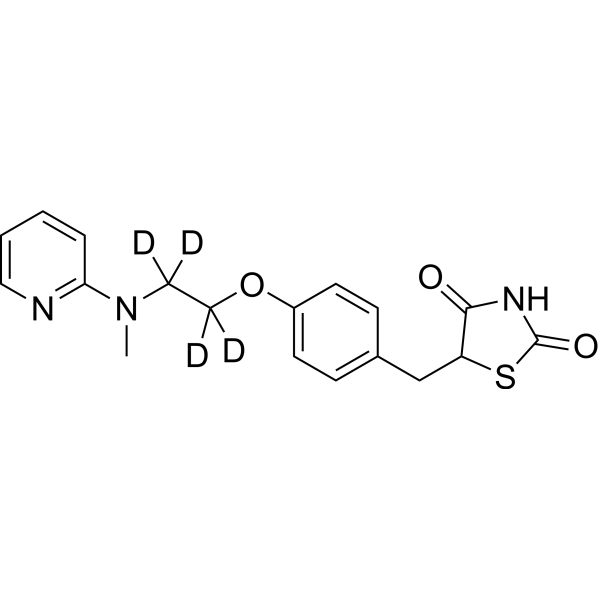
Rosiglitazone-d4
Rosiglitazone-d4 is deuterated labeled Rosiglitazone (HY-17386). Rosiglitazone (BRL 49653) is an orally active selective PPARγ agonist (EC50: 60 nM, Kd: 40 nM). Rosiglitazone is an TRPC5 activator (EC50: 30 μM) and TRPM3 inhibitor. Rosiglitazone can be used in the research of obesity and diabetes, senescence, ovarian cancer.
Nur für Forschungszwecke. Wir verkaufen nicht an Patienten.
- CAS. Nr.: 1132641-21-4
- Formel: C18H15D4N3O3S
- Molecular Weight:361.45
-
Speicherung:
Store at room temperature 3 years.
In solvent -80°C, 2 years , -20°C, 1 year

To place orders, for customer services and technical support, please contact: MedChemExpress USA
Tel: 609-228-6898 E-mail: [email protected] [email protected]


-
 Biologische Aktivität
-
Chemical Information
- Protokoll
- Reinheit & Dokumentation
- Verweise
-
 Help & FAQs




Biologische Aktivität
Beschreibung
In Vitro
Stable heavy isotopes of hydrogen, carbon, and other elements have been incorporated into drug molecules, largely as tracers for quantitation during the drug development process. Deuteration has gained attention because of its potential to affect the pharmacokinetic and metabolic profiles of drugs[1].
Rosiglitazone (0.1-10 μM, 72 h) results in pluripotent C3H10T1/2 stem cell differentiation to adipocytes[2].
Rosiglitazone (1 μM, 24 h) activates PPARγ, which binds to NF-α1 promoter to activate gene transcription in neurons[4].
Rosiglitazone (1 μM, 24 h) protects Neuro2A cells and hippocampal neurons against oxidative stress, and up-regulates BCL-2 expression in an NF-α1-dependent manner[4].
Rosiglitazone (0.01-100 μM, 15 min) inhibits TRPM3 with IC50 values of 9.5 and 4.6 μM against nifedipine- and PregS-evoked activity respectively[5].
Rosiglitazone (0.5-50 μM, 7 days) inhibits ovarian cancer cell proliferation[8].
Rosiglitazone (5 μM, 7 days) suppresses Olaparib (HY-10162) induced alterations of cellular senescence and promotes apoptosis in A2780 and SKOV3 cells[8].
MedChemExpress (MCE) has not independently confirmed the accuracy of these methods. They are for reference only. Further protocols information, click here.
In Vivo
Rosiglitazone (intraperitoneal injection, 3 mg/kg/day) ameliorates airway inflammation induced by cigarette smoke via inhibiting the M1 macrophage polarization by activating PPARγ and RXRα in male Wistar rats[7].
Rosiglitazone (intraperitoneal injection, 10 mg/kg, once every 2 days) inhibits subcutaneous ovarian cancer growth in A2780 and SKOV3 mouse subcutaneous xenograft models[8].
MedChemExpress (MCE) has not independently confirmed the accuracy of these methods. They are for reference only.
Anwendung
1. This compound can be used as a tracer
2. This compound can be used as an internal standard for quantitative analysis by NMR, GC-MS, or LC-MS.


Chemical Information
-
CAS. Nr. 1132641-21-4
-
Unlabeled CAS 122320-73-4
-
Appearance Solid
-
Molecular Weight 361.45
-
Formel C18H15D4N3O3S
-
Color White to off-white
-
SMILES
O=C(N1)SC(CC2=CC=C(OC([2H])([2H])C([2H])([2H])N(C)C3=NC=CC=C3)C=C2)C1=O
-
Synonyms
BRL 49653-d4
-
Versand
Room temperature in continental US; may vary elsewhere.
-
Speicherung
Store at room temperature 3 years
In solvent -80°C 2 years -20°C 1 year

Protokoll
-
Research Protocol for Metabolic Diseases
AMP-activated protein kinase, AMPK, is a conserved cellular energy sensor that responds to reduced cellular energy status and coordinates metabolism by increasing ATP-generating catabolic pathways while suppressing ATP-consuming anabolic processes. In metabolic disease research, the AMPK pathway is experimentally relevant because it regulates hepatic lipid synthesis, fatty acid oxidation, glucose production, skeletal-muscle glucose disposal, mTORC1-linked biosynthesis, autophagy, mitochondrial homeostasis, and whole-body energy balance. The central pathway logic is that energy stress, metformin, exercise-like stimulation, or direct AMPK activators increase AMPKα Thr172 phosphorylation and downstream substrate phosphorylation, including ACC and RAPTOR. Phosphorylation of ACC suppresses lipogenesis and supports fatty acid oxidation, whereas phosphorylation of RAPTOR suppresses mTORC1 signaling and links cellular energy status to growth and protein synthesis control. The pathway is linked
-
Senescence-associated β-galactosidase staining
Senescence-associated β-galactosidase staining detects β-galactosidase activity that is histochemically visible at pH 6. 0 in senescent cells, where X-gal cleavage produces an insoluble blue precipitate observable by bright-field microscopy. This activity reflects increased lysosomal β-galactosidase/lysosomal mass rather than a senescence-essential enzyme, because GLB1 depletion or genetic lysosomal β-galactosidase deficiency can abolish SA-β-gal staining while cells still undergo senescence. SA-β-gal was originally reported in senescent but not presenescent fibroblasts and keratinocytes, absent from quiescent fibroblasts and terminally differentiated keratinocytes, and increased with donor age in human skin samples. Because SA-β-gal can also appear in some non-senescent or tissue-specific contexts, interpretation should be paired with experimental controls and, when possible, independent senescence markers.


Reinheit & Dokumentation
-
Data Sheet (273 KB)
-
SDS (251 KB)
- English - EN (251 KB)
- Français - FR (251 KB)
- Deutsch - DE (251 KB)
- Norwegian - NO (251 KB)
- Español - ES (251 KB)
- Swedish - SV (251 KB)
- Italian - IT (251 KB)
- Korean - KR (251 KB)
- Portuguese - PT (251 KB)
-
Handling Instructions (2659 KB)
Verweise
[1]. Russak EM, et al. Impact of Deuterium Substitution on the Pharmacokinetics of Pharmaceuticals. Ann Pharmacother. 2019 Feb;53(2):211-216. [Content Brief]
[2]. Lehmann JM, et al. An antidiabetic thiazolidinedione is a high affinity ligand for peroxisome proliferator-activated receptor gamma (PPAR gamma). J Biol Chem. 1995 Jun 2;270(22):12953-6. [Content Brief]
[3]. Haoshen Feng, et al. Rosiglitazone ameliorated airway inflammation induced by cigarette smoke via inhibiting the M1 macrophage polarization by activating PPARγ and RXRα. Int Immunopharmacol. 2021 Aug;97:107809. [Content Brief]
[4]. Willson TM, et al. The structure-activity relationship between peroxisome proliferator-activated receptor gamma agonism and the antihyperglycemic activity of thiazolidinediones. J Med Chem. 1996 Feb 2;39(3):665-8. [Content Brief]
[5]. Zehua Wang, et al. Rosiglitazone ameliorates senescence and promotes apoptosis in ovarian cancer induced by olaparib. Cancer Chemother Pharmacol. 2020 Feb;85(2):273-284. [Content Brief]
[6]. Thouennon E, et al. Rosiglitazone-activated PPARγ induces neurotrophic factor-α1 transcription contributing to neuroprotection. J Neurochem. 2015 Aug;134(3):463-70. [Content Brief]
[7]. Majeed Y, et al. Rapid and contrasting effects of rosiglitazone on transient receptor potential TRPM3 and TRPC5 channels. Mol Pharmacol. 2011 Jun;79(6):1023-30. [Content Brief]
[8]. Ateyya H, et al. Beneficial effects of rosiglitazone and losartan combination in diabetic rats. Can J Physiol Pharmacol. 2018 Mar;96(3):215-220. [Content Brief]

Calculators
Konzentration (Stammlösung) × Volumen (Stammlösung) = Konzentration (Ziellösung) × Volumen (Ziellösung)


Rosiglitazone-d4 Related Classifications
HY-17386S1 Related Classifications
 Powered by Bioz