



Oxaprozin

Based on 1 Customer Validation
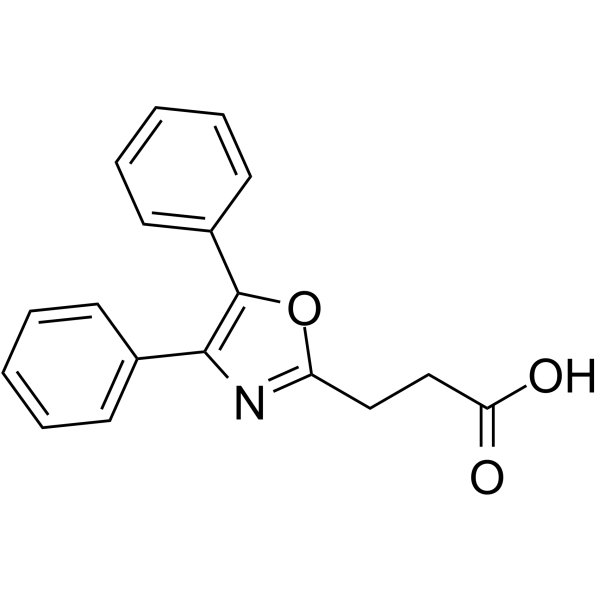
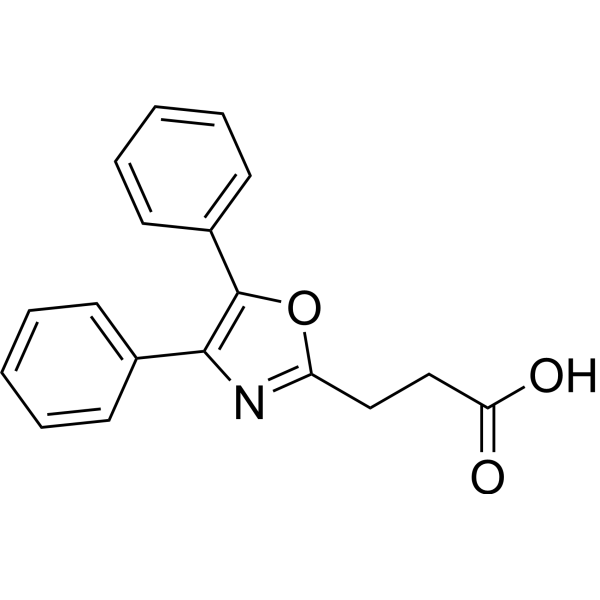
Oxaprozin is an orally active and potent COX inhibitor, with IC50 values of 2.2 μM for human platelet COX-1 and and 36 μM for IL-1-stimulated human synovial cell COX-2, respectively. Oxaprozin also inhibits the activation of NF-κB. Oxaprozin induces cell apoptosis. Oxaprozin shows anti-inflammatory activity. Oxaprozin-mediated inhibition of the Akt/IKK/NF-κB pathway contributes to its anti-inflammatory properties.
Nos produits utilisent uniquement pour la recherche. Nous ne vendons pas aux patients.
- Pureté: 99.94%
- CAS No.: 21256-18-8
- Formule: C18H15NO3
- Masse moléculaire:293.32
-
Stockage:Powder -20°C, 3 years , 4°C, 2 years ; In solvent -80°C, 2 years , -20°C, 1 year

To place orders, for customer services and technical support, please contact: MedChemExpress USA
Tel: 609-228-6898 E-mail: [email protected] [email protected]


-
 Activité biologique
-
Chemical Information
-
Solvant et solubilité
- Protocole
- Pureté et documentation
- Références
-
 Help & FAQs




Activité biologique
|
COX-1 2.2 μM (IC50) |
COX-2 36 μM (IC50) |
NF-κB |
IKK |
Oxaprozin induces apoptosis in a dose-dependent manner. Oxaprozin increases caspase-3 activity in the activated but not in the resting condition. NF-κB activation is inhibited by Oxaprozin (50 μM). Oxaprozin inhibits activation of the IKK system induced by the reagent IκBα[1].
Oxaprozin (100 μM) induces the strongest proapoptotic effect and significantly increases CD40L-treated monocyte apoptosis. Oxaprozin treatment inhibits CD40L-induced Akt and NF-κB (p65) phosphorylation[2].
MedChemExpress (MCE) has not independently confirmed the accuracy of these methods. They are for reference only.


Chemical Information
-
CAS No. 21256-18-8
-
Appearance Solid
-
Masse moléculaire 293.32
-
Formule C18H15NO3
-
Color White to off-white
-
SMILES
O=C(O)CCC1=NC(C2=CC=CC=C2)=C(C3=CC=CC=C3)O1
-
Synonyms
Oxaprozinum; Wy21743
-
Livraison
Room temperature in continental US; may vary elsewhere.
-
Stockage
Powder -20°C 3 years 4°C 2 years In solvent -80°C 2 years -20°C 1 year


Solvant et solubilité
DMSO : ≥ 100 mg/mL (340.92 mM; Hygroscopic DMSO has a significant impact on the solubility of product, please use newly opened DMSO)
* "≥" means soluble, but saturation unknown.
Please refer to the solubility information to select the appropriate solvent. Once prepared, please aliquot and store the solution to prevent product inactivation from repeated freeze-thaw cycles.
Storage method and period of stock solution: -80°C, 2 years; -20°C, 1 year. When stored at -80°C, please use it within 2 years. When stored at -20°C, please use it within 1 year.
Please refer to the solubility information to select the appropriate solvent. Once prepared, please aliquot and store the solution to prevent product inactivation from repeated freeze-thaw cycles.
Storage method and period of stock solution: -80°C, 2 years; -20°C, 1 year. When stored at -80°C, please use it within 2 years. When stored at -20°C, please use it within 1 year.
Concentration (start) × Volume (start) = Concentration (final) × Volume (final)
Select the appropriate dissolution method based on your experimental animal and administration route.
- For the following dissolution methods, please ensure to first prepare a clear stock solution using an In Vitro approach and then sequentially add co-solvents:
- To ensure reliable experimental results, the clarified stock solution can be appropriately stored based on storage conditions. As for the working solution for In Vivo experiments, it is recommended to prepare freshly and use it on the same day.
- The percentages shown for the solvents indicate their volumetric ratio in the final prepared solution. If precipitation or phase separation occurs during preparation, heat and/or sonication can be used to aid dissolution.
Add each solvent one by one: 10% DMSO 40% PEG300 5% Tween-80 45% Saline
Solubility: ≥ 2.5 mg/mL (8.52 mM); Clear solution
This protocol yields a clear solution of ≥ 2.5 mg/mL (saturation unknown).
Taking 1 mL working solution as an example, add 100 μL DMSO stock solution (25.0 mg/mL) to 400 μL PEG300, and mix evenly; then add 50 μL Tween-80 and mix evenly; then add 450 μL Saline to adjust the volume to 1 mL.
Preparation of Saline: Dissolve 0.9 g sodium chloride in ddH₂O and dilute to 100 mL to obtain a clear Saline solution.
Add each solvent one by one: 10% DMSO 90% (20% SBE-β-CD in Saline)
Solubility: ≥ 2.5 mg/mL (8.52 mM); Clear solution
This protocol yields a clear solution of ≥ 2.5 mg/mL (saturation unknown).
Taking 1 mL working solution as an example, add 100 μL DMSO stock solution (25.0 mg/mL) to 900 μL 20% SBE-β-CD in Saline, and mix evenly.
Preparation of 20% SBE-β-CD in Saline (4°C, storage for one week): 2 g SBE-β-CD powder is dissolved in 10 mL Saline, completely dissolve until clear.
Please enter the basic information of animal experiments:
-
-
-
-
Recommended: Prepare an additional quantity of animals to account for potential losses during experiments.
Please enter your animal formula composition:
-
%DMSO +
Recommended: Keep the proportion of DMSO in working solution below 2% if your animal is weak.
-
%+
-
+%Tween-80 + +
-
%Saline +
The co-solvents required include: DMSO, . All of co-solvents are available by MedChemExpress (MCE). , Tween 80. All of co-solvents are available by MedChemExpress (MCE).
Working solution concentration: 0.22 mg/mL
Method for preparing stock solution: mg drug dissolved in μL DMSO. Stock solution concentration: mg/mL.
1. Take μL DMSO stock solution;
2. Add μL .
μL , mix evenly;
3. Then add μL Tween 80, mix evenly;
4. Then add μL
Please ensure that the stock solution in the first step is dissolved to a clear state, and add co-solvents in sequence. You can use ultrasonic heating (ultrasonic cleaner, recommended frequency 20-40 kHz), vortexing, etc. to assist dissolution.

Protocole
Caspase 3 activity in the presence or absence of 200 ng/mL CD40L plus 1 μg/mL CD40L enhancer and 100 μM Oxaprozin is performed. The enzymatic activity is spectrophotometrically determined for 60 minutes at 405 nm assuming an extinction coefficient of 8.8×10³ M1/cm[2].
MedChemExpress (MCE) has not independently confirmed the accuracy of these methods. They are for reference only.
Purified monocytes are resuspended at 106/mL and cultured for 48 hours. In selective experiments, cells are cultured in the presence or absence of 50 μM PD98059, 1 μM SB203580, 50 μM LY294002, 20 μM SN-50, 50 μM Ac-DEVD-CHO, different doses (5, 10, 50, 100 μM) of Oxaprozin, 100 μM ibuprofen,100 μM indomethacin, or 100 μM naproxene. Percentages of apoptotic cells are measured by both fluorescence microscope and flow cytometer[2].
MedChemExpress (MCE) has not independently confirmed the accuracy of these methods. They are for reference only.


Pureté et documentation
-
Fiche technique (278 KB)
-
SDS (396 KB)
- English - EN (396 KB)
- Français - FR (396 KB)
- Deutsch - DE (396 KB)
- Norwegian - NO (396 KB)
- Español - ES (396 KB)
- Swedish - SV (396 KB)
- Italian - IT (396 KB)
- Korean - KR (396 KB)
- Portuguese - PT (396 KB)
-
Instruction de manipulation (2659 KB)
Références
[1]. Ottonello L, et al. Delayed apoptosis of human monocytes exposed to immune complexes is reversed byoxaprozin: role of the Akt/IkappaB kinase/nuclear factor kappaB pathway. Br J Pharmacol. 2009 May;157(2):294-306. [Content Brief]
[2]. Montecucco F, et al. Oxaprozin-induced apoptosis on CD40 ligand-treated human primary monocytes is associated with the modulation of defined intracellular pathways. J Biomed Biotechnol. 2009;2009:478785. [Content Brief]


Complete Stock Solution Preparation Table
Please refer to the solubility information to select the appropriate solvent. Once prepared, please aliquot and store the solution to prevent product inactivation from repeated freeze-thaw cycles.
Storage method and period of stock solution: -80°C, 2 years; -20°C, 1 year. When stored at -80°C, please use it within 2 years. When stored at -20°C, please use it within 1 year.
| Optional Solvent | Concentration Solvent Mass | 1 mg | 5 mg | 10 mg | 25 mg |
|---|---|---|---|---|---|
| DMSO | 1 mM | 3.4092 mL | 17.0462 mL | 34.0925 mL | 85.2311 mL |
| 5 mM | 0.6818 mL | 3.4092 mL | 6.8185 mL | 17.0462 mL | |
| 10 mM | 0.3409 mL | 1.7046 mL | 3.4092 mL | 8.5231 mL | |
| 15 mM | 0.2273 mL | 1.1364 mL | 2.2728 mL | 5.6821 mL | |
| 20 mM | 0.1705 mL | 0.8523 mL | 1.7046 mL | 4.2616 mL | |
| 25 mM | 0.1364 mL | 0.6818 mL | 1.3637 mL | 3.4092 mL | |
| 30 mM | 0.1136 mL | 0.5682 mL | 1.1364 mL | 2.8410 mL | |
| 40 mM | 0.0852 mL | 0.4262 mL | 0.8523 mL | 2.1308 mL | |
| 50 mM | 0.0682 mL | 0.3409 mL | 0.6818 mL | 1.7046 mL | |
| 60 mM | 0.0568 mL | 0.2841 mL | 0.5682 mL | 1.4205 mL | |
| 80 mM | 0.0426 mL | 0.2131 mL | 0.4262 mL | 1.0654 mL | |
| 100 mM | 0.0341 mL | 0.1705 mL | 0.3409 mL | 0.8523 mL |


Oxaprozin Related Classifications
HY-B0808 Related Classifications
 Powered by Bioz