



CP-07
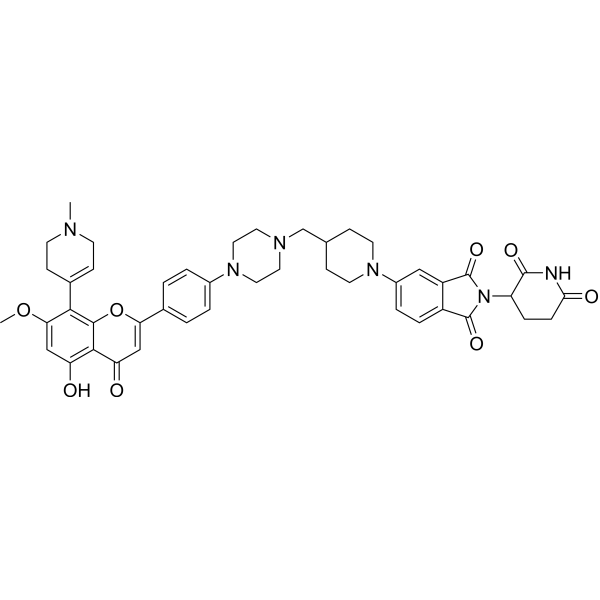
CP-07 is a selective flavonoid-based PROTAC degrader that targets and degrades CDK9. CP-07 exhibits an IC50 of 3.3 nM against CDK9/cyclin T1, and induces CDK9 degradation in a concentration-dependent manner in 22RV1 cells with a DC50 of 43 nM. CP-07 rapidly triggers ligand-dependent and proteasome-dependent degradation of CDK9. CP-07 can be applied in prostate cancer-related research.
(Pink: CDK9 ligand (HY-187016); Blue: Cereblon ligand (HY-14658); Black: linker).
For research use only. We do not sell to patients.
- Formula: C45H48N6O8
- Molecular Weight:800.90
-
Storage:
Please store the product under the recommended conditions in the Certificate of Analysis.

To place orders, for customer services and technical support, please contact: MedChemExpress USA
Tel: 609-228-6898 E-mail: [email protected] [email protected]


-
 Biological Activity
-
Chemical Information
- Purity & Documentation
- References
-
 Help & FAQs


All PROTACs Isoforms
More

Biological Activity
Description
IC50 & Target
[1]|
CDK9 3.3 nM (IC50) |
Cellular Effect
|
Cell Line

|
Type | Value | Description | References |
|---|---|---|---|---|
| CWR22R | IC50 |
0.06 μM
Compound: CP-07
|
Antiproliferative activity against human 22Rv1 cells assessed as reduction in cell viability incubated for 72 hrs by SRB assay
Antiproliferative activity against human 22Rv1 cells assessed as reduction in cell viability incubated for 72 hrs by SRB assay
|
[PMID: 37672930] |
In Vitro
CP-07 (100 nM; 2-24 h) initiates the induction of CDK9 degradation in 22RV1 cells after 2 h of treatment, and achieves complete degradation at 12 h [1].
CP-07 (500 nM; 12 h) completely downregulates CDK9 in 22RV1 cells, while exhibiting minimal or no significant effects on the protein levels of CDK2, CDK4, CDK5, CDK6, and CDK7, demonstrating selectivity for CDK9 degradation[1].
CP-07 (72 h) inhibits the growth/viability of 22RV1 cells, with an IC50 of 0.06 μM (60 nM) reported in Table 1[1].
CP-07 (14 days) inhibits the colony formation of 22RV1 cells in a concentration-dependent manner, and completely blocks colony formation at approximately 60 nM, exhibiting stronger effects than LWT-111 and flavopiridol[1].
CP-07 (0.1-1.5 μM; 24 h) downregulates p-RNAPII-Ser2, Mcl-1 and c-Myc in a concentration-dependent manner in 22RV1 cells, and reduces the protein levels of cyclin T1, AR, ARv7 and PSA[1].
CP-07 exhibits good water solubility, with a measured solubility of 53 μg/mL at pH 7.4 and 125 μg/mL at pH 6.0[1].
CP-07 exhibits an in vitro half-life of 97 min in human liver microsomes, indicating moderate in vitro metabolic stability[1].
MedChemExpress (MCE) has not independently confirmed the accuracy of these methods. They are for reference only.
-
Cell Line:22RV1 prostate cancer cells
-
Concentration:0.1, 0.5, 1.5 μM
-
Incubation Time:24 h
-
Result:Down-regulated p-RNAPII-Ser2, Mcl-1, and c-Myc in a concentration-dependent manner.
Reduced cyclin T1 protein levels.
Down-regulated AR, ARv7, and PSA protein levels.
-
Cell Line:22RV1 prostate cancer cells
-
Concentration:7.8, 31.2, 62.5, 125 nM
-
Incubation Time:14 days
-
Result:Suppressed colony formation in a concentration-dependent manner.
Completely prevented colony formation at approximately 60 nM.
Showed greater inhibition of colony formation than LWT-111 and flavopiridol.
-
Cell Line:22RV1 prostate cancer cells
-
Concentration:6.17, 18.52, 55.56, 166.67, 500 nM
-
Incubation Time:12 h
-
Result:Induced concentration-dependent CDK9 degradation.
Produced a DC50 of 43 nM.
Completely down-regulated CDK9 at 500 nM.
-
Cell Line:22RV1 prostate cancer cells
-
Concentration:100 nM
-
Incubation Time:2, 4, 8, 12, 24 h
-
Result:Initiated detectable CDK9 degradation at 2 h.
Achieved complete CDK9 degradation by 12 h.
-
Cell Line:22RV1 prostate cancer cells
-
Concentration:500 nM
-
Incubation Time:12 h
-
Result:Completely down-regulated CDK9.
Had minimal or no effect on CDK2, CDK4, CDK5, CDK6, and CDK7 protein levels.
Parmacokinetics
| Species | Dose | Route | T1/2 | AUC | Vz |
|---|---|---|---|---|---|
| Rat[1] | 2 mg/kg | i.v. | 11.1 h | 680.7 h·μg/L | 22.6 L/kg |
In Vivo
CP-07 (10 mg/kg; i.v.; every 2 days; 20 days) inhibits tumor growth in female BALB/c nude mouse 22RV1 xenograft tumor model, with a TGI of 65.7%; no death is observed during the experimental period, and the body weight decreases by 12.5%[1].
CP-07 (20 mg/kg; i.v.; every 2 days; 18 days) downregulates CDK9, ARv7, Mcl-1, and c-Myc in 22RV1 xenograft tumor tissues; immunohistochemical analysis reveals reduced levels of CDK9, c-Myc, and Ki67[1].
MedChemExpress (MCE) has not independently confirmed the accuracy of these methods. They are for reference only.
-
Animal Model:BALB/c nude (female, 4 weeks old, subcutaneous injection of 5×10⁶ 22RV1 cells)[1]
-
Dosage:10 mg/kg
-
Administration:i.v.; once every 2 days; 20 days
-
Result:Produced a TGI of 65.7%.
No mortality was observed.
Reduced body weight by 12.5%.
-
Animal Model:BALB/c nude (female, 4 weeks old, subcutaneous injection of 5×10⁶ 22RV1 cells)[1]
-
Dosage:20 mg/kg
-
Administration:i.v.; once every 2 days; 20 days
-
Result:Produced a TGI of 75.1%.
No mortality was observed.
Reduced body weight by 15.3%.
-
Animal Model:Female BALB/c nude mice bearing 22RV1 xenografts[1]
-
Dosage:20 mg/kg
-
Administration:i.v.; once every 2 days; 20 days
-
Result:Down-regulated CDK9, ARv7, Mcl-1, and c-Myc in xenograft tumor tissues.
Decreased CDK9, c-Myc, and Ki67 levels by IHC.


Chemical Information
-
Molecular Weight 800.90
-
Formula C45H48N6O8
-
SMILES
COC1=CC(O)=C(C(C=C(C2=CC=C(N3CCN(CC4CCN(C5=CC=C(C(N(C6CCC(NC6=O)=O)C7=O)=O)C7=C5)CC4)CC3)C=C2)O8)=O)C8=C1C9=CCN(C)CC9
-
Shipping
Room temperature in continental US; may vary elsewhere.
-
Storage
Please store the product under the recommended conditions in the Certificate of Analysis.


Purity & Documentation
References

Calculators
Concentration (start) × Volume (start) = Concentration (final) × Volume (final)


CP-07 Related Classifications
HY-149495 Related Classifications
 Powered by Bioz