



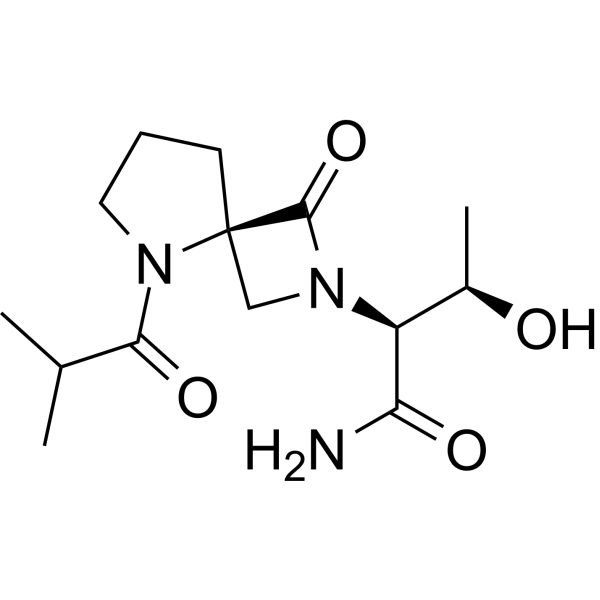
NYX-2925

Based on 1 Customer Validation
NYX-2925 is an orally active, blood-brain barrier-permeable NMDAR modulator, with EC50 values of 55 pM, 28 fM, 11 pM and 55 pM against NR2A, NR2B, NR2C and NR2D, respectively. NYX-2925 enhances synaptic plasticity, long-term potentiation, metaplasticity, structural plasticity, learning ability, memory capacity and circadian rhythm amplitude. NYX-2925 regulates the signaling pathways of Src kinase, EIF2, mTOR, CDK5 and protein kinase A (PKA). NYX-2925 increases the levels of PSD-95, GluA1, activated Src and synaptic GluN2B. NYX-2925 is used in the research of neuropathic pain, fibromyalgia, painful diabetic peripheral neuropathy, post-traumatic stress disorder, cognitive impairment, depression, age-related cognitive decline and NMDAR-mediated central nervous system diseases.
연구목적의 판매만을 진행합니다. 환자를 대상으로 한 판매는 하지 않습니다.
- Purity: 98.98%
- CAS No.: 2012536-16-0
- 화학식: C14H23N3O4
- 분자량:297.35
-
보관:
4°C, protect from light, stored under nitrogen
* In solvent : -80°C, 6 months; -20°C, 1 month (protect from light, stored under nitrogen)

To place orders, for customer services and technical support, please contact: MedChemExpress USA
Tel: 609-228-6898 E-mail: [email protected] [email protected]


-
 Biological Activity
-
Chemical Information
-
용액&용해도
- 순도&문서
- References
-
 Help & FAQs


All iGluR Isoforms
More

Biological Activity
|
NR2C 11 pM (EC50) |
NR2B 0.028 pM (EC50) |
NR2A 55 pM (EC50) |
NR2D 55 pM (EC50) |
NYX-2925 potently activates human recombinant NMDAR NR2A-D subtypes expressed in human embryonic kidney cells with EC50 values of 0.028-55 pM[3].
NYX-2925 robustly facilitates NMDAR current and NMDAR-dependent LTP in brain slices by activating the NMDAR[6].
NYX-2925 (0.1 pM-30 nM; 30-60 min) increases synaptic GluN2B (measured by colocalization with PSD-95) via an NMDAR-dependent, ion flux-independent mechanism after 30 min co-treatment with glutamate in primary hippocampal neurons derived from embryonic day 18 Sprague-Dawley rat pups, while higher concentrations have no effect or reduce synaptic GluN2B with prolonged exposure[7].
NYX-2925 (1 pM-30 nM; 1 min) enhances NMDA-induced calcium transients in primary hippocampal neurons derived from embryonic day 18 Sprague-Dawley rat pups at 30 nM, while 1 pM and 1 nM NYX-2925 have no effect[7].
NYX-2925 (1 pM; 30 min) does not alter basal synaptic GluA1 levels but facilitates chemLTP-mediated synaptic GluA1 recruitment in primary hippocampal neurons derived from embryonic day 18 Sprague-Dawley rat pups, while NYX-2925 (30 nM; 30 min) increases basal synaptic GluA1 levels but does not further enhance chemLTP-mediated recruitment beyond chemLTP alone[7].
NYX-2925 (Varying concentrations; 15 min preincubation, 15 min with [3H] MK-801) acts as a functional glycine site agonist at human GluN1/GluN2A, GluN1/GluN2B, GluN1/GluN2C, and GluN1/GluN2D NMDA receptors expressed in HEK cells, with EC50 values ranging from 28 fM to 55 pM[8].
NYX-2925 shows no significant binding activity against 81 tested neuroactive receptors, demonstrating low off-target potential[3].
NYX-2925 (10 μM) shows no significant off-target binding to 81 tested CNS protein targets, indicating low potential for off-target activity[8].
NYX-2925 (1 pM; 30 min) modulates pathways linked to receptor stabilization and homeostatic plasticity in primary hippocampal neurons derived from embryonic day 18 Sprague-Dawley rat pups, while NYX-2925 (30 nM; 30 min) modulates pathways linked to synaptic long-term potentiation and receptor trafficking[7].
MedChemExpress (MCE) has not independently confirmed the accuracy of these methods. They are for reference only.
NYX-2925 (0.1-10 mg/kg; p.o.; single administration) significantly increases resting-state alpha-band quantitative electroencephalogram (qEEG) power, as well as 6-7 Hz electroencephalogram power during auditory tetanic stimulation; meanwhile, doses of 0.1 and 1 mg/kg enhance mismatch negativity (MMN), and doses of 1 and 10 mg/kg augment late long-term potentiation (aLTP), indicating that it promotes NMDAR-dependent synaptic plasticity in male Sprague-Dawley rats[4].
NYX-2925 (0.03-100 mg/kg) produces rapid, dose-dependent and long-lasting analgesic effects in rat models of neuropathic pain induced by CCI. The analgesic effect persists for up to 1 week after a single administration, and daily administration maintains this effect. Additionally, NYX-2925 reverses pain-related affective disorders; these effects depend on NMDA receptors, and no efficacy is observed with intrathecal administration[5].
NYX-2925 (1 mg/kg; p.o.; single administration) increases the level of synaptic GluN2B in the prefrontal cortex of rats measured 24 hours after administration[7].
NYX-2925 (0.001-100 mg/kg; p.o.; single administration) enhances cognitive function and synaptic plasticity in healthy rats by regulating NMDA receptors, with significant improvements observed in novel object recognition, positive emotional learning, and persistent metaplasticity/structural plasticity, while exhibiting no ketamine-like sedation, ataxia or discriminative effects[8].
NYX-2925 (0.1-10 mg/kg; p.o.; single administration) exerts rapid and long-lasting analgesic effects in streptozotocin (STZ)-induced rat models of diabetic neuropathic pain, with the analgesic effects of the 3 mg/kg and 10 mg/kg doses persisting for up to 1 week[5].
NYX-2925 (0.1-10 mg/kg; p.o.; single administration) dose-dependently attenuates persistent pain responses in the formalin model of *Rattus norvegicus* (brown rat), with significant efficacy observed at doses of 1 and 10 mg/kg[5].
NYX-2925 (0.1-10 mg/kg; p.o.; single administration) exerts no analgesic effect in the rat tail-flick acute nociceptive pain model[5].
NYX-2925 (0.1-10 mg/kg; p.o.; single administration) dose-dependently increases non-rapid eye movement (NREM) sleep during the light period in both non-sleep-deprived and sleep-deprived Sprague-Dawley rats, with the effect induced by the 10 mg/kg p.o. dose lasting up to 3 days post-administration[6].
NYX-2925 (1 mg/kg; p.o.; single administration) reverses deficits in positive emotional learning, hedonic ultrasonic vocalizations (USVs), and play-seeking behaviors induced by sleep deprivation in Sprague-Dawley rats[6].
NYX-2925 (10 mg/kg; p.o.; single administration) enhances the amplitude and precision of circadian rhythms of spontaneous activity and positive affect, while inhibiting negative affect, in non-sleep-deprived Sprague-Dawley rats[6].
MedChemExpress (MCE) has not independently confirmed the accuracy of these methods. They are for reference only.
-
Animal Model:Sprague Dawley (adult male, 2-3 months old, chronic constriction injury of the sciatic nerve)[2]
-
Dosage:10 mg/kg
-
Administration:p.o.; single dose
-
Result:Reversed CCI-induced mechanical hypersensitivity, with paw withdrawal thresholds increased from <5 g to SHAM levels 1 hour post-dose (F(5,60)=45.67, p=0.0012; F(2,41)=56.66, p<0.0001).
Restored CCI-induced decreases in phosphorylated Src (Tyr416) in mPFC whole cell lysates (p=0.0001) and synaptosomal fractions (p=0.0090) to SHAM levels.
Restored CCI-induced decreases in Src-mediated phosphorylation sites on GluN2A (Tyr1246: p=0.0003 in whole lysates, p=0.0228 in synaptosomes; Tyr1325: trend toward restoration in synaptosomes) and GluN2B (Tyr1472: p=0.0005 in whole lysates; Tyr1252: p=0.0002 in whole lysates, p=0.0414 in synaptosomes) to SHAM levels, with no effect on phosphorylated CAMKIIα (Thr286) or GluN2B (Ser1303) levels.
Showed no effect on paw withdrawal thresholds or phosphorylated Src levels in SHAM rats.
-
Animal Model:Sprague-Dawley (male, 2-3-month old, 250-350 g, streptozotocin-induced diabetic neuropathy)[5]
-
Dosage:0.1 mg/kg; 1 mg/kg; 3 mg/kg; 10 mg/kg
-
Administration:p.o. ; single dose
-
Result:Significantly increased paw withdrawal threshold versus vehicle at 1 hour, 24 hours, and 1 week post single oral 10 mg/kg dosing; significantly increased paw withdrawal threshold at 1 hour and 1 week post single oral 3 mg/kg dosing; significantly increased paw withdrawal threshold at 1 hour post single oral 1 mg/kg dosing; showed no effect at any time point with single oral 0.1 mg/kg dosing.
-
Animal Model:Sprague-Dawley (male, 2-3-month old, 250-350 g, formalin-induced persistent pain)[5]
-
Dosage:0.1 mg/kg; 1 mg/kg; 10 mg/kg
-
Administration:p.o. ; single dose
-
Result:Significantly reduced average phase II pain responses from 18.24 (vehicle) to 8.17 with single oral 1 mg/kg dosing.
Significantly reduced average phase II pain responses from 18.24 (vehicle) to 5.70 with single oral 10 mg/kg dosing.
Showed no effect with single oral 0.1 mg/kg dosing.
-
Animal Model:Sprague-Dawley (male, 2-3-month old, 250-350 g, tail flick test for acute nociceptive pain)[5]
-
Dosage:0.1 mg/kg; 1 mg/kg; 10 mg/kg
-
Administration:p.o. ; single dose
-
Result:Showed no significant effect on tail flick latency versus vehicle, with values similar to baseline at all tested oral doses.
-
Animal Model:Sprague-Dawley (male, 2- to 3-month-old, sleep deprivation model)[6]
-
Dosage:0.1 mg/kg; 1 mg/kg; 10 mg/kg
-
Administration:p.o.; single dose
-
Result:Increased NREM sleep time and total sleep time during the lights-on phase in both non-sleep-deprived and sleep-deprived rats at 1 mg/kg, without affecting REM sleep.
Facilitated NREM sleep 24 hours post-dosing in sleep-deprived rats at 0.1, 1, and 10 mg/kg.
Showed persistent NREM sleep facilitation at 48 and 72 hours post-dosing in sleep-deprived rats at 10 mg/kg.
Increased sleep-bout duration, increased NREM to REM latency, decreased delta power in wake, and increased delta power in NREM and theta power in REM across 3 testing days at 10 mg/kg.
-
Animal Model:Sprague-Dawley (male, sleep deprivation model)[6]
-
Dosage:1 mg/kg
-
Administration:p.o.; single dose;
-
Result:Increased rates of hedonic 50-kHz USVs.
Increased rates of hedonic 50-kHz USVs and decreased rates of aversive 20-kHz USVs in response to unconditioned play.
Increased running speed to self-administer play.
Showed significant differences between NYX-2925 and sleep-deprived vehicle groups in all measured endpoints.
-
Animal Model:Sprague-Dawley (male)[6]
-
Dosage:10 mg/kg
-
Administration:p.o.; single dose
-
Result:Enhanced the amplitude of positive affect (50-kHz USVs) during the dark phase.
Suppressed negative affect (20-kHz USVs) across the 24-hour period.
Enhanced the amplitude of the locomotor activity rhythm by decreasing activity during the light phase.
Improved the accuracy of the light-dark transition for locomotor activity, reducing absolute error vs. lights-on time to 15.9 minutes (vs. vehicle 34.0 minutes).
Decreased fragmentation of diurnal behavior to 14.6% (vs. vehicle 34.0%).
-
Animal Model:Sprague Dawley (male, 60 days old)[7]
-
Dosage:1 mg/kg
-
Administration:p.o.; single dose
-
Result:Increased levels of GluN2B in PSD-95 co-immunoprecipitates of the rat prefrontal cortex 24 hours after dosing.
| NCT Number | Sponsor | Condition | Start Date |
Phase

|
|---|---|---|---|---|
| NCT01329991 | Plexxikon| | 2011-05 | PHASE1 |


Chemical Information
-
CAS No. 2012536-16-0
-
Appearance Solid
-
분자량 297.35
-
화학식 C14H23N3O4
-
Color White to off-white
-
SMILES
CC(C)C(N1[C@@]2(CCC1)C(N(C2)[C@H](C(N)=O)[C@H](O)C)=O)=O
-
선적
Room temperature in continental US; may vary elsewhere.
-
보관
4°C, protect from light, stored under nitrogen
* In solvent : -80°C, 6 months; -20°C, 1 month (protect from light, stored under nitrogen)


용액&용해도
DMSO : 100 mg/mL (336.30 mM; Need ultrasonic; Hygroscopic DMSO has a significant impact on the solubility of product, please use newly opened DMSO)
Please refer to the solubility information to select the appropriate solvent. Once prepared, please aliquot and store the solution to prevent product inactivation from repeated freeze-thaw cycles.
Storage method and period of stock solution: -80°C, 6 months; -20°C, 1 month (protect from light, stored under nitrogen). When stored at -80°C, please use it within 6 months. When stored at -20°C, please use it within 1 month.
Please refer to the solubility information to select the appropriate solvent. Once prepared, please aliquot and store the solution to prevent product inactivation from repeated freeze-thaw cycles.
Storage method and period of stock solution: -80°C, 6 months; -20°C, 1 month (protect from light, stored under nitrogen). When stored at -80°C, please use it within 6 months. When stored at -20°C, please use it within 1 month.
Concentration (start) × Volume (start) = Concentration (final) × Volume (final)


순도&문서
-
Data Sheet (295 KB)
-
SDS (252 KB)
- English - EN (252 KB)
- Français - FR (252 KB)
- Deutsch - DE (252 KB)
- Norwegian - NO (252 KB)
- Español - ES (252 KB)
- Swedish - SV (252 KB)
- Italian - IT (252 KB)
- Korean - KR (252 KB)
- Portuguese - PT (252 KB)
-
Handling Instructions (2659 KB)
References
[1]. Zeng Y, et al. New advances in small molecule drugs targeting NMDA receptors. Acta pharmacologica Sinica. 2026 Jan;47(1):3-21. [Content Brief]
[2]. Morrison G, et al. The NMDAR modulator NYX-2925 alleviates neuropathic pain via a Src-dependent mechanism in the mPFC. Neurobiology of pain (Cambridge, Mass.). 2020;7:100039. [Content Brief]
[3]. Houck DR, et al. NYX-2925, A Novel N-methyl-D-aspartate Receptor Modulator: A First-in-Human, Randomized, Double-blind Study of Safety and Pharmacokinetics in Adults. Clinical and translational science. 2019 Mar;12(2):164-171. [Content Brief]
[4]. Burgdorf JS, et al. A translational EEG-based approach to assess modulation of long-lasting NMDAR-dependent synaptic plasticity. Psychopharmacology. 2019 Dec;236(12):3687-3693. [Content Brief]
[5]. Ghoreishi-Haack N, et al. NYX-2925 Is a Novel -Methyl-d-Aspartate Receptor Modulator that Induces Rapid and Long-Lasting Analgesia in Rat Models of Neuropathic Pain. The Journal of pharmacology and experimental therapeutics. 2018 Sep;366(3):485-497. [Content Brief]
[6]. Burgdorf JS, et al. NMDAR activation regulates the daily rhythms of sleep and mood. Sleep. 2019 Oct 09;42(10):zsz135. [Content Brief]
[7]. Bowers MS, et al. NYX-2925 induces metabotropic N-methyl-d-aspartate receptor (NMDAR) signaling that enhances synaptic NMDAR and α-amino-3-hydroxy-5-methyl-4-isoxazolepropionic acid receptor. Journal of neurochemistry. 2020 Mar;152(5):523-541. [Content Brief]
[8]. Khan MA, et al. NYX-2925 Is a Novel NMDA Receptor-Specific Spirocyclic-β-Lactam That Modulates Synaptic Plasticity Processes Associated with Learning and Memory. The international journal of neuropsychopharmacology. 2018 Mar 01;21(3):242-254. [Content Brief]


Complete Stock Solution Preparation Table
Please refer to the solubility information to select the appropriate solvent. Once prepared, please aliquot and store the solution to prevent product inactivation from repeated freeze-thaw cycles.
Storage method and period of stock solution: -80°C, 6 months; -20°C, 1 month (protect from light, stored under nitrogen). When stored at -80°C, please use it within 6 months. When stored at -20°C, please use it within 1 month.
| Optional Solvent | Concentration Solvent Mass | 1 mg | 5 mg | 10 mg | 25 mg |
|---|---|---|---|---|---|
| DMSO | 1 mM | 3.3630 mL | 16.8152 mL | 33.6304 mL | 84.0760 mL |
| 5 mM | 0.6726 mL | 3.3630 mL | 6.7261 mL | 16.8152 mL | |
| 10 mM | 0.3363 mL | 1.6815 mL | 3.3630 mL | 8.4076 mL | |
| 15 mM | 0.2242 mL | 1.1210 mL | 2.2420 mL | 5.6051 mL | |
| 20 mM | 0.1682 mL | 0.8408 mL | 1.6815 mL | 4.2038 mL | |
| 25 mM | 0.1345 mL | 0.6726 mL | 1.3452 mL | 3.3630 mL | |
| 30 mM | 0.1121 mL | 0.5605 mL | 1.1210 mL | 2.8025 mL | |
| 40 mM | 0.0841 mL | 0.4204 mL | 0.8408 mL | 2.1019 mL | |
| 50 mM | 0.0673 mL | 0.3363 mL | 0.6726 mL | 1.6815 mL | |
| 60 mM | 0.0561 mL | 0.2803 mL | 0.5605 mL | 1.4013 mL | |
| 80 mM | 0.0420 mL | 0.2102 mL | 0.4204 mL | 1.0510 mL | |
| 100 mM | 0.0336 mL | 0.1682 mL | 0.3363 mL | 0.8408 mL |


NYX-2925 Related Classifications
HY-135741 Related Classifications
 Powered by Bioz