



MMP13-IN-2

Based on 1 Customer Validation
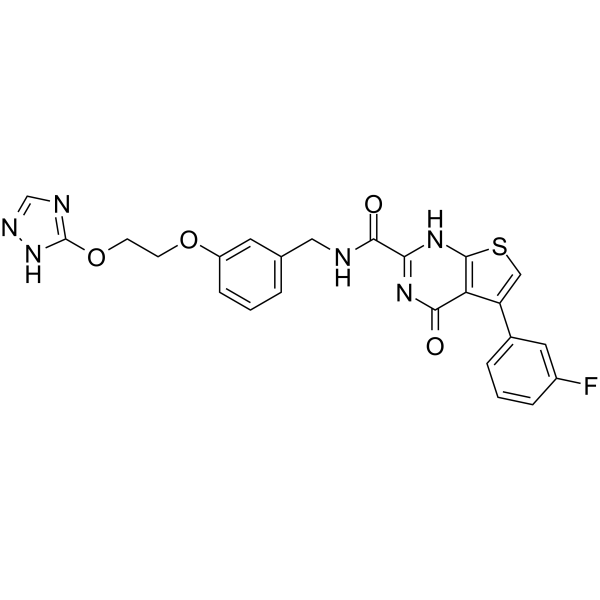
MMP13-IN-2 is a potent, selective and orally active MMP-13 inhibitor. MMP13-IN-2 exhibits excellent potency for MMP-13 (IC50=0.036 nM) and selectivities (greater than 1,500-fold) over MMP-1, 3, 7, 8, 9, 14, and TACE. MMP13-IN-2 has the ability to block the release of collagen from cartilage in vitro. MMP13-IN-2 has the potential for collagenase related disease research.
For research use only. We do not sell to patients.
- Purity : 99.13%
- CAS No.: 935759-55-0
- Formula: C24H19FN6O4S
- Molecular Weight:506.51
-
Storage:Powder -20°C, 3 years , 4°C, 2 years ; In solvent -80°C, 6 months , -20°C, 1 month

To place orders, for customer services and technical support, please contact: MedChemExpress USA
Tel: 609-228-6898 E-mail: [email protected] [email protected]


-
 Biological Activity
-
Chemical Information
-
Solvent & Solubility
- Protocols
- Purity & Documentation
- References
-
 Help & FAQs




Biological Activity
Description
IC50 & Target
[1]|
MMP-13 0.036 nM (IC50) |
MMP-2 180 nM (IC50) |
MMP-3 1100 nM (IC50) |
In Vitro
In a bovine nasal cartilage (BNC) assay, the chondrocyte-mediated degradation of cartilage was studied using bovine nasal cartilage slices cultured for up to 14 days. MMP13-IN-2 (0.01-1 µM) is effective at preventing the IL-1/OSM induced in vitro degradation of BNC (-17.6%, 48.4% and 70.8% inhibition of cartilage degradation, respectively).[1].
MedChemExpress (MCE) has not independently confirmed the accuracy of these methods. They are for reference only.
In Vivo


Chemical Information
-
CAS No. 935759-55-0
-
Appearance Solid
-
Molecular Weight 506.51
-
Formula C24H19FN6O4S
-
Color White to off-white
-
SMILES
O=C(C(NC1=C2C(C3=CC=CC(F)=C3)=CS1)=NC2=O)NCC4=CC=CC(OCCOC5=NC=NN5)=C4
-
Shipping
Room temperature in continental US; may vary elsewhere.
-
Storage
Powder -20°C 3 years 4°C 2 years In solvent -80°C 6 months -20°C 1 month


Solvent & Solubility
In Vitro:
DMSO : 100 mg/mL (197.43 mM; ultrasonic and warming and heat to 60°C; Hygroscopic DMSO has a significant impact on the solubility of product, please use newly opened DMSO)
Please refer to the solubility information to select the appropriate solvent. Once prepared, please aliquot and store the solution to prevent product inactivation from repeated freeze-thaw cycles.
Storage method and period of stock solution: -80°C, 6 months; -20°C, 1 month. When stored at -80°C, please use it within 6 months. When stored at -20°C, please use it within 1 month.
Please refer to the solubility information to select the appropriate solvent. Once prepared, please aliquot and store the solution to prevent product inactivation from repeated freeze-thaw cycles.
Storage method and period of stock solution: -80°C, 6 months; -20°C, 1 month. When stored at -80°C, please use it within 6 months. When stored at -20°C, please use it within 1 month.
Concentration (start) × Volume (start) = Concentration (final) × Volume (final)


Purity & Documentation
-
Data Sheet (271 KB)
-
SDS (251 KB)
- English - EN (251 KB)
- Français - FR (251 KB)
- Deutsch - DE (251 KB)
- Norwegian - NO (251 KB)
- Español - ES (251 KB)
- Swedish - SV (251 KB)
- Italian - IT (251 KB)
- Korean - KR (251 KB)
- Portuguese - PT (251 KB)
-
Handling Instructions (2659 KB)
References


Complete Stock Solution Preparation Table
Please refer to the solubility information to select the appropriate solvent. Once prepared, please aliquot and store the solution to prevent product inactivation from repeated freeze-thaw cycles.
Storage method and period of stock solution: -80°C, 6 months; -20°C, 1 month. When stored at -80°C, please use it within 6 months. When stored at -20°C, please use it within 1 month.
| Optional Solvent | Concentration Solvent Mass | 1 mg | 5 mg | 10 mg | 25 mg |
|---|---|---|---|---|---|
| DMSO | 1 mM | 1.9743 mL | 9.8715 mL | 19.7429 mL | 49.3574 mL |
| 5 mM | 0.3949 mL | 1.9743 mL | 3.9486 mL | 9.8715 mL | |
| 10 mM | 0.1974 mL | 0.9871 mL | 1.9743 mL | 4.9357 mL | |
| 15 mM | 0.1316 mL | 0.6581 mL | 1.3162 mL | 3.2905 mL | |
| 20 mM | 0.0987 mL | 0.4936 mL | 0.9871 mL | 2.4679 mL | |
| 25 mM | 0.0790 mL | 0.3949 mL | 0.7897 mL | 1.9743 mL | |
| 30 mM | 0.0658 mL | 0.3290 mL | 0.6581 mL | 1.6452 mL | |
| 40 mM | 0.0494 mL | 0.2468 mL | 0.4936 mL | 1.2339 mL | |
| 50 mM | 0.0395 mL | 0.1974 mL | 0.3949 mL | 0.9871 mL | |
| 60 mM | 0.0329 mL | 0.1645 mL | 0.3290 mL | 0.8226 mL | |
| 80 mM | 0.0247 mL | 0.1234 mL | 0.2468 mL | 0.6170 mL | |
| 100 mM | 0.0197 mL | 0.0987 mL | 0.1974 mL | 0.4936 mL |


MMP13-IN-2 Related Classifications
HY-122624 Related Classifications
 Powered by Bioz