



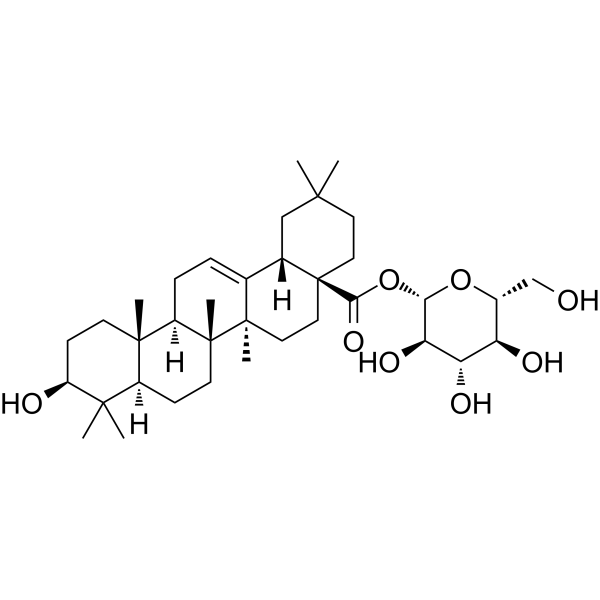
Oleanolic acid 28-O-β-D-glucopyranoside

Based on 1 Customer Validation
Oleanolic acid 28-O-β-D-glucopyranoside (β-D-Glucopyranosyl oleanolate) is an orally active pentacyclic triterpenoid compound. Oleanolic acid 28-O-β-D-glucopyranoside has anti-inflammatory effects. In ulcerative colitis models, Oleanolic acid 28-O-β-D-glucopyranoside can inhibit the inflammatory response, enhance the intestinal epithelial barrier function, and modulate the gut microbiota. Its mechanism of action is related to the PI3K-AKT and MAPK signaling pathways. Oleanolic acid 28-O-β-D-glucopyranoside can be used in the research of diseases such as colitis.
For research use only. We do not sell to patients.
- Purity : 99.42%
- CAS No.: 14162-53-9
- Formula: C36H58O8
- Molecular Weight:618.84
-
Storage:
4°C, protect from light
* In solvent : -80°C, 6 months; -20°C, 1 month (protect from light)

To place orders, for customer services and technical support, please contact: MedChemExpress USA
Tel: 609-228-6898 E-mail: [email protected] [email protected]


-
 Biological Activity
-
Chemical Information
-
Solvent & Solubility
- Purity & Documentation
- References
-
 Help & FAQs




Biological Activity
Description
IC50 & Target
[1]|
IL-6 |
COX-2 |
Cellular Effect
|
Cell Line

|
Type | Value | Description | References |
|---|---|---|---|---|
| Neutrophil | IC50 |
9.64 μM
Compound: 14
|
Inhibition of fMLP/CB-activated human neutrophil degranulation assessed as inhibition of elastase release using MeO-Suc-Ala-Ala-Pro-Val-p-nitroanilide as a substrate after 5 mins
Inhibition of fMLP/CB-activated human neutrophil degranulation assessed as inhibition of elastase release using MeO-Suc-Ala-Ala-Pro-Val-p-nitroanilide as a substrate after 5 mins
|
[PMID: 21417387] |
| RAW264.7 | IC50 |
>50 μM
Compound: 7
|
Anti-inflammatory activity in mouse RAW264.7 cells assessed as inhibition of LPS-induced NO production preincubated for 1 hr followed by LPS-stimulation and measured after 18 hrs by Griess reagent-based assay
Anti-inflammatory activity in mouse RAW264.7 cells assessed as inhibition of LPS-induced NO production preincubated for 1 hr followed by LPS-stimulation and measured after 18 hrs by Griess reagent-based assay
|
[PMID: 30808589] |
In Vitro
Oleanolic acid 28-O-β-D-glucopyranoside (2.0-8.0 μM; 24 h) can significantly increase the transepithelial electrical resistance (TEER) value, alleviate barrier function damage, increase the expression of tight junction proteins, and reduce the levels of inflammatory cytokines such as IL-6, TNF-α, COX-2, and iNOS in Caco-2 cells treated with LPS (HY-D1056)[1].
MedChemExpress (MCE) has not independently confirmed the accuracy of these methods. They are for reference only.
-
Cell Line:Caco-2 cells treated with LPS (HY-D1056)
-
Concentration:2.0, 4.0 and 8.0 μM
-
Incubation Time:24 h
-
Result:Increased the staining of tight junction proteins (ZO-1, occludin, claudin-1 and E-cadherin).
In Vivo
MedChemExpress (MCE) has not independently confirmed the accuracy of these methods. They are for reference only.
-
Animal Model:Adult male BALB/c mice (20 ± 2 g) treated 3.5% DSS (HY-116282C)
-
Dosage:5, 10 and 20 mg/kg/day
-
Administration:Oral gavage (i.g.); once a day; for 7 days
-
Result:Significantly attenuated the body weight loss in a dose-dependent manner and markedly reduced the DAI score.
Significantly improved the colon length, decreased the spleen coefficient and increased the thymus coefficient.
Significantly decreased the levels of TNF-α, IL-6, iNOS, and COX-2 in the serum and colon tissue.
Decreased the levels of oxidative stress indices (MPO and MDA), while increased SOD and GSH levels
Significantly alleviated the pathological changes of colon tissue in a dose-dependent manner and increased the expression of tight junction proteins in the colon tissue.
Enhanced the richness and diversity of the gut microbiome, promoted the growth of beneficial bacteria, suppressed the growth of harmful bacteria, and increased the levels of short-chain fatty acids.


Chemical Information
-
CAS No. 14162-53-9
-
Appearance Solid
-
Molecular Weight 618.84
-
Formula C36H58O8
-
Color White to off-white
-
SMILES
O=C([C@](CC[C@]12C)(CCC3(C)C)[C@](C3)([H])C1=CC[C@@]4([H])[C@]2(CC[C@](C(C)5C)([H])[C@@]4(CC[C@@H]5O)C)C)O[C@@H]([C@@H]([C@H]6O)O)O[C@@H]([C@H]6O)CO
-
Synonyms
β-D-Glucopyranosyl oleanolate
-
Structure Classification
-
Initial Source
-
Shipping
Room temperature in continental US; may vary elsewhere.
-
Storage
4°C, protect from light
* In solvent : -80°C, 6 months; -20°C, 1 month (protect from light)


Solvent & Solubility
In Vitro:
DMSO : 50 mg/mL (80.80 mM; Need ultrasonic; Hygroscopic DMSO has a significant impact on the solubility of product, please use newly opened DMSO)
Please refer to the solubility information to select the appropriate solvent. Once prepared, please aliquot and store the solution to prevent product inactivation from repeated freeze-thaw cycles.
Storage method and period of stock solution: -80°C, 6 months; -20°C, 1 month (protect from light). When stored at -80°C, please use it within 6 months. When stored at -20°C, please use it within 1 month.
Please refer to the solubility information to select the appropriate solvent. Once prepared, please aliquot and store the solution to prevent product inactivation from repeated freeze-thaw cycles.
Storage method and period of stock solution: -80°C, 6 months; -20°C, 1 month (protect from light). When stored at -80°C, please use it within 6 months. When stored at -20°C, please use it within 1 month.
Concentration (start) × Volume (start) = Concentration (final) × Volume (final)
In Vivo:
Select the appropriate dissolution method based on your experimental animal and administration route.
- For the following dissolution methods, please ensure to first prepare a clear stock solution using an In Vitro approach and then sequentially add co-solvents:
- To ensure reliable experimental results, the clarified stock solution can be appropriately stored based on storage conditions. As for the working solution for In Vivo experiments, it is recommended to prepare freshly and use it on the same day.
- The percentages shown for the solvents indicate their volumetric ratio in the final prepared solution. If precipitation or phase separation occurs during preparation, heat and/or sonication can be used to aid dissolution.
Add each solvent one by one: 10% DMSO 40% PEG300 5% Tween-80 45% Saline
Solubility: 1.25 mg/mL (2.02 mM); Suspended solution; Need ultrasonic
This protocol yields a suspended solution of 1.25 mg/mL. Suspended solution can be used for oral and intraperitoneal injection.
Taking 1 mL working solution as an example, add 100 μL DMSO stock solution (12.5 mg/mL) to 400 μL PEG300, and mix evenly; then add 50 μL Tween-80 and mix evenly; then add 450 μL Saline to adjust the volume to 1 mL.
Preparation of Saline: Dissolve 0.9 g sodium chloride in ddH₂O and dilute to 100 mL to obtain a clear Saline solution.
Add each solvent one by one: 10% DMSO 90% (20% SBE-β-CD in Saline)
Solubility: ≥ 1.25 mg/mL (2.02 mM); Clear solution
This protocol yields a clear solution of ≥ 1.25 mg/mL (saturation unknown).
Taking 1 mL working solution as an example, add 100 μL DMSO stock solution (12.5 mg/mL) to 900 μL 20% SBE-β-CD in Saline, and mix evenly.
Preparation of 20% SBE-β-CD in Saline (4°C, storage for one week): 2 g SBE-β-CD powder is dissolved in 10 mL Saline, completely dissolve until clear.
In Vivo Dissolution Calculator
Please enter the basic information of animal experiments:
-
-
-
-
Recommended: Prepare an additional quantity of animals to account for potential losses during experiments.
Please enter your animal formula composition:
-
%DMSO +
Recommended: Keep the proportion of DMSO in working solution below 2% if your animal is weak.
-
%+
-
+%Tween-80 + +
-
%Saline +
The co-solvents required include: DMSO, . All of co-solvents are available by MedChemExpress (MCE). , Tween 80. All of co-solvents are available by MedChemExpress (MCE).
Working solution concentration: 0.22 mg/mL
Method for preparing stock solution: mg drug dissolved in μL DMSO. Stock solution concentration: mg/mL. * In solvent : -80°C, 6 months; -20°C, 1 month (protect from light)
1. Take μL DMSO stock solution;
2. Add μL .
μL , mix evenly;
3. Then add μL Tween 80, mix evenly;
4. Then add μL
Please ensure that the stock solution in the first step is dissolved to a clear state, and add co-solvents in sequence. You can use ultrasonic heating (ultrasonic cleaner, recommended frequency 20-40 kHz), vortexing, etc. to assist dissolution.


Purity & Documentation
-
Data Sheet (277 KB)
-
SDS (252 KB)
- English - EN (252 KB)
- Français - FR (252 KB)
- Deutsch - DE (252 KB)
- Norwegian - NO (252 KB)
- Español - ES (252 KB)
- Swedish - SV (252 KB)
- Italian - IT (252 KB)
- Korean - KR (252 KB)
- Portuguese - PT (252 KB)
-
Handling Instructions (2659 KB)
References
[1]. Wang C, et al. Oleanolic acid 28-O-β-D-glucopyranoside: A novel therapeutic agent against ulcerative colitis via anti-inflammatory, barrier-preservation, and gut microbiota-modulation. Biomed Pharmacother. 2024 Nov;180:117534. [Content Brief]
[2]. A. Marouf, et al. Triterpene Saponins from the Roots of Achyranthes bidentata.


Complete Stock Solution Preparation Table
Please refer to the solubility information to select the appropriate solvent. Once prepared, please aliquot and store the solution to prevent product inactivation from repeated freeze-thaw cycles.
Storage method and period of stock solution: -80°C, 6 months; -20°C, 1 month (protect from light). When stored at -80°C, please use it within 6 months. When stored at -20°C, please use it within 1 month.
| Optional Solvent | Concentration Solvent Mass | 1 mg | 5 mg | 10 mg | 25 mg |
|---|---|---|---|---|---|
| DMSO | 1 mM | 1.6159 mL | 8.0796 mL | 16.1593 mL | 40.3982 mL |
| 5 mM | 0.3232 mL | 1.6159 mL | 3.2319 mL | 8.0796 mL | |
| 10 mM | 0.1616 mL | 0.8080 mL | 1.6159 mL | 4.0398 mL | |
| 15 mM | 0.1077 mL | 0.5386 mL | 1.0773 mL | 2.6932 mL | |
| 20 mM | 0.0808 mL | 0.4040 mL | 0.8080 mL | 2.0199 mL | |
| 25 mM | 0.0646 mL | 0.3232 mL | 0.6464 mL | 1.6159 mL | |
| 30 mM | 0.0539 mL | 0.2693 mL | 0.5386 mL | 1.3466 mL | |
| 40 mM | 0.0404 mL | 0.2020 mL | 0.4040 mL | 1.0100 mL | |
| 50 mM | 0.0323 mL | 0.1616 mL | 0.3232 mL | 0.8080 mL | |
| 60 mM | 0.0269 mL | 0.1347 mL | 0.2693 mL | 0.6733 mL | |
| 80 mM | 0.0202 mL | 0.1010 mL | 0.2020 mL | 0.5050 mL |


Oleanolic acid 28-O-β-D-glucopyranoside Related Classifications
HY-N7635 Related Classifications
 Powered by Bioz