



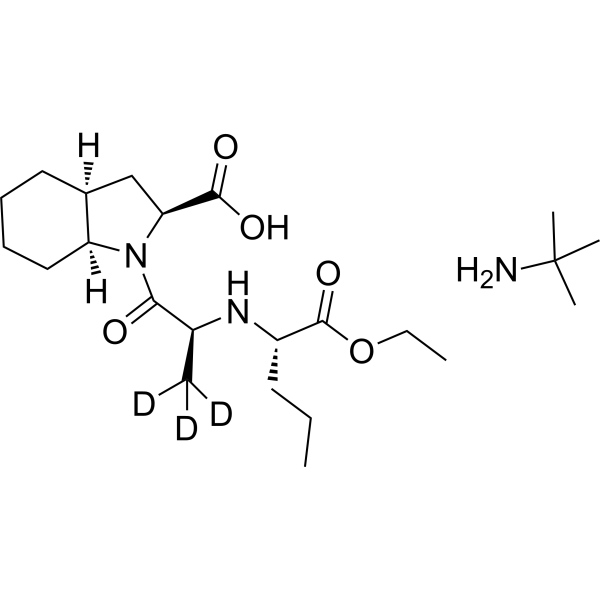
Perindopril-d3 erbumine
Perindopril-d3 (erbumine) is deuterated labeled Perindopril (erbumine) (HY-B0130A). Perindopril erbumine is an angiotensin-converting enzyme inhibitor. Perindopril erbumine modulates NF-κB and STAT3 signaling and inhibits glial activation and neuroinflammation. Perindopril erbumine can be used for the research of Chronic Kidney Disease and high blood pressure.
Nos produits utilisent uniquement pour la recherche. Nous ne vendons pas aux patients.
- Formule: C23H40D3N3O5
- Masse moléculaire:444.62
-
Stockage:
Please store the product under the recommended conditions in the Certificate of Analysis.

To place orders, for customer services and technical support, please contact: MedChemExpress USA
Tel: 609-228-6898 E-mail: [email protected] [email protected]


-
 Activité biologique
-
Chemical Information
- Protocole
- Pureté et documentation
- Références
-
 Help & FAQs




Activité biologique
Description
In Vitro
Stable heavy isotopes of hydrogen, carbon, and other elements have been incorporated into drug molecules, largely as tracers for quantitation during the drug development process. Deuteration has gained attention because of its potential to affect the pharmacokinetic and metabolic profiles of drugs[1].
Perindopril erbumine (1 μM, 24 h) ameliorats gliosis and blunts decrease induced by LPS (HY-D1056) in AT2R expression in Rat astrocytoma cell line (C6) and murine microglial cell line (BV2)[2].
Perindopril erbumine (1 μM, 24 h) prevents IκBα degradation, NF-кB nuclear translocation and STAT3 activation induced by LPS (HY-D1056) in C6 and BV2[2].
Perindopril erbumine (1 μM, 24 h) ameliorats the imbalance in the release of inflammatory cytokine and blunts the aberrant ROS production and the nitrite release induced by LPS (HY-D1056) in C6 and BV2[2].
MedChemExpress (MCE) has not independently confirmed the accuracy of these methods. They are for reference only. Further protocols information, click here.
In Vivo
Perindopril erbumine (0.42 mg/kg, Oral, once a day for 4 weeks) with Huangqi-Danshen decoction (HDD) (4.7 g/kg, Oral, once a day for 4 weeks) attenuates adenine(HY-B0152)-induced Chronic kidney disease (CKD) in rats[3].
Perindopril erbumine (0.4-1.5 mg/kg, Oral, once a day for 4-24 weeks) has a persistent effect on blood pressure in spontaneously hypertensive rats (SHR)[5].
MedChemExpress (MCE) has not independently confirmed the accuracy of these methods. They are for reference only.
Application
1. This compound can be used as a tracer
2. This compound can be used as an internal standard for quantitative analysis by NMR, GC-MS, or LC-MS.


Chemical Information
-
Unlabeled CAS 107133-36-8
-
Masse moléculaire 444.62
-
Formule C23H40D3N3O5
-
SMILES
O=C([C@H]1N(C([C@@H](N[C@H](C(OCC)=O)CCC)C([2H])([2H])[2H])=O)[C@@]2([H])CCCC[C@@]2([H])C1)O.CC(C)(C)N
-
Synonyms
Perindopril-d3 (tert-butylamine salt); S-9490-d3 erbumine
-
Livraison
Room temperature in continental US; may vary elsewhere.
-
Stockage
Please store the product under the recommended conditions in the Certificate of Analysis.

Protocole
-
Research Protocol for Inflammation-related Diseases
The NLRP3 inflammasome is a cytosolic innate immune signaling platform that integrates priming signals and danger-signal activation to promote caspase-1 activation, maturation of IL-1β and IL-18, and gasdermin D-mediated pyroptotic cell death. The core experimental logic is to determine whether inflammatory disease phenotypes are driven by increased NLRP3 expression, ASC-containing inflammasome assembly, caspase-1 cleavage, GSDMD cleavage, and extracellular release of IL-1β/IL-18 rather than by nonspecific cell injury alone. The pathway is strongly linked to inflammation-related disease phenotypes because monosodium urate crystals activate NALP3/NLRP3 inflammasome signaling in gout-like crystal inflammation, cholesterol crystals activate NLRP3 inflammasomes in atherogenesis models, and DSS-induced intestinal inflammation has been reported to involve NLRP3 inflammasome activity. However, experimental colitis studies also show context-dependent protective effects of NLRP3 inflammasome co
-
Research Protocol for Neurological Diseases
PINK1/Parkin-mediated mitophagy pathway is a mitochondrial quality-control signaling axis in which mitochondrial depolarization stabilizes PINK1 on damaged mitochondria, activates Parkin recruitment and E3 ubiquitin ligase activity, promotes ubiquitination of outer mitochondrial membrane proteins, recruits selective autophagy adaptors, and drives lysosomal degradation of damaged mitochondria. In neurological disease research, this pathway is experimentally important because neurons, especially dopaminergic neurons, are highly dependent on mitochondrial integrity, and defective mitochondrial turnover can lead to mitochondrial dysfunction, oxidative stress, impaired neuronal survival, α-synuclein accumulation, and neuroinflammatory damage-associated signals. The genetic disease link is strongest in Parkinson’s disease because mutations in PRKN/parkin cause autosomal recessive juvenile parkinsonism, mutations in PINK1 cause hereditary early-onset Parkinson’s disease, and Drosophila studie


Pureté et documentation
Références
[1]. Russak EM, et al. Impact of Deuterium Substitution on the Pharmacokinetics of Pharmaceuticals. Ann Pharmacother. 2019 Feb;53(2):211-216. [Content Brief]
[2]. Bhat S A, et al. Angiotensin receptor blockade modulates NFκB and STAT3 signaling and inhibits glial activation and neuroinflammation better than angiotensin-converting enzyme inhibition [J]. Molecular neurobiology, 2016, 53: 6950-6967. [Content Brief]
[3]. Wei X, et al. Combination of perindopril erbumine and huangqi-danshen decoction protects against chronic kidney disease via sirtuin3/mitochondrial dynamics pathway [J]. Evidence-Based Complementary and Alternative Medicine, 2022, 2022. [Content Brief]
[4]. Afonso T, et al. Pharmacodynamic evaluation of 4 angiotensin‐converting enzyme inhibitors in healthy adult horses [J]. Journal of veterinary internal medicine, 2013, 27(5): 1185-1192. [Content Brief]
[5]. Thybo N K, et al. Dose-dependent effects of perindopril on blood pressure and small-artery structure [J]. Hypertension, 1994, 23(5): 659-666. [Content Brief]

Calculators
Concentration (start) × Volume (start) = Concentration (final) × Volume (final)


Perindopril-d3 erbumine Related Classifications
HY-B0130AS Related Classifications
 Powered by Bioz