



PROTAC IRAK4 degrader-2
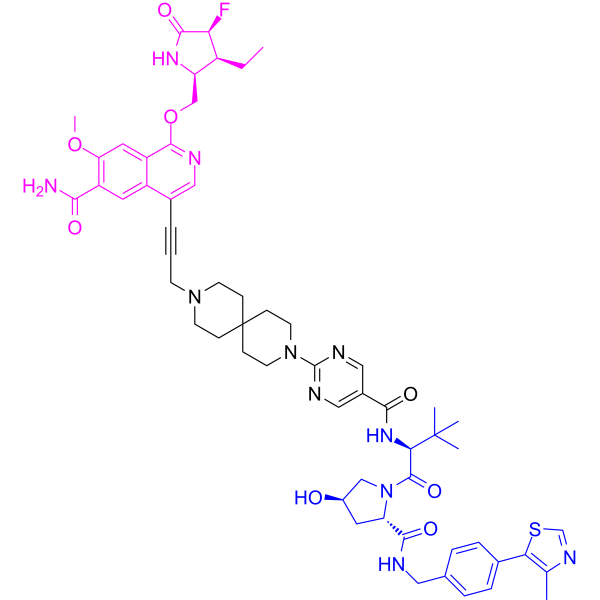
PROTAC IRAK4 degrader-2 is a PROTAC degrader targeting IRAK4. PROTAC IRAK4 degrader-2 induces proteasome-dependent degradation of IRAK4 by recruiting the VHL E3 ligase. PROTAC IRAK4 degrader-2 inhibits multiple cytokines in peripheral blood mononuclear cells. PROTAC IRAK4 degrader-2 can be used in the research of autoimmune diseases, inflammatory diseases and neoplastic diseases.
(Pink: IRAK4 ligand (HY-19836); Blue: VHL ligand (HY-125845); Black: linker).
For research use only. We do not sell to patients.
- CAS No.: 2374122-27-5
- Formula: C57H68FN11O8S
- Molecular Weight:1086.28
-
Storage:
Please store the product under the recommended conditions in the Certificate of Analysis.

To place orders, for customer services and technical support, please contact: MedChemExpress USA
Tel: 609-228-6898 E-mail: [email protected] [email protected]


-
 Biological Activity
-
Chemical Information
- Protocols
- Purity & Documentation
- References
-
 Help & FAQs


All PROTACs Isoforms
More

Biological Activity
Description
IC50 & Target
[1]|
IRAK4 |
IL-6 |
IL-8 |
IL-10 |
IL-1β |
TNF-α |
Cellular Effect
|
Cell Line

|
Type | Value | Description | References |
|---|---|---|---|---|
| PBMC | DC50 |
151 nM
|
IRAK4 degradation in human peripheral blood mononuclear cells (PBMCs) assessed by Western blotting after 24 h incubation.
IRAK4 degradation in human peripheral blood mononuclear cells (PBMCs) assessed by Western blotting after 24 h incubation.
|
31312412 |
In Vitro
PROTAC IRAK4 degrader-2 (compound 9) (1 nM-10 μM; 24 h or 2 h pretreatment + 22 h) efficiently degrades IRAK4 in human peripheral blood mononuclear cells (PBMCs) via a proteasome-dependent mechanism, with a DC50 of 151 nM[1].
PROTAC IRAK4 degrader-2 (1 nM-1 μM; 24 h) potently degrades IRAK4 in human dermal fibroblasts, with a DC50 of 36 nM[1].
PROTAC IRAK4 degrader-2 (18 h pretreatment + 8 h stimulation) completely inhibits the secretion of multiple proinflammatory cytokines, including IL-6, IL-1β, IFN-γ, IL-8, IL-10 and TNF-α, in human peripheral blood mononuclear cells (PBMCs) stimulated with R848, with pIC50 values ranging from 6.5 to 7.5[1].
MedChemExpress (MCE) has not independently confirmed the accuracy of these methods. They are for reference only. Further protocols information, click here.
-
Cell Line:PBMC
-
Concentration:100 nM, 300 nM, 1 μM, 3 μM, 10 μM
10 nM, 30 nM, 100 nM, 300 nM, 1 μM, 3 μM -
Incubation Time:24 h
2 h pretreatment + 22 h -
Result:Degraded IRAK4 in human PBMCs with a DC50 of 151 nM via a proteasome-dependent mechanism.
-
Cell Line:human dermal fibroblasts
-
Concentration:1 nM, 3 nM, 1 nM, 30 nM, 100 nM, 300 nM, 1 μM
-
Incubation Time:24 h
-
Result:Induced IRAK4 degradation with a DC50 of 36 nM.
Reduced IRAK4 protein to 4% remaining at 1 μM.
Reduced IRAK4 protein to 9% remaining at 300 nM.


Chemical Information
-
CAS No. 2374122-27-5
-
Molecular Weight 1086.28
-
Formula C57H68FN11O8S
-
SMILES
COC1=C(C(N)=O)C=C(C(C#CCN2CCC3(CCN(C4=NC=C(C(N[C@@H](C(C)(C)C)C(N5C[C@H](O)C[C@H]5C(NCC6=CC=C(C7=C(C)N=CS7)C=C6)=O)=O)=O)C=N4)CC3)CC2)=CN=C8OC[C@@H]9[C@H](CC)[C@H](F)C(N9)=O)C8=C1
-
Shipping
Room temperature in continental US; may vary elsewhere.
-
Storage
Please store the product under the recommended conditions in the Certificate of Analysis.

Protocols
-
PBMC Thawing for Immune Assays
PBMC thawing for immune assays recovers viable cryopreserved peripheral blood mononuclear cells for downstream functional or phenotypic readouts, including ELISPOT, intracellular cytokine staining, proliferation assays, and flow-cytometric immunophenotyping. Cryopreserved PBMCs can support immune monitoring because antigen-specific T-cell function and major CD4/CD8 phenotypes may be retained after optimized freezing and thawing, although some lymphocyte subsets and activation or memory markers can be altered by cryopreservation. The technical objective is rapid warming of the frozen vial followed by controlled dilution and removal of DMSO-containing cryomedium, because thawing and wash conditions measurably affect viable PBMC recovery and downstream assay performance. Viability alone is insufficient for protocol evaluation because high viability may occur with low live-cell recovery, so both viable percentage and absolute live-cell recovery should be measured after thawing.


Purity & Documentation
References

Calculators
Concentration (start) × Volume (start) = Concentration (final) × Volume (final)


PROTAC IRAK4 degrader-2 Related Classifications
HY-135382 Related Classifications
 Powered by Bioz