517 Results for "

RAW264.7

" in MedChemExpress (MCE) Product Catalog:
Products (517)

517 Results for "RAW264.7" in MCE Product Catalog:

159
159 Publications Verification
Cat. No.: HY-13982
CAS No.: 749886-87-1
Purity:  99.30%
Target:  

NF-κB

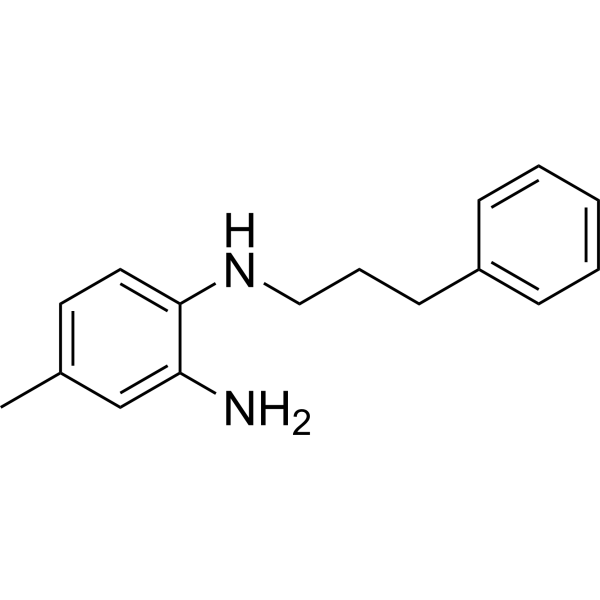
JSH-23 is an NF-κB inhibitor which inhibits NF-κB transcriptional activity with an IC50 of 7.1 μM in lipopolysaccharide (LPS)-stimulated macrophages RAW 264.7. JSH-23 inhibits nuclear translocation of NF-κB p65 without affecting IκBα degradation .
loading...
    loading...
79
79 Cited Publications
Cat. No.: HY-N0716B
CAS No.: 633-66-9
Synonyms: Natural Yellow 18 sulfate
Berberine sulfate is an alkaloid isolated from the Chinese herbal medicine Huanglian, as an antibiotic. Berberine sulfate induces reactive oxygen species (ROS) generation and inhibits DNA topoisomerase. Berberine sulfate has antineoplastic properties. The sulfate form improves bioavailability .
loading...
    loading...
53
53 Cited Publications
Cat. No.: HY-N0716A
CAS No.: 316-41-6
Synonyms: Natural Yellow 18 hemisulfate
Berberine hemisulfate is the hemisulfate form of Berberine (HY-N0716). Berberine hemisulfate is an alkaloid isolated from the Chinese herbal medicine Huanglian. Berberine hemisulfate exhibits anti-inflammatory, antibiobic, antitumor, cardiovascular protective and neuroprotective activity .
loading...
    loading...
19
19 Cited Publications
Cat. No.: HY-P1439
CAS No.: 1449566-36-2
Research Areas:  

Inflammation/Immunology

RS 09 is an LPS (HY-D1056) peptide mimic and TLR4 agonist. RS 09 can bind to TLR-4 and activate NF-κB. RS 09 can function as an adjuvant in vivo, enhancing the antigen-specific immune response .
loading...
    loading...
19
19 Cited Publications
Cat. No.: HY-P1439A
Research Areas:  

Inflammation/Immunology

RS 09 TFA is an LPS (HY-D1056) peptide mimic and TLR4 agonist. RS 09 TFA can bind to TLR-4 and activate NF-κB. RS 09 TFA can function as an adjuvant in vivo, enhancing the antigen-specific immune response .
loading...
    loading...
19
19 Cited Publications
Cat. No.: HY-122272
CAS No.: 61869-08-7
Purity:  99.92%
Synonyms: BRL29060
Paroxetine (BRL29060) is an orally active and selective serotonin reuptake inhibitor (SSRI) and apoptosis inducer with blood-brain barrier permeability. Paroxetine inhibits nitric oxide synthase and CYP2D6, induces desensitization of 5-HT1A/1B/1D autoreceptors, downregulates 5-HT2 receptors, and promotes the production of inflammatory cytokines. Paroxetine is a weak norepinephrine (NE) uptake inhibitor and possesses antitumor activity. Paroxetine is widely used in research concerning depression, obsessive-compulsive disorder, panic disorder, social phobia, generalized anxiety disorder, post-traumatic stress disorder, premenstrual dysphoric disorder, hot flashes, and related conditions .
loading...
    loading...
19
19 Cited Publications
Cat. No.: HY-B0492
CAS No.: 78246-49-8
Synonyms: BRL29060 hydrochloride; BRL29060A
Paroxetine (BRL29060) hydrochloride is an orally active and selective serotonin reuptake inhibitor (SSRI) and apoptosis inducer with blood-brain barrier permeability. Paroxetine hydrochloride inhibits nitric oxide synthase and CYP2D6, induces desensitization of 5-HT1A/1B/1D autoreceptors, downregulates 5-HT2 receptors, and promotes the production of inflammatory cytokines. Paroxetine hydrochloride is a weak norepinephrine (NE) uptake inhibitor and possesses antitumor activity. Paroxetine hydrochloride is widely used in research concerning depression, obsessive-compulsive disorder, panic disorder, social phobia, generalized anxiety disorder, post-traumatic stress disorder, premenstrual dysphoric disorder, hot flashes, and related conditions .
loading...
    loading...
17
17 Cited Publications
Cat. No.: HY-115502
CAS No.: 1245792-51-1
Purity:  99.73%
Synonyms: (E)-BCI
Target:  

Phosphatase

Research Areas:  

Inflammation/Immunology

BCI ((E)-BCI) is a DUSP6 (dual specificity phosphatase 6) inhibitor. BCI shows anti-inflammatory activity and decreases reactive oxygen species (ROS) production. BCI can be used in inflammatory disease research .
loading...
    loading...
17
17 Cited Publications
Cat. No.: HY-115502A
CAS No.: 95130-23-7
Purity:  99.93%
Synonyms: (E)-BCI hydrochloride
Target:  

Phosphatase

Research Areas:  

Inflammation/Immunology

BCI ((E)-BCI) hydrochloride is a DUSP6 (dual specificity phosphatase 6) inhibitor. BCI hydrochloride shows anti-inflammatory activity and decreases reactive oxygen species (ROS) production. BCI hydrochloride can be used in inflammatory disease research .
loading...
    loading...
17
17 Cited Publications
Cat. No.: HY-13241A
CAS No.: 862505-00-8
Synonyms: LY2228820
Target:  

p38 MAPK Autophagy

Research Areas:  

Cancer

Ralimetinib is an ATP-competitive p38α and p38β MAPK inhibitor with an IC50 of 5.3 nmol/L against human p38α and an IC50 of 3.2 nmol/L against human p38β. Ralimetinib slows tumor growth in preclinical in vivo cancer models, exhibits oral bioavailability in mice, and achieves sustained target inhibition for 4 to 8 h. Ralimetinib is applicable for research on melanoma, non-small cell lung cancer, ovarian cancer, glioma, multiple myeloma, breast cancer, renal cancer, and head and neck squamous cell carcinoma .
loading...
    loading...
17
17 Cited Publications
Cat. No.: HY-N0143A
CAS No.: 7061-54-3
Synonyms: Floridzin dihydrate
Phlorizin (Floridzin) dihydrate is an orally active non-selective sodium-glucose cotransporter (SGLT) inhibitor, with an IC50 of 0.04 μM and a Ki of 39 nM against hSGLT2, and an IC50 of 0.17 μM and a Ki of 0.31 μM against hSGLT1. Phlorizin dihydrate promotes GLUT4 translocation, inhibits gluconeogenesis and promotes glycogen synthesis by activating the PI3K/Akt/mTOR pathway. Phlorizin dihydrate reduces DNA damage and apoptosis (apoptosis) by inhibiting the NF-κB inflammatory pathway. Phlorizin dihydrate induces apoptosis via activating the Caspase pathway by antagonizing the JAK/STAT3 and PCK pathways. Phlorizin dihydrate also exhibits antibacterial, anti-inflammatory and neuroprotective activities .
loading...
    loading...
12
12 Cited Publications
Cat. No.: HY-N0373
CAS No.: 58749-23-8
Licochalcone B is an extract from the root of Glycyrrhiza uralensis. Licochalcone B inhibits amyloid β (42) self-aggregation (IC50=2.16 μM) and disaggregate pre-formed Aβ42 fibrils, reduce metal-induced Aβ42 aggregation through chelating metal ionsLicochalcone B inhibits phosphorylation of NF-κB p65 in LPS signaling pathway. Licochalcone B inhibits growth and induces apoptosis of NSCLC cells. Licochalcone B specifically inhibits the NLRP3 inflammasome by disrupting NEK7‐NLRP3 interaction .
loading...
    loading...
11
11 Cited Publications
Cat. No.: HY-B0492A
CAS No.: 110429-35-1
Synonyms: BRL29060 hydrochloride hemihydrate; BRL29060A hemihydrate
Paroxetine (BRL29060) hydrochloride hemihydrate is an orally active and selective serotonin reuptake inhibitor (SSRI) and apoptosis inducer with blood-brain barrier permeability. Paroxetine hydrochloride hemihydrate inhibits nitric oxide synthase and CYP2D6, induces desensitization of 5-HT1A/1B/1D autoreceptors, downregulates 5-HT2 receptors, and promotes the production of inflammatory cytokines. Paroxetine hydrochloride hemihydrate is a weak norepinephrine (NE) uptake inhibitor and possesses antitumor activity. Paroxetine hydrochloride hemihydrate is widely used in research concerning depression, obsessive-compulsive disorder, panic disorder, social phobia, generalized anxiety disorder, post-traumatic stress disorder, premenstrual dysphoric disorder, hot flashes, and related conditions .
loading...
    loading...
8
8 Cited Publications
Cat. No.: HY-111152
CAS No.: 912798-42-6
Purity:  99.89%
Target:  

STAT

Research Areas:  

Cancer

ML115, a molecular probe of the signal transducer, is a selective STAT3 agonist, with an EC50 of 2 nM. ML115 increases the expression of BCL3, a known STAT3-dependent oncogene. ML115 is inactive against the related STAT1, STAT5 and NF-κB anti-targets. ML115 counteracts the effects of Ginsenoside Rc (HY-N0042) on cell viability and inflammatory responses in LPS (HY-D1056)-stimulated H9c2 and RAW264.7 cells, while altering oxidative stress markers. ML115 can be used for the study of breast and prostate cancers .
loading...
    loading...
8
8 Cited Publications
Cat. No.: HY-113556
CAS No.: 102067-84-5
Purity:  99.87%
Sappanone A is an orally active homoisoflavone found in sappan L. Sappanone A is a PDE4 and NF-κB inhibitor with anti-inflammatory and antioxidant effect. Sappanone A induces HO-1 expression through activation of Nrf2 pathway. Sappanone A also inhibits RANKL-induced osteoclastogenesis. Sappanone A has great potential in the research of inflammation-related and cardiovascular .
loading...
    loading...
8
8 Cited Publications
Cat. No.: HY-132591A
Purity:  98.10%
Synonyms: ALN-PCSsc sodium
Inclisiran sodium is a double-stranded small interfering RNA (siRNA) molecule. Inclisiran sodium inhibits the transcription of PCSK9. Inclisiran sodium inhibits Pyroptosis, activates PPARγ, and reduces NLRP3, cleaved caspase-1, IL-1β, and IL-18. Inclisiran sodium has anti-inflammatory, lipid-regulating and anti-atherosclerotic activities. Inclisiran sodium can be used in researches of hyperlipidemia and cardiovascular disease (CVD) .
loading...
    loading...
6
6 Cited Publications
Cat. No.: HY-N1363
CAS No.: 14113-05-4
Synonyms: (E)-Queen Bee Acid; (E)-10-Hydroxy-2-decenoic acid
Royal Jelly Acid ((E)-Queen Bee Acid) is a major fatty acid found in royal jelly with oral bioavailability, exhibiting anti-inflammatory, anticancer, antimalarial, antiprotozoal, and neuroregulatory activities. Royal Jelly Acid can be used for research in various fields, including cancer, infections, immune inflammation, and neurological diseases .
loading...
    loading...
6
6 Cited Publications
Cat. No.: HY-B0182
CAS No.: 61422-45-5
Synonyms: HCFU
Carmofur (HCFU) is a rat recombinant acid ceramidase inhibitor with an IC50 of 29 nM. Carmofur is also a protease inhibitor of SARS-CoV-2 main protease (Mpro), fatty acid amide hydrolase (FAAH) and N-acylethanolamine acid amidase (NAAA). Carmofur has anti-cancer, anti-inflammatory and anti-virus activities, and can be used for the study of COVID-19 and acute lung injury (ALI) .
loading...
    loading...
6
6 Cited Publications
Cat. No.: HY-N0260
CAS No.: 110642-44-9
Synonyms: Epimedin-C; Baohuoside-VI
Epmedin C (Epimedin-C; Baohuoside-VI) is an orally active anti-inflammatory agent and immunomodulator that binds to multiple key proteins including UCP1, Caspase-1, CDK2 and Keap1. Epmedin C inhibits epithelial cell proliferation by disrupting the complex function of CDK2/Cyclin E. Epmedin C also upregulates Nrf2 expression, reduces ROS levels and inhibits pro-inflammatory cytokine secretion, thereby effectively restoring antibody production and alleviating tissue damage. Epmedin C has good safety with no hepatotoxicity or skin sensitization, and it has been used in studies on diseases such as obesity, Deoxynivalenol (HY-N6684)-induced immunotoxicity and mammary hyperplasia .
loading...
    loading...
5
5 Cited Publications
Cat. No.: HY-N2526
CAS No.: 506-37-6
Synonyms: Selacholeic acid; cis-15-Tetracosenoic acid
Nervonic acid is a monounsaturated fatty acid with oral activity. Nervonic acid exerts anti-inflammatory activity by inhibiting NF-κB signaling. Nervonic acid can be used in the study of neurodegenerative diseases .
loading...
    loading...

