



Skimmianine
Based on 4 publication(s) in Google Scholar
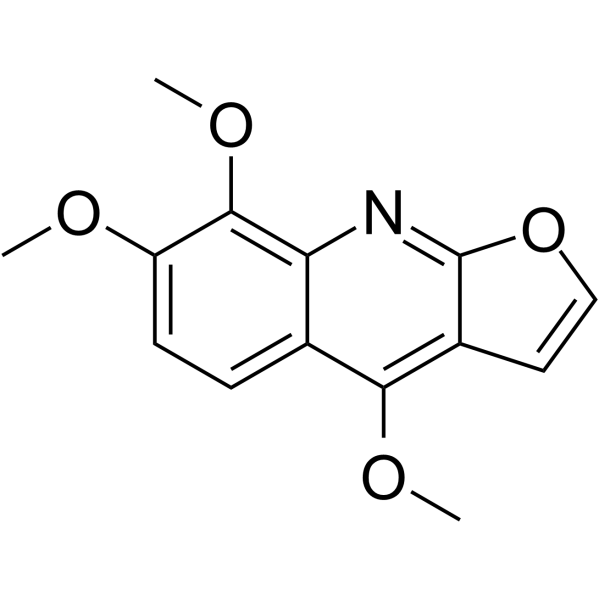
Skimmianine is an orally active furoquiniline alkaloid present mainly in the Rutaceae family. Skimmianine has analgesic, antispastic, sedative, and anti-inflammatory properties. Skimmianine inhibits acetylcholinesterase (AChE) (IC50 = 8.6 μg/mL). Skimmianine exhibits cytotoxicity against a variety of cancer cell lines and genotoxicity. Skimmianine has antioxidant and anti-inflammatory effects on ischemia-reperfusion (IR) injury. Skimmianine exerts anti-inflammatory effects through activation of the phosphatidylinositol-3-kinase (PI3K)-protein kinase B (AKT) pathway. Skimmianine is neuroprotective by targeting the NF-κB activation pathway to prevent neuroinflammation. Skimmianine inhibits the release of histamine, intracellular Ca2+ signaling and protein kinase C signaling.
For research use only. We do not sell to patients.
- Purity : 99.93%
- CAS No.: 83-95-4
- Formula: C14H13NO4
- Molecular Weight:259.26
-
Storage:Powder -20°C, 3 years , 4°C, 2 years ; In solvent -80°C, 6 months , -20°C, 1 month

To place orders, for customer services and technical support, please contact: MedChemExpress USA
Tel: 609-228-6898 E-mail: [email protected] [email protected]


-
 Biological Activity
-
Chemical Information
-
Solvent & Solubility
- Protocols
- Purity & Documentation
- References
-
 Help & FAQs




Publications Citing Use of MedChemExpress (MCE) Skimmianine
More

Biological Activity
Description
IC50 & Target
[4]|
AChE 8.6 μg/mL (IC50) |
Cellular Effect
|
Cell Line

|
Type | Value | Description | References |
|---|---|---|---|---|
| A2780 | IC50 |
4.2 μg/mL
Compound: 7
|
Cytotoxicity against human A2780 cells
Cytotoxicity against human A2780 cells
|
[PMID: 12713408] |
| A549 | IC50 |
>10 μM
Compound: 8
|
Cytotoxicity against human A549 cells by SRB assay
Cytotoxicity against human A549 cells by SRB assay
|
[PMID: 18950230] |
| Neutrophil | IC50 |
13.24 μM
Compound: 18
|
Antiinflammatory activity in human neutrophils assessed as inhibition of formyl-L-methionyl-L-leucyl-L-phenylalanine/cytochalasin B-induced superoxide anion generation
Antiinflammatory activity in human neutrophils assessed as inhibition of formyl-L-methionyl-L-leucyl-L-phenylalanine/cytochalasin B-induced superoxide anion generation
|
[PMID: 18211005] |
| Neutrophil | IC50 |
19.15 μM
Compound: 18
|
Antiinflammatory activity in human neutrophils assessed as inhibition of formyl-L-methionyl-L-leucyl-L-phenylalanine/cytochalasin B-induced elastase release
Antiinflammatory activity in human neutrophils assessed as inhibition of formyl-L-methionyl-L-leucyl-L-phenylalanine/cytochalasin B-induced elastase release
|
[PMID: 18211005] |
| Neutrophil | IC50 |
35.5 μM
Compound: 8
|
Immunomodulatory activity in polymorphoneutrophils assessed as inhibition of luminol-induced oxidative burst by chemiluminescence assay
Immunomodulatory activity in polymorphoneutrophils assessed as inhibition of luminol-induced oxidative burst by chemiluminescence assay
|
[PMID: 18950230] |
In Vitro
In Vivo
Skimmianine (40 mg/kg, p.o., single dose) leads to a reduction in MDA levels and an increase in SOD and CAT activities in female Wistar albino rats[2].
Skimmianine (1-10 mg/kg, i.p., single dose) results in 82% edema inhibition with 5 mg/kg dose where 5 mg/kg is the minimal concentration for maximal edema inhibition in male Wistar rats[3].
Skimmianine (5 mg/kg, i.p., single dose) leads to a significant decrease in the concentration of PGE2 compared to the Carrageenan (Carr) (HY-125474) and a non-significant decrease compared to the Diclofenac (Dic) (HY-15036) group of male Wistar rats[3].
MedChemExpress (MCE) has not independently confirmed the accuracy of these methods. They are for reference only.
-
Animal Model:24 female Wistar albino rats[2]
-
Dosage:40 mg/kg
-
Administration:Oral gavage (p.o.) single dose
-
Result:Significantly downregulated the expression of IBA-1 in cerebral tissues.
Downregulated the expression of IL-6 in cells in both white and gray matter.
Prevented the activation of NF-κB in neurons and glial cells, lowering NF-κB expression.
Significantly decreases NF-κB immune reactivity in cerebral tissues.
-
Animal Model:Adult male Wistar rats (140-160 g)[3]
-
Dosage:5 mg/kg
-
Administration:Intraperitoneal injection (i.p.) single dose
-
Result:Showed a significant decrease when Skimmianine used as a pre-treatment.
Showed a significant decrease in the level of TBARS when combined with Carr compared to Carr alone.
Showed a significant reduction in TNF-α and IL-6 mRNA levels when combined with Carr.


Chemical Information
-
CAS No. 83-95-4
-
Appearance Solid
-
Molecular Weight 259.26
-
Formula C14H13NO4
-
Color White to off-white
-
SMILES
COC1=C2N=C(OC=C3)C3=C(OC)C2=CC=C1OC
-
Structure Classification
-
Initial Source
-
Shipping
Room temperature in continental US; may vary elsewhere.
-
Storage
Powder -20°C 3 years 4°C 2 years In solvent -80°C 6 months -20°C 1 month


Publications (4)
-
Journal Impact Factor
-
Most Recent
-
Antioxidants (Basel)
Skimmianine Pretreatment Attenuates Cerebellar Neuroinflammation and Myelin Injury Following Experimental Cerebral Ischemia-Reperfusion. [Abstract]2026 Jun 11;15(6):743. PMID: 42352049 -
Pharmaceuticals (Basel)
Skimmianine Modulates Tumor Proliferation and Immune Dynamics in Breast Cancer by Targeting PCNA and TNF-α. [Abstract]2025 May 20;18(5):756. PMID: 40430573 -
Curr Issues Mol Biol
2024 Jul 12;46(7):7373-7385. PMID: 39057078 -


Solvent & Solubility
In Vitro:
DMSO : 33.33 mg/mL (128.56 mM; ultrasonic and warming and heat to 60°C; Hygroscopic DMSO has a significant impact on the solubility of product, please use newly opened DMSO)
Please refer to the solubility information to select the appropriate solvent. Once prepared, please aliquot and store the solution to prevent product inactivation from repeated freeze-thaw cycles.
Storage method and period of stock solution: -80°C, 6 months; -20°C, 1 month. When stored at -80°C, please use it within 6 months. When stored at -20°C, please use it within 1 month.
Please refer to the solubility information to select the appropriate solvent. Once prepared, please aliquot and store the solution to prevent product inactivation from repeated freeze-thaw cycles.
Storage method and period of stock solution: -80°C, 6 months; -20°C, 1 month. When stored at -80°C, please use it within 6 months. When stored at -20°C, please use it within 1 month.
Concentration (start) × Volume (start) = Concentration (final) × Volume (final)
In Vivo:
Select the appropriate dissolution method based on your experimental animal and administration route.
- For the following dissolution methods, please ensure to first prepare a clear stock solution using an In Vitro approach and then sequentially add co-solvents:
- To ensure reliable experimental results, the clarified stock solution can be appropriately stored based on storage conditions. As for the working solution for In Vivo experiments, it is recommended to prepare freshly and use it on the same day.
- The percentages shown for the solvents indicate their volumetric ratio in the final prepared solution. If precipitation or phase separation occurs during preparation, heat and/or sonication can be used to aid dissolution.
Add each solvent one by one: 10% DMSO 40% PEG300 5% Tween-80 45% Saline
Solubility: ≥ 2.5 mg/mL (9.64 mM); Clear solution
This protocol yields a clear solution of ≥ 2.5 mg/mL (saturation unknown).
Taking 1 mL working solution as an example, add 100 μL DMSO stock solution (25.0 mg/mL) to 400 μL PEG300, and mix evenly; then add 50 μL Tween-80 and mix evenly; then add 450 μL Saline to adjust the volume to 1 mL.
Preparation of Saline: Dissolve 0.9 g sodium chloride in ddH₂O and dilute to 100 mL to obtain a clear Saline solution.
In Vivo Dissolution Calculator
Please enter the basic information of animal experiments:
-
-
-
-
Recommended: Prepare an additional quantity of animals to account for potential losses during experiments.
Please enter your animal formula composition:
-
%DMSO +
Recommended: Keep the proportion of DMSO in working solution below 2% if your animal is weak.
-
%+
-
+%Tween-80 + +
-
%Saline +
The co-solvents required include: DMSO, . All of co-solvents are available by MedChemExpress (MCE). , Tween 80. All of co-solvents are available by MedChemExpress (MCE).
Working solution concentration: 0.22 mg/mL
Method for preparing stock solution: mg drug dissolved in μL DMSO. Stock solution concentration: mg/mL.
1. Take μL DMSO stock solution;
2. Add μL .
μL , mix evenly;
3. Then add μL Tween 80, mix evenly;
4. Then add μL
Please ensure that the stock solution in the first step is dissolved to a clear state, and add co-solvents in sequence. You can use ultrasonic heating (ultrasonic cleaner, recommended frequency 20-40 kHz), vortexing, etc. to assist dissolution.


Purity & Documentation
-
Data Sheet (282 KB)
-
SDS (396 KB)
- English - EN (396 KB)
- Français - FR (396 KB)
- Deutsch - DE (396 KB)
- Norwegian - NO (396 KB)
- Español - ES (396 KB)
- Swedish - SV (396 KB)
- Italian - IT (396 KB)
- Korean - KR (396 KB)
- Portuguese - PT (396 KB)
-
Handling Instructions (2659 KB)
References
[1]. Huang A, et al. Metabolic Profile of Skimmianine in Rats Determined by Ultra-Performance Liquid Chromatography Coupled with Quadrupole Time-of-Flight Tandem Mass Spectrometry. Molecules. 2017 Mar 23;22(4). [Content Brief]
[2]. Ayaz, H., et al., (2024). Skimmianine Showed Neuroprotection against Cerebral Ischemia/Reperfusion Injury. Current issues in molecular biology, 46(7), 7373–7385. [Content Brief]
[3]. Ratheesh, M., et al., (2013). Anti-inflammatory effect of quinoline alkaloid skimmianine isolated from Ruta graveolens L. Inflammation research : official journal of the European Histamine Research Society ... [et al.], 62(4), 367–376. [Content Brief]


Complete Stock Solution Preparation Table
Please refer to the solubility information to select the appropriate solvent. Once prepared, please aliquot and store the solution to prevent product inactivation from repeated freeze-thaw cycles.
Storage method and period of stock solution: -80°C, 6 months; -20°C, 1 month. When stored at -80°C, please use it within 6 months. When stored at -20°C, please use it within 1 month.
| Optional Solvent | Concentration Solvent Mass | 1 mg | 5 mg | 10 mg | 25 mg |
|---|---|---|---|---|---|
| DMSO | 1 mM | 3.8571 mL | 19.2857 mL | 38.5713 mL | 96.4283 mL |
| 5 mM | 0.7714 mL | 3.8571 mL | 7.7143 mL | 19.2857 mL | |
| 10 mM | 0.3857 mL | 1.9286 mL | 3.8571 mL | 9.6428 mL | |
| 15 mM | 0.2571 mL | 1.2857 mL | 2.5714 mL | 6.4286 mL | |
| 20 mM | 0.1929 mL | 0.9643 mL | 1.9286 mL | 4.8214 mL | |
| 25 mM | 0.1543 mL | 0.7714 mL | 1.5429 mL | 3.8571 mL | |
| 30 mM | 0.1286 mL | 0.6429 mL | 1.2857 mL | 3.2143 mL | |
| 40 mM | 0.0964 mL | 0.4821 mL | 0.9643 mL | 2.4107 mL | |
| 50 mM | 0.0771 mL | 0.3857 mL | 0.7714 mL | 1.9286 mL | |
| 60 mM | 0.0643 mL | 0.3214 mL | 0.6429 mL | 1.6071 mL | |
| 80 mM | 0.0482 mL | 0.2411 mL | 0.4821 mL | 1.2054 mL | |
| 100 mM | 0.0386 mL | 0.1929 mL | 0.3857 mL | 0.9643 mL |


Skimmianine Related Classifications
HY-N2081 Related Classifications
 Powered by Bioz