



Sophoranone

Based on 1 Customer Validation
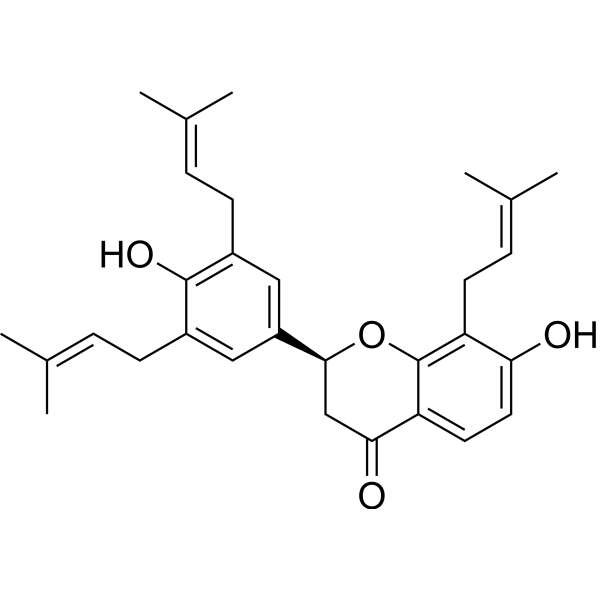
Sophoranone ((-)-Sophoranone; Sophoranon) is an orally active competitive inhibitor of CYP2C9 (IC50 = 0.966 μM) and CYP3A4. Sophoranone is a prenylated flavonoid isolated from the roots of Sophora subprostrata. Sophoranone induces apoptosis by increasing reactive oxygen species (ROS) and opening the mitochondrial channel, while upregulating myogenic genes to promote muscle regeneration. Sophoranone can be used for research on asthma, leukemia, and paralytic strabismus.
For research use only. We do not sell to patients.
- Purity : 98.58%
- CAS No.: 23057-55-8
- Formula: C30H36O4
- Molecular Weight:460.60
-
Storage:
-20°C, protect from light, stored under nitrogen
* In solvent : -80°C, 6 months; -20°C, 1 month (protect from light, stored under nitrogen)

To place orders, for customer services and technical support, please contact: MedChemExpress USA
Tel: 609-228-6898 E-mail: [email protected] [email protected]


-
 Biological Activity
-
Chemical Information
-
Solvent & Solubility
- Protocols
- Purity & Documentation
- References
-
 Help & FAQs


All Endogenous Metabolite Isoforms
More

Biological Activity
Description
IC50 & Target
[1]|
CYP2C9 0.966 μM (IC50) |
CYP3A4 3.98 |
ERK1 |
ERK2 |
Cellular Effect
|
Cell Line

|
Type | Value | Description | References |
|---|---|---|---|---|
| U-937 | IC50 |
3.8 μM
|
Inhibition of growth of human leukemia U937 cells incubated for 4 days by XTT assay.
Inhibition of growth of human leukemia U937 cells incubated for 4 days by XTT assay.
|
12115492 |
| COLO 320DM | IC50 |
11.7 μM
|
Inhibition of growth of human COLO320DM colon adenocarcinoma cells incubated for 4 days by XTT assay.
Inhibition of growth of human COLO320DM colon adenocarcinoma cells incubated for 4 days by XTT assay.
|
12115492 |
| MKN-7 | IC50 |
1.2 μM
|
Inhibition of growth of human MKN7 stomach cancer cells incubated for 4 days by XTT assay.
Inhibition of growth of human MKN7 stomach cancer cells incubated for 4 days by XTT assay.
|
12115492 |
| AZ-521 cell line | IC50 |
6.8 μM
|
Inhibition of growth of human AZ-521 stomach cancer cells incubated for 4 days by XTT assay.
Inhibition of growth of human AZ-521 stomach cancer cells incubated for 4 days by XTT assay.
|
12115492 |
| MIA PaCa-2 | IC50 |
18.7 μM
|
Inhibition of growth of human MIAPaCa-2 pancreatic cancer cells incubated for 4 days by XTT assay.
Inhibition of growth of human MIAPaCa-2 pancreatic cancer cells incubated for 4 days by XTT assay.
|
12115492 |
| TYK-nu | IC50 |
16.3 μM
|
Inhibition of growth of human TYK-nu ovarian carcinoma cells incubated for 4 days by XTT assay.
Inhibition of growth of human TYK-nu ovarian carcinoma cells incubated for 4 days by XTT assay.
|
12115492 |
| HeLa | IC50 |
17.8 μM
|
Inhibition of growth of human HeLa cervical epithelioid carcinoma cells incubated for 4 days by XTT assay.
Inhibition of growth of human HeLa cervical epithelioid carcinoma cells incubated for 4 days by XTT assay.
|
12115492 |
| U-937 | EC50 |
21.5 μM
|
Induction of apoptosis in 50% of human leukemia U937 cells assessed by Hoechst 33258 staining.
Induction of apoptosis in 50% of human leukemia U937 cells assessed by Hoechst 33258 staining.
|
12115492 |
In Vitro
Sophoranone ((-)-Sophoranone; Sophoranon) (4 days) inhibits the growth of human leukemia U937 (IC50 = 3.8 μM) cells and human gastric cancer cells MKN7 (IC50 = 1.2 μM) and AZ-521 (IC50 = 6.8 μM)[2].
Sophoranone potently and reversibly inhibits CYP2C9 enzyme activity in human liver microsomes (HLMs) in a competitive manner, with an IC50 of 0.966 µM and a Ki of 0.503 µM for CYP2C9-induced tolbutamide 4-hydroxylation, while exhibiting weak or no inhibition against other tested CYP isoforms[3].
Sophoranone (10-50 µM; 2 h) exhibits extremely low bidirectional permeability in Caco-2 cells[3].
Sophoranone (0.5-100 μM; 30 min) exhibits potent competitive inhibition of CYP3A4 in human liver microsomes, with an IC50 of 3.98 μM and a Ki of 2.17 μM for bufalin 5′-hydroxylation, and its inhibitory activity against CYP3A4 is superior to that against CYP2C19, CYP1A2, and CYP2C9[6].
Sophoranone (5-10 µM; 6-48 h) significantly promotes cell proliferation in C2C12 cells[5].
Sophoranone (5-10 µM; 3 days) promotes cell differentiation and fusion in C2C12 cells and upregulates Myh3, Myog, and MCK gene and protein expression[5].
Sophoranone (up to 50 µM; 3 h-2 days) induces apoptosis in U937, HL-60, AZ-521, COLO 320DM cells and normal monocytes[2].
Sophoranone (30 µM; 0.5-4 h) inhibits ERK1/2 and p38 kinase phosphorylation, increases caspase-3-like enzyme activity, and induces procaspase-3 cleavage activation in U937 cells[2].
Sophoranone (20-30 µM; 6 h-1 day) increases DNA degradation without altering cell cycle distribution in U937 cells[2].
Sophoranone (50 µM; 20 min-2 h) promotes superoxide anion production and transient hydrogen peroxide generation in U937 cells[2].
Sophoranone (30 µM; up to 10 min) induces mitochondrial permeability transition pore (PTP) opening in mitochondria isolated from mouse liver[2].
Sophoranone (30 µM; 0.5-4 h) promotes the release of cytochrome c from mitochondria in U937 cells and mitochondria isolated from mouse liver[2].
Sophoranone (5-10 μM; 24 h) maintains cell survival in C2C12 cells without inducing apoptosis or altering ROS levels and the cell cycle[5].
MedChemExpress (MCE) has not independently confirmed the accuracy of these methods. They are for reference only. Further protocols information, click here.
-
Cell Line:U937 cells and isolated mouse liver mitochondria
-
Concentration:30 µM
-
Incubation Time:0.5, 1, 2, 3, 4 h (U937); 3 h, 4 h (isolated mitochondria)
-
Result:Promoted the release of cytochrome c from mitochondria into the cytoplasm.
-
Cell Line:U937
-
Concentration:20, 30 μM
-
Incubation Time:6 h, 1 day
-
Result:Increased the proportion of cells with degraded DNA (below the G1 peak) without causing significant cell cycle arrest.
-
Cell Line:U937
-
Concentration:30 μM
-
Incubation Time:0.5, 1, 2, 3, 4 h
-
Result:Rapidly decreased the levels of active phosphorylated ERK1/2 and p38, but had no significant effect on JNK activity.
Induced the cleavage of procaspase-3 into its 17 kDa active form.
-
Cell Line:C2C12
-
Concentration:5 µM, 10 µM, 20 µM
-
Incubation Time:3 days
-
Result:Induced apoptosis at 20 µM, but produced no significant apoptotic effects.
-
Cell Line:C2C12
-
Concentration:5, 10 μM
-
Incubation Time:24 h
-
Result:Produced no significant cell cycle alterations at concentrations up to 10 µM.
-
Cell Line:C2C12
-
Concentration:5, 10 μM
-
Incubation Time:3 days
-
Result:Upregulated the mRNA expression levels of Myog, Myh3, and MCK.
Parmacokinetics
| Species | Dose | Route | T1/2 | CL | MRT | Vdss | Cmax | Tmax | F |
|---|---|---|---|---|---|---|---|---|---|
| Rat[3] | 75 mg/kg | p.o. | / | / | / | / | 33.7 ng/mL | / | / |
| Rat[4] | 5 mg/kg | i.v. | 33.7 min | 21.1 mL/min/kg | 15.5 min | 324 mL/kg | / | / | / |
| Rat[4] | 10 mg/kg | i.v. | 47.6 min | 18.8 mL/min/kg | 17.8 min | 362 mL/kg | / | / | / |
| Rat[4] | 20 mg/kg | i.v. | 83.5 min | 14.8 mL/min/kg | 17.9 min | 269 mL/kg | / | / | / |
| Rat[4] | 200 mg/kg | p.o. | 63.8 min | / | / | / | 0.0379 μg/mL | 30 min | / |
| Rat[4] | 400 mg/kg | p.o. | 69.4 min | / | / | / | 0.0540 μg/mL | 30 min | 0.540 % |
| Rat[4] | 1000 mg/kg | p.o. | 80.6 min | / | / | / | 0.0860 μg/mL | 30 min | / |
In Vivo
Sophoranone (75 mg/kg; o.p.; single administration; 480 min) does not significantly interfere with the in vivo pharmacokinetics of Diclofenac (HY-15036) in normal Sprague-Dawley male rat models[3].
MedChemExpress (MCE) has not independently confirmed the accuracy of these methods. They are for reference only.
-
Animal Model:New Zealand rabbits (4 to 8 weeks-old) acute extraocular muscle injury[5]
-
Dosage:10 μM
-
Administration:subconjunctival injection; once daily; 3 days
-
Result:Increased mRNA levels of Myog, Myh3, and MCK in injured medial recti compared to control.
Analyzed Myh3 protein levels by western blot.


Chemical Information
-
CAS No. 23057-55-8
-
Appearance Solid
-
Molecular Weight 460.60
-
Formula C30H36O4
-
Color White to off-white
-
SMILES
C/C(C)=C\CC1=C2C(C(C[C@@H](C3=CC(C/C=C(C)\C)=C(C(C/C=C(C)\C)=C3)O)O2)=O)=CC=C1O
-
Synonyms
(-)-Sophoranone; Sophoranon
-
Structure Classification
-
Initial Source
-
Shipping
Room temperature in continental US; may vary elsewhere.
-
Storage
-20°C, protect from light, stored under nitrogen
* In solvent : -80°C, 6 months; -20°C, 1 month (protect from light, stored under nitrogen)


Solvent & Solubility
In Vitro:
DMSO : 100 mg/mL (217.11 mM; Need ultrasonic; Hygroscopic DMSO has a significant impact on the solubility of product, please use newly opened DMSO)
Please refer to the solubility information to select the appropriate solvent. Once prepared, please aliquot and store the solution to prevent product inactivation from repeated freeze-thaw cycles.
Storage method and period of stock solution: -80°C, 6 months; -20°C, 1 month (protect from light, stored under nitrogen). When stored at -80°C, please use it within 6 months. When stored at -20°C, please use it within 1 month.
Please refer to the solubility information to select the appropriate solvent. Once prepared, please aliquot and store the solution to prevent product inactivation from repeated freeze-thaw cycles.
Storage method and period of stock solution: -80°C, 6 months; -20°C, 1 month (protect from light, stored under nitrogen). When stored at -80°C, please use it within 6 months. When stored at -20°C, please use it within 1 month.
Concentration (start) × Volume (start) = Concentration (final) × Volume (final)
In Vivo:
Select the appropriate dissolution method based on your experimental animal and administration route.
- For the following dissolution methods, please ensure to first prepare a clear stock solution using an In Vitro approach and then sequentially add co-solvents:
- To ensure reliable experimental results, the clarified stock solution can be appropriately stored based on storage conditions. As for the working solution for In Vivo experiments, it is recommended to prepare freshly and use it on the same day.
- The percentages shown for the solvents indicate their volumetric ratio in the final prepared solution. If precipitation or phase separation occurs during preparation, heat and/or sonication can be used to aid dissolution.
Add each solvent one by one: 10% DMSO 90% (20% SBE-β-CD in Saline)
Solubility: 2.5 mg/mL (5.43 mM); Suspended solution; Need ultrasonic
This protocol yields a suspended solution of 2.5 mg/mL. Suspended solution can be used for oral and intraperitoneal injection.
Taking 1 mL working solution as an example, add 100 μL DMSO stock solution (25.0 mg/mL) to 900 μL 20% SBE-β-CD in Saline, and mix evenly.
Preparation of 20% SBE-β-CD in Saline (4°C, storage for one week): 2 g SBE-β-CD powder is dissolved in 10 mL Saline, completely dissolve until clear.
In Vivo Dissolution Calculator
Please enter the basic information of animal experiments:
-
-
-
-
Recommended: Prepare an additional quantity of animals to account for potential losses during experiments.
Please enter your animal formula composition:
-
%DMSO +
Recommended: Keep the proportion of DMSO in working solution below 2% if your animal is weak.
-
%+
-
+%Tween-80 + +
-
%Saline +
The co-solvents required include: DMSO, . All of co-solvents are available by MedChemExpress (MCE). , Tween 80. All of co-solvents are available by MedChemExpress (MCE).
Working solution concentration: 0.22 mg/mL
Method for preparing stock solution: mg drug dissolved in μL DMSO. Stock solution concentration: mg/mL. * In solvent : -80°C, 6 months; -20°C, 1 month (protect from light, stored under nitrogen)
1. Take μL DMSO stock solution;
2. Add μL .
μL , mix evenly;
3. Then add μL Tween 80, mix evenly;
4. Then add μL
Please ensure that the stock solution in the first step is dissolved to a clear state, and add co-solvents in sequence. You can use ultrasonic heating (ultrasonic cleaner, recommended frequency 20-40 kHz), vortexing, etc. to assist dissolution.

Protocols
-
Apoptosis
Apoptosis, also called programmed cell death, is generally characterized by distinct morphological characteristics.
-
TUNEL staining for apoptotic DNA fragmentation
TUNEL staining detects DNA strand breaks by using terminal deoxynucleotidyl transferase to add labeled nucleotides to exposed 3′-OH DNA termini, generating either microscopic staining in fixed cells or tissue sections, or fluorescence/cytometric signal in cell suspensions. TUNEL positivity reflects DNA fragmentation but should not be interpreted alone as definitive apoptosis, because TUNEL can also label necrotic, autolytic, mechanically damaged, or DNA-repair-associated DNA breaks.
-
Cell Cytotoxicity Assay
Cytotoxicity assays are usually based on the assessment of cell membrane damage, which can also be indirectly detected by measuring cell viability. Detection methods include MTT assay, CKK-8 assay, LDH assay and ATP assay, etc.
-
Annexin V plus membrane-impermeant dye apoptosis staining
Annexin V-based apoptosis assays rely on the detection of phosphatidylserine (PS) externalization from the inner leaflet of the plasma membrane to the outer leaflet, an early biochemical hallmark of apoptosis. Fluorescently labeled Annexin V binds PS in a calcium-dependent manner, enabling identification of early apoptotic cells by flow cytometry or fluorescence microscopy. When combined with a membrane-impermeant DNA-binding dye (e. g. , propidium iodide), this approach allows discrimination between viable (Annexin V−/dye−), early apoptotic (Annexin V+/dye−), and late apoptotic or necrotic (Annexin V+/dye+) cell populations by assessing membrane integrity and PS exposure.
-
ROS/oxidative-stress fluorescent staining
ROS/oxidative-stress fluorescent staining uses cell-permeant fluorogenic probes that become fluorescent after oxidation inside cells or tissues; commonly used examples include DCFH-DA/DCFDA for broad cellular oxidant detection, DHE for superoxide-related signal detection, MitoSOX for mitochondrial superoxide-related signal detection, and CellROX probes for oxidative-stress-associated fluorescence readouts. The assay detects probe oxidation rather than a single ROS species unless the probe and analysis method have been chemically validated for that species. DCFH-DA enters cells, is deacetylated by intracellular esterases to DCFH, and produces fluorescent DCF after oxidation, so the readout is used as an operational measure of total cellular oxidative stress rather than a species-specific ROS measurement. DHE and MitoSOX can report superoxide-related oxidation, but red fluorescence alone can include non-specific ethidium-like oxidation products; HPLC or optimized spectral approaches are
-
Apoptosis Solutions
Apoptosis is a regulated, generally non-lytic cell-death pathway that removes unwanted, damaged, infected, or abnormal cells through coordinated morphological changes, caspase activation, DNA fragmentation, and membrane remodeling. The intrinsic apoptosis pathway is controlled mainly by mitochondrial outer membrane permeabilization, BCL-2 family proteins, cytochrome c release, apoptosome formation, caspase-9 activation, and downstream executioner caspase-3/7 activation. The extrinsic apoptosis pathway is initiated by death receptors such as Fas, TNFR, and TRAIL receptors, which recruit adaptor proteins and activate caspase-8 before engaging executioner caspases or mitochondrial amplification through BID cleavage. Apoptosis is linked to many phenotypes, including cancer cell killing, tissue homeostasis, immune regulation, neurodegeneration, infection response, and treatment-induced cytotoxicity; unresolved questions include how apoptosis interacts with necroptosis, pyroptosis, ferroptos


Purity & Documentation
-
Data Sheet (295 KB)
-
SDS (394 KB)
- English - EN (394 KB)
- Français - FR (394 KB)
- Deutsch - DE (394 KB)
- Norwegian - NO (394 KB)
- Español - ES (394 KB)
- Swedish - SV (394 KB)
- Italian - IT (394 KB)
- Korean - KR (394 KB)
- Portuguese - PT (394 KB)
-
Handling Instructions (2659 KB)
References
[4]. Jang SM, et al. Pharmacokinetic properties of trifolirhizin, (-)-maackiain, (-)-sophoranone and 2-(2,4-dihydroxyphenyl)-5,6-methylenedioxybenzofuran after intravenous and oral administration of Sophora tonkinensis extract in rats. Xenobiotica; the fate of foreign compounds in biological systems. 2015;45(12):1092-104. [Content Brief]
[5]. Xia Q, et al. Flavonoids Sophoranone Promotes Differentiation of C2C12 and Extraocular Muscle Satellite Cells. Ophthalmic research. 2021;64(2):337-344. [Content Brief]
[6]. Li Y, et al. Drug interaction study of flavonoids toward CYP3A4 and their quantitative structure activity relationship (QSAR) analysis for predicting potential effects. Toxicology letters. 2018 Sep 15;294:27-36. [Content Brief]


Complete Stock Solution Preparation Table
Please refer to the solubility information to select the appropriate solvent. Once prepared, please aliquot and store the solution to prevent product inactivation from repeated freeze-thaw cycles.
Storage method and period of stock solution: -80°C, 6 months; -20°C, 1 month (protect from light, stored under nitrogen). When stored at -80°C, please use it within 6 months. When stored at -20°C, please use it within 1 month.
| Optional Solvent | Concentration Solvent Mass | 1 mg | 5 mg | 10 mg | 25 mg |
|---|---|---|---|---|---|
| DMSO | 1 mM | 2.1711 mL | 10.8554 mL | 21.7108 mL | 54.2770 mL |
| 5 mM | 0.4342 mL | 2.1711 mL | 4.3422 mL | 10.8554 mL | |
| 10 mM | 0.2171 mL | 1.0855 mL | 2.1711 mL | 5.4277 mL | |
| 15 mM | 0.1447 mL | 0.7237 mL | 1.4474 mL | 3.6185 mL | |
| 20 mM | 0.1086 mL | 0.5428 mL | 1.0855 mL | 2.7139 mL | |
| 25 mM | 0.0868 mL | 0.4342 mL | 0.8684 mL | 2.1711 mL | |
| 30 mM | 0.0724 mL | 0.3618 mL | 0.7237 mL | 1.8092 mL | |
| 40 mM | 0.0543 mL | 0.2714 mL | 0.5428 mL | 1.3569 mL | |
| 50 mM | 0.0434 mL | 0.2171 mL | 0.4342 mL | 1.0855 mL | |
| 60 mM | 0.0362 mL | 0.1809 mL | 0.3618 mL | 0.9046 mL | |
| 80 mM | 0.0271 mL | 0.1357 mL | 0.2714 mL | 0.6785 mL | |
| 100 mM | 0.0217 mL | 0.1086 mL | 0.2171 mL | 0.5428 mL |


Sophoranone Related Classifications
HY-N2529 Related Classifications
 Powered by Bioz
Keywords
- Sophoranone
- 23057-55-8
- (-)-Sophoranone
- Sophoranon
- Cytochrome P450
- Reactive Oxygen Species (ROS)
- Apoptosis
- ERK
- p38 MAPK
- Endogenous Metabolite
- mitochondrial permeability transition pore
- U937 cells
- CYP3A4
- human liver microsomes
- CYP2C9
- 5-lipoxygenase
- leukemia
- extraocular muscle
- C2C12 cells
- Caco-2 cells
- Inhibitor
- inhibitor
- inhibit