



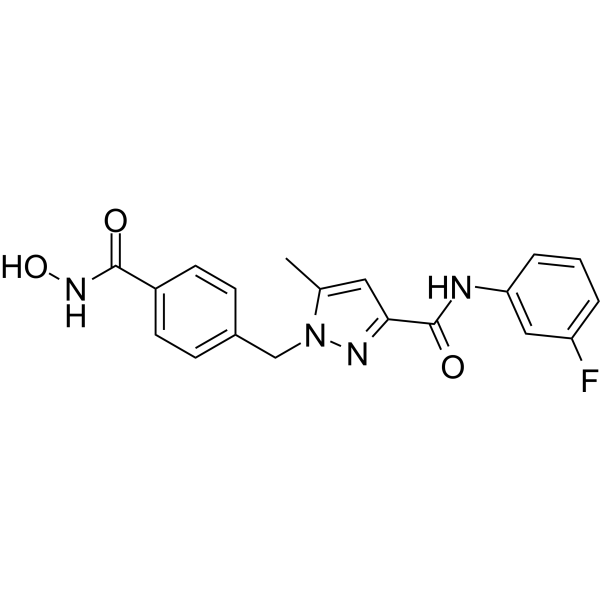
LT-630
LT-630 is a HDAC6 inhibitor. LT-630 ameliorates liver injury by reducing oxidative damage.
For research use only. We do not sell to patients.
- Formula: C19H17FN4O3
- Molecular Weight:368.36
-
Storage:
Please store the product under the recommended conditions in the Certificate of Analysis.

To place orders, for customer services and technical support, please contact: MedChemExpress USA
Tel: 609-228-6898 E-mail: [email protected] [email protected]


-
 Biological Activity
-
Chemical Information
- Protocols
- Purity & Documentation
- References
-
 Help & FAQs




Biological Activity
Description
IC50 & Target
[1]|
HDAC6 |
In Vitro
LT-630 (2-8 nM, 3 h and 24 h) inhibits Acetaminophen (HY-66005)-induced cell damage, reduces the increased oxidative stress and apoptosis in AML-12 cells[1].
MedChemExpress (MCE) has not independently confirmed the accuracy of these methods. They are for reference only.
-
Cell Line:AML-12 cells
-
Concentration:2-8 nM
-
Incubation Time:3 h and 24 h
-
Result:Reduced the increased ratio of bax/bcl-2 and the levels of cleaved caspase3 and cyt-c.
In Vivo
MedChemExpress (MCE) has not independently confirmed the accuracy of these methods. They are for reference only.
-
Animal Model:male C57BL/6J mice (16–20 g, 6-week-old)[1]
-
Dosage:10-40 mg/kg befor APAP (350 mg/kg, i.p.)
-
Administration:tail vein injection
-
Result:Enhanced the release of GSH, SOD and NADPH.
Reduced apoptosis, the bax/bcl-2 ratio, and the levels of cleaved caspase3 and cyt-c in APAP.


Chemical Information
-
Molecular Weight 368.36
-
Formula C19H17FN4O3
-
SMILES
O=C(NO)C1=CC=C(CN2N=C(C(NC3=CC(F)=CC=C3)=O)C=C2C)C=C1
-
Shipping
Room temperature in continental US; may vary elsewhere.
-
Storage
Please store the product under the recommended conditions in the Certificate of Analysis.


Purity & Documentation
References

Calculators
Concentration (start) × Volume (start) = Concentration (final) × Volume (final)


LT-630 Related Classifications
HY-162378 Related Classifications
 Powered by Bioz