



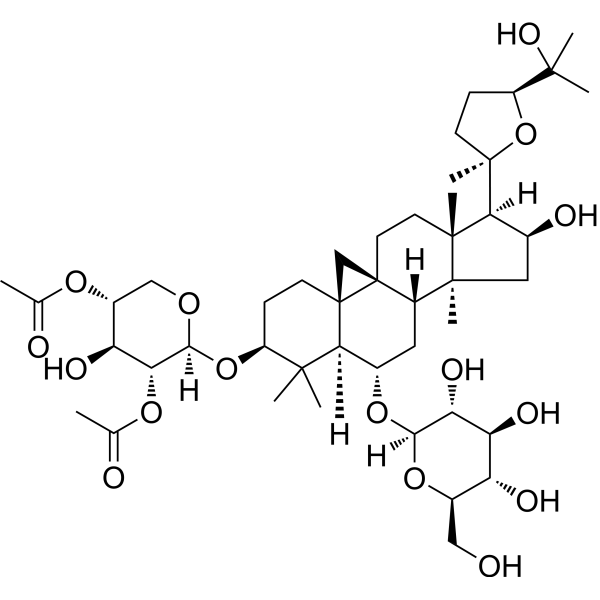
Isoastragaloside I
Based on 2 publication(s) in Google Scholar
Isoastragaloside I is a natural compound found in Astragalus membranaceus, with oral activity and multiple biological activities such as anti-inflammatory and antioxidant properties. Isoastragaloside I inhibits Akt, NF-κB, MAPKs and PI3K, enhances the activity of hepatic FXR, regulates the TGF-β/Smads signaling pathway, and upregulates antioxidant molecules downstream of Nrf2. Isoastragaloside I inhibits the expression of NO, TNF-α, iNOS, COX-2, IL-1β and VCAM-1, and reduces intracellular ROS levels. Isoastragaloside I attenuates blood-brain barrier disruption, restores intestinal barrier function, increases β-cell mass, improves glucose homeostasis, and elevates circulating adiponectin levels. Isoastragaloside I can be used for the study of neuroinflammation-related neurodegenerative diseases, cholestatic liver disease, and diabetes.
For research use only. We do not sell to patients.
- Purity : 99.49%
- CAS No.: 84676-88-0
- Formula: C45H72O16
- Molecular Weight:869.04
-
Storage:
4°C, sealed storage, away from moisture
* In solvent : -80°C, 6 months; -20°C, 1 month (sealed storage, away from moisture)

To place orders, for customer services and technical support, please contact: MedChemExpress USA
Tel: 609-228-6898 E-mail: [email protected] [email protected]


-
 Biological Activity
-
Chemical Information
-
Solvent & Solubility
- Protocols
- Purity & Documentation
- References
-
 Help & FAQs


Publications Citing Use of MedChemExpress (MCE) Isoastragaloside I
More

Biological Activity
Description
IC50 & Target
[1]|
Akt |
NF-κB |
p38 MAP kinase |
PI3K |
iNOS |
COX-2 |
IL-1β |
In Vitro
Isoastragaloside I (ISO I) (25-100 μM; 24 h) has no cytotoxic effect on BV-2 microglial cells[1].
Isoastragaloside I (25-100 μM; 2 h pre-treatment, followed by 20 h LPS stimulation) dose-dependently inhibits LPS-induced nitric oxide and TNF-α secretion from BV-2 microglial cells[1].
Isoastragaloside I (100 μM; 2 h pre-treatment, followed by 20 h LPS stimulation) inhibits LPS-induced expression of iNOS and COX-2 proteins in BV-2 microglia and phosphorylation of NF-κB, IκBα, p38, JNK and ERK1/2[1].
Isoastragaloside I (100 μM; 2 h pre-treatment, followed by 20 h LPS stimulation) downregulates LPS-induced TNF-α, IL-1β, and iNOS mRNA expression in BV-2 microglial cells[1].
Isoastragaloside I (100 μM; 2 h pre-treatment, followed by 20 h LPS stimulation) inhibits LPS-induced transactivation of NF-κB in BV-2 microglia. It blocked LPS-induced nuclear translocation of phosphorylated NF-κB in BV-2 microglia[1].
Isoastragaloside I (100 μM; 2 h pre-treatment, followed by 5-30 min LPS stimulation) suppresses LPS-induced phosphorylation of PI3K and Akt in BV-2 microglial cells[1].
Isoastragaloside I (ISOI) (25-100 μM; 2 h pre-incubation, 1-24 h co-treatment with LPS) pre-treatment prevents LPS-induced TEER reduction in bEnd.3 cells[3].
Isoastragaloside I (25-100 μM; 2 h pre-incubation, 24 h co-treatment with LPS) pre-treatment mitigates LPS-induced Na+F− exudation in bEnd.3 cells, reduced ROS accumulation, and restored the expression of tight junction proteins (ZO-1, occludin, claudin-5)[3].
Isoastragaloside I (25-100 μM; 2 h pre-incubation, 24 h co-treatment with LPS) pre-treatment reduces LPS-induced JAWS II monocyte adhesion to bEnd.3 cells[3].
Isoastragaloside I pre-treatment reduces LPS-induced mRNA expression of IL-1β, TNF-α, VCAM-1, and ICAM-1 in bEnd.3 cells[3].
Isoastragaloside I (100 μM; 2 h pre-incubation, 24 h co-treatment with LPS) pre-treatment suppresses LPS-induced VCAM-1 protein expression in bEnd.3 cells and restored LPS-depleted Nrf2, HO-1, and NQO1 protein expression in bEnd.3 cells[3].
Isoastragaloside I (25-100 μM; 24 h) activates Nrf2 transactivation in HEK293T cells[3].
Isoastragaloside I (100 μM; 2 h pre-incubation, 24 h co-treatment with LPS) pre-treatment enhances LPS-reduced Nrf2 nuclear translocation in bEnd.3 cells[3].
Isoastragaloside I (100 μM; 2 h pre-incubation, 12 or 24 h co-treatment with LPS after Nrf2 siRNA transfection) pre-treatment's ability to restore the expression of tight junction proteins and VCAM-1 in LPS-stimulated bEnd.3 cells, which depends on the Nrf2 signaling pathway, as silencing Nrf2 eliminates this effect[3].
Isoastragaloside I (10 μM) inhibits pancreatic ductal organoid growth in vitro, while low doses do not alter organoid cell proliferation[4].
MedChemExpress (MCE) has not independently confirmed the accuracy of these methods. They are for reference only.
-
Cell Line:BV-2 microglial cells
-
Concentration:25, 50, 100 μM
-
Incubation Time:24 h
-
Result:Did not alter the viability of BV-2 cells.
-
Cell Line:LPS-stimulated BV-2 microglial cells
-
Concentration:100 μM
-
Incubation Time:2 h pre-treatment, followed by 20 h LPS stimulation
-
Result:Reduced LPS-triggered iNOS and COX-2 protein expression, and suppressed the phosphorylation of NF-κB and IκBα.
Mitigated LPS-induced activation of p38, JNK and ERK1/2.
-
Cell Line:LPS-stimulated BV-2 microglial cells
-
Concentration:100 μM
-
Incubation Time:2 h pre-treatment, followed by 20 h LPS stimulation
-
Result:Significantly reduced LPS-induced mRNA expression of TNF-α, IL-1β, and iNOS.
-
Cell Line:LPS-stimulated BV-2 microglial cells
-
Concentration:100 μM
-
Incubation Time:2 h pre-treatment, followed by 5, 15, or 30 min LPS stimulation
-
Result:Significantly attenuated LPS-induced phosphorylation of PI3K and Akt across all time points tested.
-
Cell Line:mouse brain endothelial bEnd.3 cells
-
Concentration:100 μM
-
Incubation Time:2 h pre-incubation; 24 h co-treatment with LPS
-
Result:Rescued LPS-induced reductions of ZO-1, occludin, and claudin-5 protein expression, with significant restoration of occludin and claudin-5 levels, and visible restoration of ZO-1 membrane localization.
Restrained LPS-induced elevation of VCAM-1 protein levels and restored LPS-mediated downregulation of Nrf2, HO-1 and NQO1 protein expression.
-
Cell Line:mouse brain endothelial bEnd.3 cells
-
Concentration:100 μM
-
Incubation Time:2 h pre-incubation; 24 h co-treatment with LPS
-
Result:Increased nuclear Nrf2 fluorescence intensity, indicating enhanced Nrf2 nuclear translocation.
-
Cell Line:mouse brain endothelial bEnd.3 cells
-
Concentration:100 μM
-
Incubation Time:2 h pre-incubation; 12 or 24 h co-treatment with LPS, after Nrf2 siRNA transfection
-
Result:No longer exerted a significant effect on ZO-1, occludin, or claudin-5 levels when Nrf2 was silenced.\nDid not reverse LPS-induced VCAM-1 expression elevation when Nrf2 was silenced.
In Vivo
Isoastragaloside I (IAS-I) (0.5-5 mg/kg; intravenous injection; days 0-21) significantly increases the mass of small islets by approximately 60% in healthy mice; it also alleviates symptoms and increases small islet mass in both type 1 and type 2 diabetic mice[4].
MedChemExpress (MCE) has not independently confirmed the accuracy of these methods. They are for reference only.
-
Animal Model:C57BL/6J (male, 8 weeks old, 18-20 g, DDC diet-induced cholestatic liver disease)[2]
-
Dosage:20 mg/kg; 50 mg/kg
-
Administration:p.o.; daily; 4 weeks
-
Result:Increased body weight dose-dependently compared to the DDC model group.
Reduced liver weight and liver/body weight ratio significantly.
Reduced intraluminal porphyrin embolism, inflammatory cell aggregation, and portal duct reaction via H&E staining.
Reduced collagen deposition significantly via Sirius Red staining.
Dose-dependently reduced levels of alanine aminotransferase, aspartate aminotransferase, total bilirubin, direct bilirubin, alkaline phosphatase, and total bile acid compared to the DDC model group.
Reduced liver hydroxyproline content and Sirius Red-positive area significantly.
Reduced positive areas and mRNA/protein expression of cholangiocyte biomarkers cytokeratin 19 and cytokeratin 7 significantly.
Reduced positive area and mRNA/protein expression of α-smooth muscle actin significantly.
Reduced mRNA expression of collagen type I alpha 1 chain, collagen type IV, and transforming growth factor-β1 significantly.
Reduced protein expression of TGF-β1 and phosphorylated Smad2/3 (p-Smad2/3)/Smad2/3 significantly.
Reduced positive area and mRNA expression of F4/80 significantly.
Reduced mRNA expression of tumor necrosis factor-α and interleukin-1β significantly.
Reduced protein expression of interleukin-6 and CD68 significantly.
Reduced levels of arachidonic acid metabolites 5-hydroxyeicosatetraenoic acid, 15-HETE, 11(S)-HETE, prostaglandin E2, prostaglandin D2, 14(15)-DiHET, and 11(12)-DiHET significantly.
Increased levels of ω-3 fatty acids eicosapentaenoic acid and docosahexaenoic acid significantly.
Increased fecal bile acid concentrations, including tau-BAs, gly-BAs, uncon-BAs, and total BAs significantly.
Normalized serum and liver bile acid profiles, with significant reductions in total BAs, uncon-BAs, con-BAs, and tau-BAs compared to the DDC model group.
Increased liver levels of taurocholic acid, taurohyocholic acid, taurodeoxycholic acid, and taurochenodeoxycholic acid significantly.
Increased mRNA expression of hepatic farnesoid X receptor, small heterodimer partner, cholesterol 7α-hydroxylase, sodium taurocholate cotransport peptide, and bile-salt export pump significantly.
Increased protein expression of FXR and Cyp7a1 significantly.
Improved colonic mucosal structural integrity, reduced inflammatory cell infiltration, and restored goblet cell count.
Increased positive area and mRNA expression of zonula occludens protein 1 significantly.
Increased mRNA expression of Occludin and Muc2 significantly.
Increased protein expression of Occludin significantly.
-
Animal Model:ICR and C57BL/6 (8-week-old, healthy)[4]
-
Dosage:0.5 mg/kg; 5 mg/kg
-
Administration:i.v.; days 0, 3, 7, 10, 14, 17, 21
-
Result:Induced a statistically significant ~60% increase in small islet mass compared to controls at 0.5 mg/kg.
Showed a non-significant trend towards increased total β-cell proportion and total β-cell mass at both doses.
-
Animal Model:C57BL/6 (6-week-old, type 2 diabetes induced by 3 months high-fat diet + 3 consecutive daily i.p. 50 mg/kg streptozotocin, blood glucose >16.7 mM on two consecutive days)[4]
-
Dosage:0.5 mg/kg; 5 mg/kg
-
Administration:i.v.; days 0, 3, 7, 10, 14, 17, 21
-
Result:Alleviated hyperglycaemia at both doses without affecting body weight.
Improved insulin resistance only at 0.5 mg/kg (~40% AUC reduction), but not at 5 mg/kg, and did not improve glucose responsiveness at either dose.
Increased small islet mass at both doses, with a non-significant trend towards increased total β-cell mass.
-
Animal Model:ICR (8-week-old, type 1 diabetes induced by single i.p. 150 mg/kg Streptozotocin (HY-13753), blood glucose >16.7 mM on two consecutive days)[4]
-
Dosage:0.5 mg/kg
-
Administration:i.v.; days 0, 3, 7, 10, 14, 17, 21
-
Result:Reduced fasting blood glucose without affecting body weight or glucose responsiveness.
Increased β-cell proportion and total β-cell mass in the pancreas, as well as β-cell proportion in both small and large islets.
Found that proliferating β-cells accounted for only 0.009% of total pancreatic cells, indicating the increase in β-cell mass was not primarily mediated by β-cell proliferation.
-
Animal Model:SOX9-CreERT2; R26-LSL-tdTomato (type 1 diabetes induced by single i.p. 150 mg/kg streptozotocin, blood glucose >16.7 mM on two consecutive days; ductal cells labelled via 5 consecutive daily i.p. 75 mg/kg tamoxifen (HY-13757A) prior to diabetes induction)[4]
-
Dosage:0.5 mg/kg
-
Administration:i.v.; days 0, 3, 7, 10, 14, 17, 21
-
Result:Alleviated hyperglycaemia compared to controls.
Showed co-localization of tdTomato+ duct-derived cells with Insulin+ β-cells in islets and small islets, and significantly increased the proportion of duct-derived Insulin+ cells to 3.1% of total tdTomato+ cells compared to controls.
Resulted in proliferating β-cells almost exclusively arising from SOX9-derived cells.


Chemical Information
-
CAS No. 84676-88-0
-
Appearance Solid
-
Molecular Weight 869.04
-
Formula C45H72O16
-
Color White to yellow
-
SMILES
C[C@]([C@@]1(CC2)C)(C[C@H](O)[C@]1([H])[C@@]3(O[C@H](C(C)(O)C)CC3)C)[C@@](C[C@H](O[C@]([C@@H]([C@@H](O)[C@@H]4O)O)([H])O[C@@H]4CO)[C@@]5([H])C6(C)C)([H])[C@@]72[C@]5(CC[C@@H]6O[C@@](OC[C@@H](OC(C)=O)[C@@H]8O)([H])[C@@H]8OC(C)=O)C7
-
Synonyms
Isoastragaloside-I
-
Structure Classification
-
Shipping
Room temperature in continental US; may vary elsewhere.
-
Storage
4°C, sealed storage, away from moisture
* In solvent : -80°C, 6 months; -20°C, 1 month (sealed storage, away from moisture)


Publications (2)
-
Journal Impact Factor
-
Most Recent
-
Phytomedicine
A saponin from astragalus promotes pancreatic ductal organoids differentiation into insulin-producing cells. [Abstract]2022 May 18;102:154190. PMID: 35636173 -
Tohoku J Exp Med
Isoastragaloside I Inhibits Production of Inflammatory Mediators and Matrix Metalloproteinases via the NF-κB and MAPK Pathways in IL-1β-Treated Chondrocyte. [Abstract]2024 Oct 31. PMID: 39477446


Solvent & Solubility
In Vitro:
DMSO : 50 mg/mL (57.53 mM; Need ultrasonic; Hygroscopic DMSO has a significant impact on the solubility of product, please use newly opened DMSO)
Please refer to the solubility information to select the appropriate solvent. Once prepared, please aliquot and store the solution to prevent product inactivation from repeated freeze-thaw cycles.
Storage method and period of stock solution: -80°C, 6 months; -20°C, 1 month (sealed storage, away from moisture). When stored at -80°C, please use it within 6 months. When stored at -20°C, please use it within 1 month.
Please refer to the solubility information to select the appropriate solvent. Once prepared, please aliquot and store the solution to prevent product inactivation from repeated freeze-thaw cycles.
Storage method and period of stock solution: -80°C, 6 months; -20°C, 1 month (sealed storage, away from moisture). When stored at -80°C, please use it within 6 months. When stored at -20°C, please use it within 1 month.
Concentration (start) × Volume (start) = Concentration (final) × Volume (final)
In Vivo:
Select the appropriate dissolution method based on your experimental animal and administration route.
- For the following dissolution methods, please ensure to first prepare a clear stock solution using an In Vitro approach and then sequentially add co-solvents:
- To ensure reliable experimental results, the clarified stock solution can be appropriately stored based on storage conditions. As for the working solution for In Vivo experiments, it is recommended to prepare freshly and use it on the same day.
- The percentages shown for the solvents indicate their volumetric ratio in the final prepared solution. If precipitation or phase separation occurs during preparation, heat and/or sonication can be used to aid dissolution.
Add each solvent one by one: 10% DMSO 40% PEG300 5% Tween-80 45% Saline
Solubility: ≥ 2.5 mg/mL (2.88 mM); Clear solution
This protocol yields a clear solution of ≥ 2.5 mg/mL (saturation unknown).
Taking 1 mL working solution as an example, add 100 μL DMSO stock solution (25.0 mg/mL) to 400 μL PEG300, and mix evenly; then add 50 μL Tween-80 and mix evenly; then add 450 μL Saline to adjust the volume to 1 mL.
Preparation of Saline: Dissolve 0.9 g sodium chloride in ddH₂O and dilute to 100 mL to obtain a clear Saline solution.
In Vivo Dissolution Calculator
Please enter the basic information of animal experiments:
-
-
-
-
Recommended: Prepare an additional quantity of animals to account for potential losses during experiments.
Please enter your animal formula composition:
-
%DMSO +
Recommended: Keep the proportion of DMSO in working solution below 2% if your animal is weak.
-
%+
-
+%Tween-80 + +
-
%Saline +
The co-solvents required include: DMSO, . All of co-solvents are available by MedChemExpress (MCE). , Tween 80. All of co-solvents are available by MedChemExpress (MCE).
Working solution concentration: 0.22 mg/mL
Method for preparing stock solution: mg drug dissolved in μL DMSO. Stock solution concentration: mg/mL. * In solvent : -80°C, 6 months; -20°C, 1 month (sealed storage, away from moisture)
1. Take μL DMSO stock solution;
2. Add μL .
μL , mix evenly;
3. Then add μL Tween 80, mix evenly;
4. Then add μL
Please ensure that the stock solution in the first step is dissolved to a clear state, and add co-solvents in sequence. You can use ultrasonic heating (ultrasonic cleaner, recommended frequency 20-40 kHz), vortexing, etc. to assist dissolution.


Purity & Documentation
-
Data Sheet (303 KB)
-
SDS (393 KB)
- English - EN (393 KB)
- Français - FR (393 KB)
- Deutsch - DE (393 KB)
- Norwegian - NO (393 KB)
- Español - ES (393 KB)
- Swedish - SV (393 KB)
- Italian - IT (393 KB)
- Korean - KR (393 KB)
- Portuguese - PT (393 KB)
-
Handling Instructions (2659 KB)
References
[1]. Liu H, et al. Isoastragaloside I inhibits NF-κB activation and inflammatory responses in BV-2 microglial cells stimulated with lipopolysaccharide. Int J Mol Med. 2017;40(4):1270-1276. [Content Brief]
[2]. Zhang L, et al. Isoastragaloside I attenuates cholestatic liver diseases by ameliorating liver injury, regulating bile acid metabolism and restoring intestinal barrier. J Ethnopharmacol. 2024;335:118649. [Content Brief]
[4]. Pan A, et al. Isoastragaloside I improves hyperglycaemia and increases β-cell mass in mice. Diabet Med. 2026;43(1):e70162. [Content Brief]
[5]. Luo L, et al. Isoastragaloside II modulates PPAR-α/FXR signaling and bile acid metabolism to ameliorate cholestatic liver diseases (CLD). Eur J Pharmacol. Published online May 20, 2026. [Content Brief]


Complete Stock Solution Preparation Table
Please refer to the solubility information to select the appropriate solvent. Once prepared, please aliquot and store the solution to prevent product inactivation from repeated freeze-thaw cycles.
Storage method and period of stock solution: -80°C, 6 months; -20°C, 1 month (sealed storage, away from moisture). When stored at -80°C, please use it within 6 months. When stored at -20°C, please use it within 1 month.
| Optional Solvent | Concentration Solvent Mass | 1 mg | 5 mg | 10 mg | 25 mg |
|---|---|---|---|---|---|
| DMSO | 1 mM | 1.1507 mL | 5.7535 mL | 11.5070 mL | 28.7674 mL |
| 5 mM | 0.2301 mL | 1.1507 mL | 2.3014 mL | 5.7535 mL | |
| 10 mM | 0.1151 mL | 0.5753 mL | 1.1507 mL | 2.8767 mL | |
| 15 mM | 0.0767 mL | 0.3836 mL | 0.7671 mL | 1.9178 mL | |
| 20 mM | 0.0575 mL | 0.2877 mL | 0.5753 mL | 1.4384 mL | |
| 25 mM | 0.0460 mL | 0.2301 mL | 0.4603 mL | 1.1507 mL | |
| 30 mM | 0.0384 mL | 0.1918 mL | 0.3836 mL | 0.9589 mL | |
| 40 mM | 0.0288 mL | 0.1438 mL | 0.2877 mL | 0.7192 mL | |
| 50 mM | 0.0230 mL | 0.1151 mL | 0.2301 mL | 0.5753 mL |


Isoastragaloside I Related Classifications
HY-N0887 Related Classifications
 Powered by Bioz